
If you’ve ever tried choosing a book size, you know it’s a nightmare. One website tells you one thing, another contradicts it completely, and suddenly you’re drowning in terms like “trim size” and “B format” without a clue what any of it actually means. For aspiring authors and self-publishers, this isn’t just confusing, it’s expensive. Pick the wrong dimensions and you’ll pay for it, literally, in higher printing costs, awkward design constraints, and a book that just doesn’t feel right when someone picks it up.
That’s what this guide is for. Whether you’re writing your manuscript yourself or working with a ghost writing service, understanding book dimensions is fundamental to producing a professional final product.
We’re going to walk through everything you need to know about UK paperback book sizes, the actual standards, what the jargon means, and how to make a decision that works for your book. No fluff, no vague advice. Just practical information that’ll help you choose dimensions that look professional, feel good in your readers’ hands, and don’t blow your budget.
What is Book Size? Understanding Trim Size and Its Importance
Defining “Book Size”: The Trim Size Explained
When publishers and printers talk about book size, they mean “trim size”, the final dimensions of your book after everything’s been printed, bound, and cut. Simple enough, right? But it matters more than you’d think.
Trim size is just the width and height of the actual pages. It doesn’t include the cover if it hangs over the edges, and it doesn’t factor in spine thickness (that depends on how many pages you’ve got and what paper you’re using). Basically, it’s the size of your book when you lay it flat on a table.
Why does this matter? Because trim size is the first physical decision you make, and it ripples through everything else. It shapes your design, affects how the book feels when someone picks it up, and influences your printing costs. Get it wrong at this stage and you’re stuck fixing problems all the way down the line.
Why Trim Size Matters: A Foundational Decision
Trim size isn’t just a technical specification you tick off a checklist. It’s a foundational decision that ripples through every aspect of your publishing project.
Aesthetic Impact comes first. The dimensions of your book determine how it looks and feels. A slim, tall book conveys elegance and sophistication. A compact, pocket-sized edition suggests portability and convenience. The physical presence of your book speaks before a single word is read.
Design Constraints follow closely behind. Your chosen trim size dictates your layout options, font size, margins, and where you can place images. A designer working with a small A format book faces very different challenges than one working with a spacious Royal format. The canvas size shapes the art.
Expert Tip: Prioritize Readability. Consider font size, line spacing, and page count when choosing a trim size. A larger page might allow for more text, but also requires larger fonts or more white space for comfort.
Readability and Reader Experience cannot be overlooked. Larger pages might accommodate more text per page, but they also demand larger fonts and generous white space to prevent eye strain. The relationship between page size, text density, and reading comfort is delicate. Strike the wrong balance, and readers will struggle through your work, no matter how brilliant the content.
Production and Printing Costs are directly tied to trim size. Paper usage, binding methods, and overall print costs all hinge on the dimensions you choose. Standard sizes are designed to optimize paper usage, minimizing waste and keeping costs down. Venture into custom territory, and you’ll see those costs climb quickly.
Shipping and Distribution Logistics might seem mundane, but they’re crucial. Your trim size influences packaging requirements, freight costs, and how much shelf space your book occupies in warehouses and bookstores. If you’re navigating the publishing process for the first time, these logistical considerations can make or break your budget. Smaller, lighter books are cheaper to ship and easier to store. It’s basic physics with real financial implications.
Market Perception and Genre Conventions round out the picture. Readers have built in expectations about certain genres. Your book’s physical format is actually a crucial element of your marketing strategy, it signals quality, genre positioning, and target audience before a single word is read.
They expect thrillers to be portable, academic texts to be substantial, and poetry collections to feel intimate. Defy these conventions without good reason, and you risk alienating your audience before they’ve read a word.
Many authors struggle to understand both the aesthetic and practical implications of different book sizes. This confusion is understandable, there’s a lot to weigh. But by the end of this guide, those clouds will clear.
Ready to move forward?
Ready to Choose the Perfect Trim Size for Your Book?
Selecting the ideal trim size is crucial to your book’s design, readability, and production costs. At UK Publishing House, we guide authors through this foundational decision, ensuring your book stands out and meets industry standards.
Why Book Sizes Matter: Impact on Your Publishing Project
Readability and Reader Comfort
Ergonomics of Reading
Consider how a book fits in the hand. This isn’t an abstract concern, it’s about the physical reality of holding a book for minutes, hours, or days. A thick paperback in a small format becomes heavy and awkward. A large format book with wide pages can tire the arms during extended reading sessions.
The ergonomics of book sizes affect the physical reading experience in tangible ways. Comfort matters. Portability matters. Even the perceived value readers unconsciously assign to a book is influenced by how it feels in their hands. A well proportioned book invites readers in. An awkward one pushes them away.
Text Flow and Eye Strain
The interplay between font size, line length, and white space determines how comfortable a reading experience will be. Cramped text on a small page strains the eyes. Excessively long lines on a large page force readers to work harder to track from one line to the next. The sweet spot varies by format, but the principle remains constant: readability trumps everything.
Expert Tip: Prioritize Readability. Consider font size, line spacing, and page count when choosing a trim size.
Portability
Where will readers engage with your book? On their daily commute? During travel? Curled up at home? These contexts matter. A mass market thriller needs to slip easily into a bag or coat pocket. A literary novel might afford more generous dimensions since readers are more likely to read it at home or in leisurely settings.
Expert Tip: Think About Portability. For books intended for travel or daily commute (e.g., thrillers, mass market fiction), smaller, lighter formats like B format or Pocket are often preferred by readers.
Aesthetic Appeal and Shelf Presence
Visual Impact
Walk into any bookshop and scan the shelves. Certain books catch your eye immediately. Others fade into the background. Size plays a significant role in this visual hierarchy. A book’s dimensions influence its shelf presence, how it looks next to competitors, and whether it commands attention or blends in.
Expert Tip: Factor in Shelf Presence. A book’s size and spine width contribute to its visual impact on a bookshelf. Consider how it will look alongside other books in its category.
Spine Design
The spine is prime real estate. It’s often the only part of your book visible when shelved, and its width is determined by your page count and paper thickness. A thin book has limited spine space, forcing designers to make tough choices about what information to include. A thicker book offers more room for branding, title, author name, and design elements.
Expert Tip: Don’t Forget Spine Width. This is determined by page count and paper thickness. Ensure your design accounts for the spine to accommodate the title and author name.
Perceived Value
Readers make snap judgments. A substantial book feels more valuable than a slim one, even if the word count is identical. Weight, size, and the tactile quality of a book all contribute to perceived value. This doesn’t mean bigger is always better, but it does mean you need to be conscious of the signals your book’s physical form sends.
Production Costs and Logistics
Paper Usage
Here’s where the rubber meets the road financially. Printers work with large sheets of paper that are folded and cut to create your book pages. Standard sizes are designed to maximize the use of these sheets, minimizing waste. Choose a standard size, and you’re working with the grain of the industry. Choose a custom size, and you’re creating waste, waste you’ll pay for.
Differentiation Opportunity: Environmental Considerations. The environmental impact of various paper sizes is worth discussing. Choosing a standard size can reduce waste, making your project more sustainable. In an era of growing environmental consciousness, this matters to many readers and publishers.
Printing Machine Compatibility
Commercial printing presses are optimized for standard sizes. They can handle these dimensions efficiently, keeping production times down and costs reasonable. Non standard sizes require adjustments, additional setup time, and sometimes specialized equipment. All of this translates to higher costs.
Binding Methods
Certain book sizes pair naturally with specific binding methods. Perfect binding, the most common method for paperbacks, works beautifully with standard sizes. Case binding, used for hardbacks, has its own considerations. Your trim size choice influences which binding options are practical and cost effective.
Shipping and Storage
Logistics might not be glamorous, but they’re crucial. Smaller, lighter books cost less to ship, both to retailers and to individual customers. They take up less space in warehouses. They’re easier to pack. These savings add up quickly, especially for self publishers managing their own inventory.
Many authors worry about how book size impacts printing costs and distribution logistics. These concerns are valid. The good news is that by understanding the relationships between size, cost, and distribution, you can make strategic choices that serve both your creative vision and your budget.
Differentiation Opportunity: Cost Impact Analysis. Understanding how different book sizes influence printing costs, through paper usage and binding complexity, gives you negotiating power and helps you make informed decisions. Many print on demand services offer calculators that let you estimate costs based on size, page count, and paper stock. Use them.
Demystifying Book Size Terminology: A UK Glossary
One of the biggest obstacles facing new publishers is the sheer volume of industry jargon. Terms like Demy, Royal, A format, B format, trim size, and bleed get thrown around as if everyone should know what they mean. Let’s fix that.
Consideration: Provide Clear, Verifiable Measurements. All dimensions in this guide are precisely stated in both metric and imperial units with consistent formatting. This precision builds trust and ensures you can take these measurements straight to your printer or designer.
Essential Terms for Book Design
Trim Size is, as we’ve established, the final dimension of your book after printing and trimming. This is the measurement you’ll use when discussing your project with printers, designers, and distributors.
Bleed refers to the portion of an image or background color that extends beyond the trim edge. Why does this matter? Because cutting isn’t perfectly precise. Bleed ensures that after trimming, you won’t have any unwanted white edges around your images or colored backgrounds. Standard bleed is typically 3 5mm.
Margins are the blank spaces around the edges of your pages, inside the trim. These aren’t wasted space, they’re essential for readability and aesthetic balance. Text that runs too close to the edge looks cramped and unprofessional.
Gutter is the inner margin of your book, where the pages meet at the spine. This is critical. Text placed too close to the gutter becomes difficult or impossible to read as the book’s binding naturally creates resistance. Adequate gutter space is non negotiable for readability.
Spine is the backbone of your book, literally connecting the front and back covers. Its width depends on your page count and paper thickness. Thicker paper means a wider spine. More pages mean a wider spine. This width determines what you can fit on the spine design wise.
Common UK Book Formats
A format typically refers to smaller, mass market paperbacks, often measuring around 110 x 178 mm. There’s some overlap here with the ISO A series of paper sizes (A4, A5, etc.), which can cause confusion. In UK publishing, A format generally means those compact, highly portable books you see in airport bookshops and supermarkets.
B format is a popular mid-size paperback in the UK, typically around 129 x 198 mm. It strikes an excellent balance between portability and readability, making it versatile across many genres. This is one of the most common sizes you’ll encounter in UK bookshops.
Demy is a traditional UK publishing size, typically larger than B format at around 135 x 216 mm or 138 x 216 mm. The name comes from historical paper sizing conventions. Demy offers more generous page space and is often used for general fiction and non-fiction.
Royal is another traditional UK size, often used for academic or higher end paperbacks. At approximately 153 x 234 mm, it provides substantial page area, making it suitable for books with complex layouts, illustrations, or dense text.
Pocket Book is generally a very small format, often even smaller than A format, designed for maximum portability. These are the books that actually fit in a coat pocket, hence the name.
Ready to move forward?
Why Book Sizes Matter: Impact on Your Publishing Project
The trim size of your book is a pivotal decision in the publishing process. It affects everything from readability to production costs, and even how your book is perceived by readers. Whether you’re designing for portability, aesthetics, or production efficiency, UK Publishing House is here to guide you through the complexities of book sizing.
Standard UK Paperback Book Sizes: A Comprehensive Chart
Finding a comprehensive, UK specific guide that clarifies all common sizes in one place has been frustratingly difficult for many authors. That changes here.
Consideration: The information in this chart is drawn from industry standards maintained by the British Printing Industries Federation, major UK publishers’ submission guidelines, and established printing practices. These are genuine industry standards, though it’s worth noting that ‘standard’ can vary slightly between individual printers.
| Book Size Name | Dimensions (mm) | Dimensions (inches) | Common Use/Typical Genre | Notes/Key Characteristics |
| A
format |
110 x 178 | 4.33 x 7 | Mass market fiction, thrillers, romance, travel guides | Highly portable, cost effective for high print runs. |
| B
format |
129 x 198 | 5.06 x 7.78 | Literary fiction, general non fiction, poetry, academic texts | Popular UK standard, good balance of portability and page real estate. |
| Demy | 135 x 216 | 5.31 x 8.5 | General fiction, biographies, some non-fiction | Traditional UK size, slightly larger than B format, offers a more generous layout. |
| Royal | 153 x 234 | 6.02 x 9.21 | Academic business, larger format non-fiction, some literary fiction | Offers substantial page area, often preferred for books with more complex layouts or illustrations. |
| A5 | 148 x 210 | 5.83 x 8.27 | Journals, notebooks, some non-fiction, graphic novels | Standard ISO paper size, less common for trade fiction but useful for specific content. |
| US Trade | 152 x 229 | 6 x 9 | Common US standard for fiction and non-fiction | Widely accepted by global print on demand services; important for authors targeting the US market. |
| Pocket Book | (Varies, often smaller than A format, e.g., 105 x 170) | (Varies, e.g., 4.13 x 6.69) | Mass market fiction, novellas, short stories, highly portable | Designed for maximum portability, fits easily into pockets or small bags. |
Note: While these are industry standards, some variation exists between printers. Always verify the exact specifications with your chosen printer before finalizing your design. What one printer calls Demy might vary by a few millimeters from another’s standard. This is why communication with your printer is essential.
Visualizing Book Sizes: Giving Readers a Real World Sense of Scale
Numbers on a page only tell part of the story. To truly understand book sizes, you need to visualize them in real world contexts.
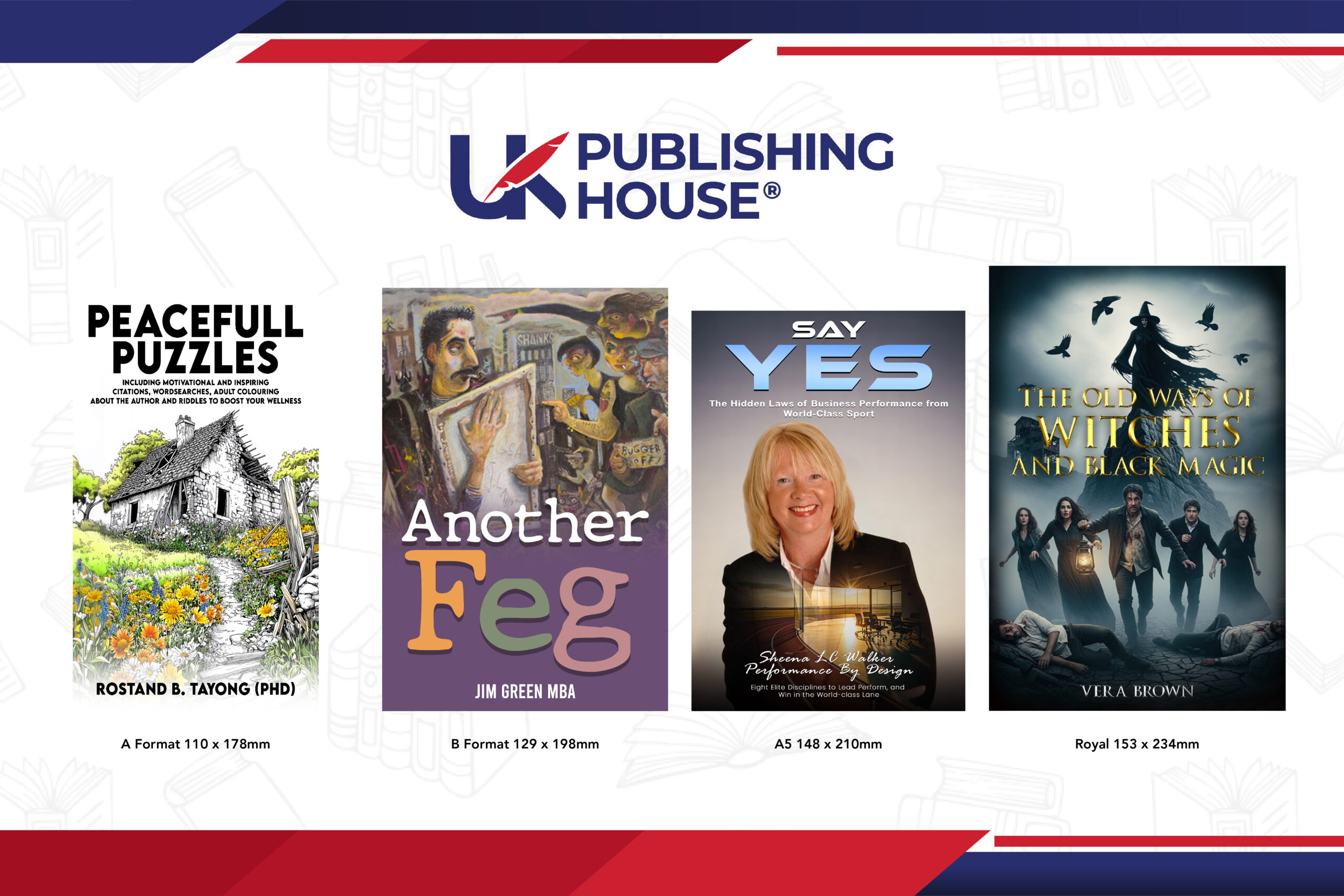
Understanding size in context helps you make better decisions. An A format book that seems small on paper might feel perfectly substantial when you’re holding it. A Royal format book that sounds impressively large might feel unwieldy during a commute.
Differentiation Opportunity: Genre Specific Recommendations with Examples. It’s one thing to list sizes and their typical uses. It’s another to show you actual, successful books in your genre and their dimensions. This concrete approach gives you benchmarks and inspiration.
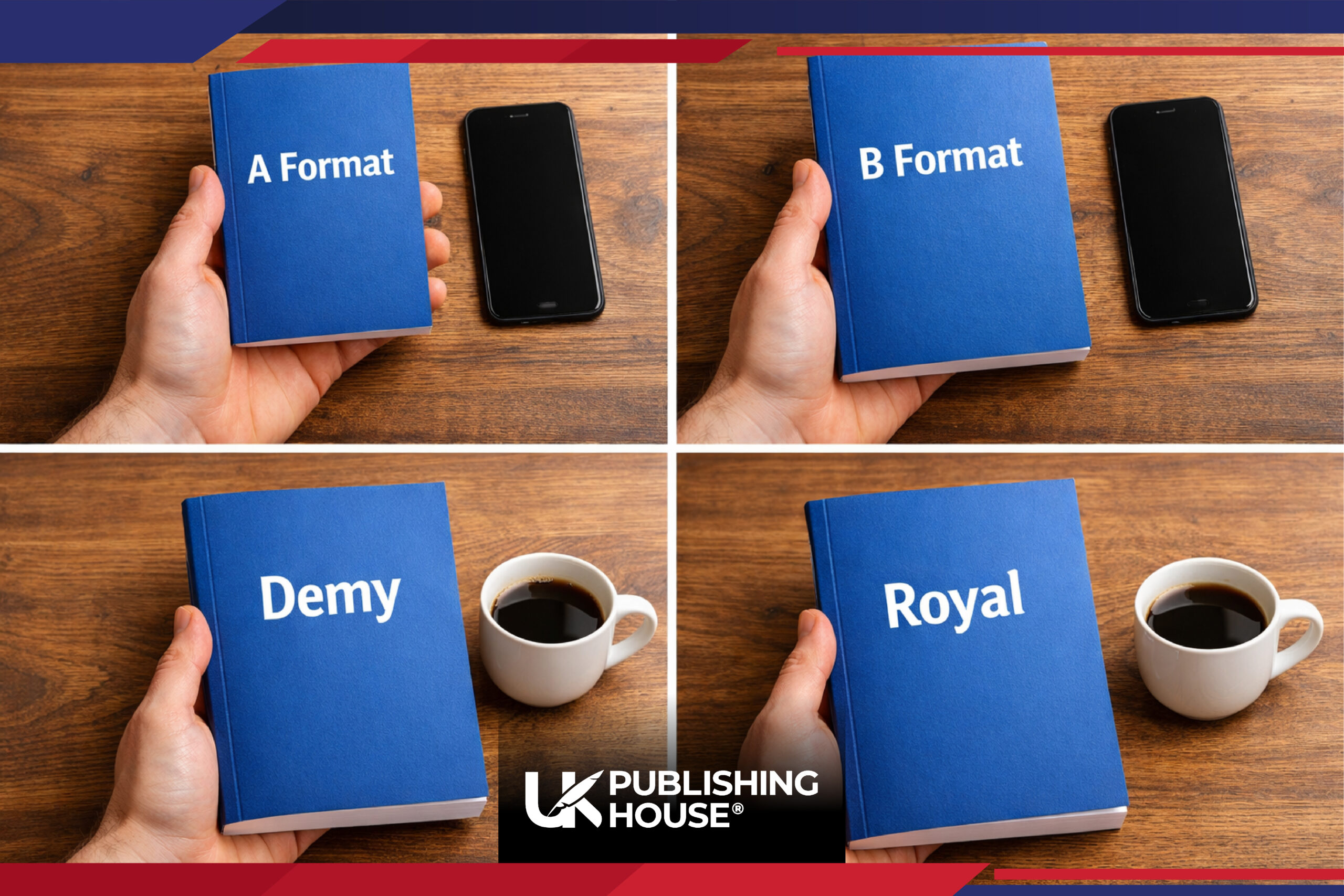
When you can see which sizes successful books in your genre use, decision making becomes significantly easier. You’re not guessing, you’re following proven patterns.
Hardback vs. Paperback Sizes: Key Differences for UK Publishing
Distinct Characteristics of Hardbacks
Hardbacks occupy a different space in the publishing ecosystem. They’re built for durability and longevity, designed to withstand years of handling, lending, and rereading. The physical construction reflects this purpose.
Perceived value is higher with hardbacks. They’re associated with premium editions, library collections, and books worth keeping. A hardback signals importance, both to retailers and readers.
Typical hardback sizes often overlap with larger paperback formats. Many hardbacks use page block dimensions similar to Royal or US Trade sizes. However, the case binding adds bulk, and hardbacks often have slightly larger covers that extend beyond the page edges. Special editions, art books, and coffee table books can be produced in much larger, more varied formats.
The production process for hardbacks is more involved. Case binding, endpapers, and dust jackets add complexity and cost. These aren’t just aesthetic choices, they’re structural elements that contribute to the book’s durability.
Common Overlaps and Specific Hardback Dimensions
Many hardback page blocks align with larger paperback sizes. Royal (153 x 234 mm) and US Trade (6 x 9 inches) are common for consistency within series. Publishers often release a hardback first, then a paperback with the same page block dimensions to maintain consistency.
Unique hardback formats include Crown Quarto (189 x 246 mm), often used for illustrated non fiction or coffee table books. Large Royal (160 x 240 mm) is another common large format for substantial non fiction works.
Cost implications are significant. Hardbacks are considerably more expensive to produce per unit than paperbacks. The materials, binding process, and shipping costs all run higher. This is why hardbacks typically retail at premium prices and why many books release in hardback first, then transition to more affordable paperback editions later.
Global vs. UK Standards: A Brief Comparison
The publishing world doesn’t stop at UK borders, and neither should your understanding of book sizes.
Differentiation Opportunity: Global vs. UK Standards. Many self-publishers operate globally, so understanding both UK and international standards is crucial. This knowledge helps you make strategic decisions about distribution and market reach.
The 6 x 9 inch format (152 x 229 mm), known as “US Trade,” is extremely prevalent in the American market for both fiction and non-fiction. It’s also widely supported by global print on demand services, making it an attractive option for authors targeting international audiences. If you’re considering Amazon KDP or IngramSpark, you’ll find US Trade is one of their most supported sizes.
European standards show more variation. While A series sizes (A5, A4) are ISO standards used across Europe, traditional publishing sizes vary by country. B format is broadly recognized across Europe and the UK, creating some common ground.
The impact on distribution matters if you’re thinking globally. Choosing a size that’s recognized in multiple markets can simplify international distribution, especially for self-publishers working with print on demand services. A book sized for the UK market might face challenges in the US, and vice versa, unless you choose dimensions that work across both.
Choosing the Right Size for Your Book: A Strategic Approach
This is where theory meets practice. You understand the terminology, you know the standard sizes, and you’ve seen how they’re used. Now, how do you choose the right size for your specific project?
Genre Conventions and Audience Expectations
Start here. Seriously. Research the standard sizes for your specific genre before making any other decisions. As you dive into this, consider how each of your books fits into a broader strategy. Building a meaningful collection can help ensure your books not only align with genre conventions but also establish your author brand.
Expert Tip: Start with Genre Conventions. Research the standard sizes for your specific genre. Readers often have expectations, and deviating too much can impact marketability.
For fiction, the landscape divides fairly clearly. Mass market genres, thrillers, romance, science fiction, typically use A format (110 x 178 mm) or Pocket sizes. These are the books designed for airport lounges, beach bags, and daily commutes. Portability is paramount.
Literary and general fiction gravitates toward B format (129 x 198 mm) or Demy (135 x 216 mm). These sizes offer a more substantial feel without sacrificing too much portability. They signal that this is a book to be savored, not just consumed.
Non fiction spans a wider range General non fiction works well in B format, Demy, or Royal (153 x 234 mm). If you’re writing a memoir or autobiography, these mid-range sizes strike the perfect balance between readability and the substantial feel readers expect from personal narratives.
These sizes provide good page count and readability for extended text. Academic and technical books often prefer larger sizes like Royal or US Trade. Why? They need room for diagrams, footnotes, references, and the information density that characterizes scholarly work.
Children’s books and illustrated works are highly variable. Square formats, landscape orientations, and custom sizes are common because the visual component is paramount. Standard rules apply less rigidly here.
Poetry often uses smaller, more intimate sizes. B format is popular, though some poetry publishers favour slightly squarer, more compact formats that emphasize the intimacy of the form.
Many authors feel uncertain about which book size is truly ‘standard’ or most appropriate for their specific genre. This uncertainty is understandable given the variations that exist. The key is to look at successful books similar to yours. Visit a bookshop or browse online retailers. See what sizes dominate your genre. Those conventions exist for good reasons.
Target Audience and Reader Experience
Think carefully about your target audience and how they’ll interact with your book. Authors working with ghostwriters should discuss format preferences early, ensuring the manuscript is developed with both content and physical presentation in mind.
Portability questions matter. Is your book meant for commuters? Travelers? Bedside reading? A thriller aimed at commuters needs to slip easily into a bag. A coffee table book about architecture has different requirements entirely.
Expert Tip: Think About Portability. For books intended for travel or daily commute, smaller, lighter formats are often preferred by readers.
Comfort during extended reading is another consideration. How will it feel to hold your book for an hour? Two hours? A thick, small format book becomes heavy. A large format book might tire the arms. These aren’t trivial concerns, they affect reader satisfaction.
Unique Angle: The Reader’s Hand: Ergonomics of Book Sizes. Consider the physical reading experience from your reader’s perspective. How will your book feel in their hands? What contexts will they read it in?
Accessibility deserves attention too. Readers with visual impairments benefit from larger formats that can accommodate larger fonts without becoming unwieldy. If your audience includes older readers or those with sight difficulties, this consideration becomes more important.
Page Count and Manuscript Length
Your manuscript length influences your size choice more than you might think. Before committing to a trim size, get your manuscript professionally edited to establish an accurate final word count and page estimate.
A longer manuscript in a small format means more pages, which increases printing costs, sometimes more than choosing a larger format with fewer pages would. There’s a balancing act here between compact dimensions and practical economics.
Readability versus bulk is another tension. You might want a compact book, but if that means creating a dense brick of tiny text, you’ve defeated your purpose. Readers won’t thank you for saving them a few millimetres if it means squinting through 400 pages of cramped text.
Budget and Printing Costs
Let’s talk money. Standard sizes are almost always more cost effective than custom dimensions. This isn’t a small difference, it can be significant, especially for larger print runs.
Expert Tip: Balance Aesthetics and Budget. While a unique size might serve your creative vision, standard sizes offer substantial cost savings. If the budget is tight, standard is the way to go.
Paper stock affects costs too. Different paper weights and finishes influence spine width and overall book thickness. Heavier paper creates a thicker, more substantial book, which might feel premium but costs more. Lighter paper reduces costs but might feel cheaper. These decisions interact with your size choice. For authors considering professional ghostwriting services, discussing format and production specifications upfront ensures everyone’s aligned on the final product before writing even begins.
Differentiation Opportunity: Cost Impact Analysis. Understanding cost implications gives you power. Many print on demand services offer calculators that let you experiment with different size and specification combinations to see how costs change.
Product Recommendation: Print on Demand Service Calculators (e.g., KDP Print Calculator, IngramSpark Pricing Tool) are invaluable for estimating costs based on size, page count, and paper specifications. Use them early in your planning process.
Distribution Channels and Shelf Presence
Where will your book be sold? This matters more than you might think.
Some bookstores have shelving standards or preferences. While they’ll accommodate various sizes, books that fit standard shelving dimensions often display better. Online sales present different considerations. Digital storefronts display dimensions, but the physical impact is lost until the book arrives. Optimizing your Amazon Author Central profile with precise specifications helps readers understand exactly what they’re purchasing and sets proper expectations. This is where professional looking specifications in your book listing become important.
Expert Tip: Factor in Shelf Presence. Consider how your book will look alongside others in its category. Spine width, height, and overall visual impact contribute to shelf appeal.
Series consistency is crucial if you’re planning multiple books. Nothing looks less professional than a series with inconsistent sizing across volumes.
Expert Tip: Future Proofing for Series. If you plan a book series, decide on a consistent size early. Visual harmony across volumes is essential for professional presentation and reader satisfaction.
Desired Aesthetic and Book “Feel”
Some decisions come down to aesthetics and how you want your book to feel.
Expert Tip: Consider the ‘Feel’ of the Book. Physically holding a book of a certain size can inform your decision. Print a dummy or visit a bookstore to get a tactile sense of different dimensions.
This is genuinely useful advice. Professional publishing service can provide physical samples and mockups during the planning stage, letting you make informed decisions based on actual tactile experience rather than guesswork.
Seeing measurements on a screen or paper doesn’t compare to holding a physical object. Visit a bookshop. Pick up books in different sizes. Feel their weight. Notice how they sit in your hand. This tactile research is time well spent.
Product Recommendation: Physical Prototypes or Blanks. Some printers offer blank dummy books in various dimensions. Order one in your proposed size. Live with it for a few days. See how it feels. This small investment can prevent expensive mistakes.
Consulting Your Printer
Don’t make your final decision in isolation.
Expert Tip: Consult Your Printer Early. Before finalizing your design, discuss your chosen dimensions with your printer. They can advise on cost efficiency, paper availability, and specific bleed and margin requirements.
Printers possess practical knowledge that can save you headaches. Whether you’re self-publishing or exploring traditional routes, understanding how to publish your book means knowing which questions to ask at every stage, starting with format decisions.
They know which sizes run most efficiently on their equipment. They understand paper availability. They can flag potential issues before they become expensive problems. This consultation is free advice, use it.
Ready to move forward?
Choosing the Perfect Book Size for Your Publishing Project
The right book size influences everything from readability and comfort to production costs and shelf presence. Whether you’re working on a thriller for commuters, a memoir for personal reflection, or a coffee table book to showcase stunning visuals, the size of your book plays a pivotal role in shaping its success.
Practical Application: Measuring & Preparing Your Book Files
Theory becomes practical when you start preparing files.
How to Accurately Measure an Existing Book
Sometimes you’ll want to match the size of an existing book or simply verify dimensions.
Tools needed are simple: a ruler or measuring tape that shows both millimeters and inches.
The method is straightforward. Place the book flat on a surface. Measure the width from the edge of the front cover to the spine. Measure the height from the top edge to the bottom edge of the cover. Record measurements in both millimeters and inches.
Tips for precision: Measure from the printed page edge, not the cover if it overhangs. Take multiple measurements to ensure accuracy. Even a millimeter or two of difference can matter when setting up design files.
Determining the Correct Trim Size for a New Project
Here’s your step by step process.
First, research genre standards. Look at books similar to yours. Note their dimensions. This isn’t copying, it’s understanding market conventions.
Second, consider your page count and content. Estimate your final page count. How much text do you have? How many images? This affects which sizes will work practically.
Third, consult your printer or print on demand service. Check their available standard sizes and templates. Different services support different sizes. This narrows your options to what’s actually feasible.
Fourth, create a mock up. Print out a few pages at different proposed sizes. Hold them. Stack them. Get a physical sense of what you’re creating.
Product Recommendation: Canva offers simple tools for creating book cover mockups and visualizing dimensions. While it’s not professional publishing software, it’s accessible for authors just starting out.
Utilizing Templates for Design
Templates are your friend.
Expert Tip: Utilize Templates. Many print on demand services and professional software like InDesign offer templates for standard book sizes. These save significant design time and prevent errors.
Starting from a template ensures your bleed, margins, and trim settings are correct from the beginning. If the technical side feels overwhelming, partnering with professional book designers ensures your specifications are perfect while bringing your creative vision to life.
This prevents the frustration of discovering, after hours of layout work, that your specifications are wrong.
Product Recommendation: Adobe InDesign remains the industry standard for professional book layout and design. While it has a learning curve, it’s worth mastering if you’re serious about publishing.
Preparing Design Files
Get these technical details right.
Trim size settings in your design software must match your chosen trim size exactly. Even small discrepancies cause problems during printing.
Bleed and margins are non negotiable. Always include adequate bleed, usually 3-5mm. Set appropriate margins for text safety and comfort. Text that runs too close to page edges looks unprofessional and becomes uncomfortable to read.
Gutter allowance is especially important. Account for the gutter to prevent text from disappearing into the spine. Nothing frustrates readers more than having to crack a spine to read text.
Many authors don’t know how to correctly prepare design files based on specific trim sizes. This is understandable, it’s technical. But learning these basics, or working with a designer who knows them, is essential. Incorrect file preparation leads to rejected proofs, reprints, and wasted money. Having a skilled proofreader review your formatted manuscript before it goes to print can catch critical layout and formatting errors that might otherwise cost you dearly.
Beyond the Standard: When to Break the Mold (and the Challenges)
Sometimes standard sizes don’t serve your purpose. Let’s talk about when and why you might deviate, and what challenges you’ll face.
Niche Genres and Artistic Projects
Unique Angle: Beyond the Standard: When & Why to Break the Mold. For niche genres or artistic projects, non standard sizes might be essential to your vision. Understanding when this makes sense, and what it costs, is important.
Art books, photography collections, graphic novels, children’s picture books, and special limited editions often benefit from non standard dimensions. The content drives the format, not the other way around. A photography book might demand a large square format to showcase images properly. A children’s board book might use a small, chunky format perfect for little hands.
Creative freedom is valuable. Non standard sizes can enhance your unique vision and make your book genuinely distinctive. For projects where the physical form is integral to the artistic statement, standard sizes might feel constraining.
Potential Challenges of Non Standard Sizes
But this freedom comes with costs, literal and logistical.
Increased production costs are the first challenge. Custom paper orders, specific trimming requirements, and non standard binding all raise per unit costs significantly. Where standard sizes optimize efficiency, custom sizes create inefficiencies you’ll pay for.
Limited printer options follow. Fewer printers are equipped or willing to handle highly custom sizes. This reduces competition and can increase costs further. Your choices become more limited.
Distribution hurdles emerge quickly. Non standard books might not fit standard shelving, packaging, or shipping containers. This leads to higher logistics costs. Bookstores might be reluctant to stock them. Online retailers might charge extra for special handling.
Reader expectations can work against you. Books that feel unfamiliar or awkward in size might put readers off, even if the content is excellent. There’s a reason standards exist, they work with how people interact with books.
None of this means you shouldn’t pursue a non standard size if it serves your project. It means you should do so with eyes open, understanding the trade offs and additional costs involved.
The Evolution of Book Sizes: A Brief History & Future Outlook
Understanding where book sizes come from helps you understand where they’re going.
Historical Context of Standard Sizes
Early printing saw sizes dictated primarily by available paper dimensions and the mechanics of manual presses. Terms like quarto, octavo, and folio described how many times a large sheet was folded to create pages. These weren’t arbitrary, they were practical responses to the limitations and capabilities of the technology.
The Industrial Revolution brought mechanized printing and greater standardization. As paper mills industrialized, their output influenced what sizes became standard. Publishers and printers converged on sizes that worked efficiently with the equipment and materials available.
The paperback revolution of the mid 20th century popularized smaller, more portable formats. Mass market paperbacks like A format and B format emerged to serve growing demand for affordable, accessible books. These formats were designed for wide distribution through non traditional channels, train stations, supermarkets, airports, where portability mattered enormously.
Emerging Trends and Digital Influences
The landscape continues to evolve.
Print on demand services have democratized publishing but primarily offer standard sizes due to efficiency. POD technology has made niche publishing viable, but it reinforces standard sizing because those dimensions work best with the business model. Custom sizes remain expensive even with POD.
E books and audiobooks have provided alternative consumption methods, potentially freeing print books to be more luxurious or specialized in their physical presentation. As digital formats handle the “reading anywhere” function, physical books can focus on being beautiful objects worth owning. This might lead to more variety in print dimensions in certain markets.
Sustainability concerns are growing. Interest in eco-friendly printing favors standard sizes that optimize paper usage and reduce waste. As environmental considerations become more important to publishers and readers, expect efficiency and standardization to gain emphasis.
The future likely holds both standardization and specialization. Mass market publishing will continue gravitating toward efficient standard sizes. Small presses and special editions might explore more varied formats as they serve collectors and enthusiasts rather than mass audiences. Technology enables both trends simultaneously.
Need Expert Support With Your Book Project?
Getting the technical details right, from trim sizes to file preparation, is just one part of bringing your book to life. At UK Publishing House, we understand that aspiring authors need more than just information; they need a trusted partner who can guide them through every stage of the publishing journey.
Established in 2015 in London, UK Publishing House has helped hundreds of authors transform their manuscripts into professionally published books. Our team of over 50 publishing professionals specializes in making the complex simple, whether you’re wrestling with format decisions, preparing your first manuscript, or planning a complete book launch.
We offer comprehensive services designed to take the stress out of publishing. Our ghostwriting services help bring your ideas to life when you need expert writing support. Our professional editing ensures your manuscript is polished to perfection. When it comes to the visual side, our book design team creates covers and layouts that capture your vision while meeting industry standards, including getting all those technical specifications we’ve discussed exactly right.
Beyond production, we handle publishing logistics and offer strategic marketing services to ensure your book reaches its intended audience. We even provide opportunities through our Page-to-Production Initiative, connecting select authors with UK-based producers and media scouts interested in adaptations.
What sets us apart? We believe every story deserves to be heard, and we’re committed to author-first principles. You retain your voice, your vision, and your rights throughout the entire process. Whether you’re a first-time author or an experienced writer, we’re here to make publishing personal and professional.
Ready to move forward?
Designing Your Perfect Book: The Right Size Makes All the Difference!
When it comes to creating a book that stands out, size matters and not just in terms of dimensions. The trim size you choose for your book plays a vital role in the overall design, readability, and reader experience.