Search "best digital publishing platforms," and you'll land on a strange mix of results. Some are about ebook retailers. Some are about website builders. A surprising number are about turning a PDF into a flipbook for a sales brochure. If you're an author trying to work out where to actually publish a book, none of that helps, and it's not your fault for feeling lost in it.
That confusion is the real starting point for this guide. "Digital publishing platform" gets used by marketing software companies, content teams, and newsletter tools just as often as it's used by authors. This article means only one thing by it: a service that turns a finished manuscript into a book readers can buy, whether that's an ebook, a paperback, or both.
Getting this choice wrong costs more than time. Sign up to the wrong platform, and you might find yourself locked into an exclusivity agreement you didn't read carefully, distributing to a handful of overseas retailers while your UK readers can't find you anywhere, or facing a much smaller royalty than the headline percentage suggested. The right platform for you depends on four things: how much control you want to keep, how much you're able or willing to spend, how far you need your book to reach, and how much hands-on support you actually want when something doesn't go to plan.
This guide walks through the four types of digital publishing platforms, compares six leading platforms UK authors commonly consider, breaks that comparison down further by ebook, direct versus aggregator, and UK trade reach, explains what to check before you commit to any of them, covers the UK-specific essentials of ISBNs, legal deposit and tax, and looks at where a publisher like UK Publishing House fits in, for authors who'd rather have the whole process managed for them.
What Is a Digital Publishing Platform for Authors?
Short answer: A digital publishing platform for authors is a service that turns a finished manuscript into an ebook, a paperback, or both, and makes it available for readers to buy. That can be as simple as a single retailer's own upload tool, or as involved as an aggregator that pushes one file out to dozens of stores at once.
The phrase covers a wide range of setups, and that range is exactly what causes the confusion. At one end, you're uploading a file yourself to one retailer's store. At the other, you're relying on a service that distributes your file wholesale to retailers and libraries you'll never deal with directly. Both are "digital publishing platforms" in the loosest sense, but they ask completely different things of you, in completely different amounts of time and money.
For a book author, the practical questions are always the same: does this route take ebooks, print, or both? Does it require exclusivity? Who does the editing, cover design, and formatting? And can it actually get your book in front of UK readers, or just readers somewhere else? Keep those four questions in mind, because every section that follows comes back to them.
What Types of Digital Publishing Platforms Are There?
Short answer: There are four main types of digital publishing platforms for authors: retailer-direct platforms, ebook aggregators, and full-service publishing providers. Each trades off control, cost, and support differently, and none of them is automatically "better" than the others; they're built for different jobs.
Retailer-direct platforms let you upload straight to one retailer's own store. You create an account, format your file to that retailer's specifications, set your price, and publish. This route is often free and gives you full control, but your reach is limited to that one retailer's customers, and some retailers offer optional programmes that come with exclusivity conditions attached.
Ebook aggregators distribute a single uploaded file to multiple retailers and library services at once, so you're not creating and managing separate accounts everywhere. This saves considerable time if you want wide ebook distribution, though most aggregators charge an account fee, a commission, or both, and won't touch your editing or cover design.
Full-service publishing providers sit apart from the three routes above. Rather than being a platform you upload to yourself, this is a publisher who prepares your manuscript (editing, design, formatting, ISBN registration) and then publishes it through the appropriate ebook routes on your behalf. You're paying for coordination and expertise, not for a self-serve upload tool.
These categories aren't mutually exclusive, and most authors end up combining them. It's entirely normal for a publisher to use a service or an aggregator as part of managing your book's production and distribution; a lot of what a full-service publisher actually does is coordinate those separate pieces so you don't have to.
Which Publishing Platform Is Right for You as a UK Author?
Short answer: The right platform depends on how much control, cost, reach and hands-on support you want. A do-it-yourself, retailer-direct upload suits a confident, budget-conscious author who's happy formatting and troubleshooting alone; working with a publisher like UK Publishing House suits an author who wants editing, design and distribution handled for them instead.
Here's a quick way to work out where you sit:
Choose a retailer-direct platform if: you want the fastest, lowest-cost way to publish an ebook, and you're comfortable formatting and uploading it yourself.
Choose an ebook aggregator if: you want your ebook available across multiple retailers and library services without setting up and managing each one separately.
Choose a publisher like UK Publishing House if: you want editing, cover design, formatting, ISBN registration and distribution handled together, across both ebook and print, by someone else managing the routes above on your behalf.
A one-minute self-check. Answer these honestly before you go any further: Have you already had your manuscript professionally edited, or is that still outstanding? Do you know how to format a print-ready PDF and a clean EPUB file, or would you need to learn that from scratch? Do you want your book on UK bookshop shelves and in libraries, or is an ebook enough for now? And if something goes wrong with formatting, pricing, or metadata halfway through, do you want to solve that yourself, or would you rather have someone to call? If most of your answers point towards "I'd rather this were handled," working with a publisher is probably the better fit. If you're confident in all four, a self-serve platform will likely serve you well.
Which Are the Best Digital Publishing Platforms for UK Authors?
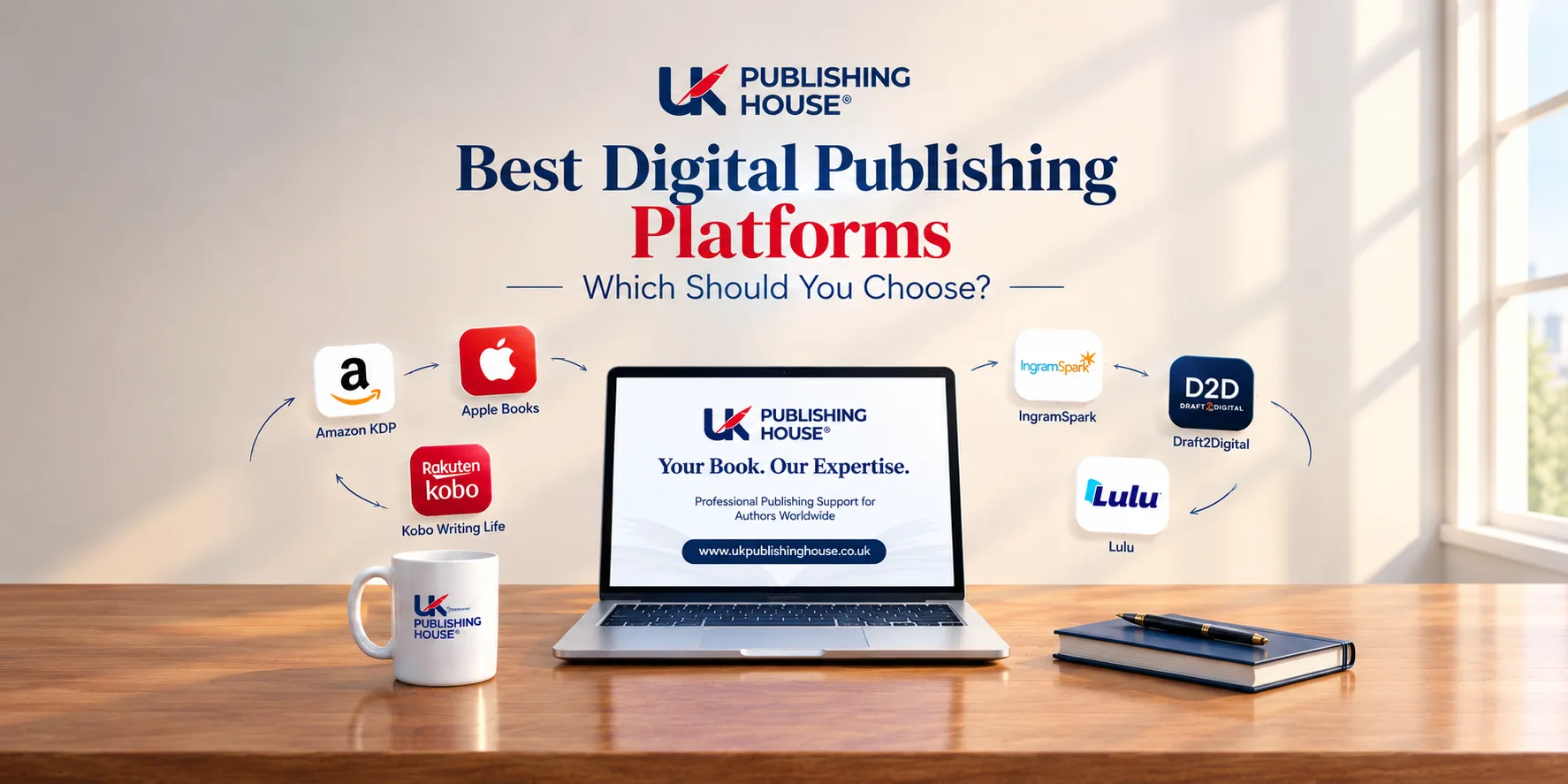
Short answer: The best digital publishing platforms for UK authors span retailer-direct routes, aggregators and other services, each with its own mix of cost, reach and control. The table below compares six of them side by side on format support, cost structure, distribution and support.
It's worth being clear on where UK Publishing House sits before you read it: it isn't one of these platforms; it's a publisher. UK Publishing House doesn't compete with the six routes below; it prepares a manuscript through editing, design, formatting and ISBN registration, then publishes it through the appropriate ebook routes on the author's behalf, which may include one or more of the platforms compared here. The six platforms below are the self-serve routes UK authors most commonly weigh up when publishing independently, and none of them are discussed again individually elsewhere in this guide.
Terms, fees and royalty structures across this industry change often, so treat the figures below as a snapshot rather than a permanent quote, and confirm current terms directly with any provider before you commit.
Platform and type | Formats and reach | Costs and terms | Best fit and limitation |
Amazon KDP, Retailer-direct and POD | UK authors; Kindle ebooks, paperback and hardback. Primary reach is Amazon's own stores, and wider print distribution eligibility varies. | No upload fee, though printing and other applicable deductions affect what you receive. Ebook royalty sits at 35% or 70%, depending on price, territory and delivery-cost rules. An optional exclusivity programme is available and requires ebook exclusivity while enrolled. | Suits authors managing their own Amazon publication. Editorial and design work remain the author's own responsibility, and opting into exclusivity limits selling the same ebook elsewhere. |
Apple Books, Retailer-direct | UK authors; ebooks sold through Apple Books. | Free direct ebook publishing, with a 70% ebook royalty and no file delivery fee. Publishing is non-exclusive, subject to meeting account, banking and tax requirements. | Suits authors who want to reach Apple Books readers directly. Covers this one retail channel only, not a complete print or multi-store solution. |
Kobo Writing Life, Retailer-direct | UK authors; ebooks and audiobooks. Kobo's own retail reach, plus optional partner and subscription channels, subject to eligibility. | Free self-publishing route. Ebook earnings depend on price and content eligibility, up to 70%, with no exclusivity requirement. | Suits authors adding a non-exclusive ebook channel. |
IngramSpark, POD and ebook distribution | UK authors; paperback, hardback and ebooks. Wholesale availability to retailers and libraries. | Account and title upload are free. Print receipts depend on list price, wholesale discount, print cost, and any applicable fees or returns. Distribution is non-exclusive, so avoid overlapping arrangements elsewhere. | Suits authors seeking wholesale print availability. Being orderable doesn't guarantee shelf placement; discount and return settings directly affect your margin. |
Draft2Digital, Aggregator and POD | UK authors; ebooks and POD paperbacks. Selected retail and library channels, with partner eligibility varying. | An annual maintenance fee may apply to accounts that do not meet the platform’s required sales threshold. Accounts with no active titles in distribution may be exempt, subject to the provider’s current terms. | Suits authors managing several outlets from one dashboard. Account fees and commission reduce receipts, and editorial or cover services aren't included; avoid duplicating distribution to the same outlet. |
Lulu, POD and distribution | UK-accessible route, across multiple print formats. Retail distribution depends on the format chosen and eligibility. | Print cost varies by specification. Revenue depends on the sales channel used, so check gross profit separately from list price, after applicable production and distribution costs. | Suits authors who prioritise print format choices. Not every format qualifies for retail distribution; run a live cost calculation and confirm shipping costs before pricing your book. |
This shortlist deliberately excludes business flipbook software and academic-only publishing platforms, since neither is built for a book author. It also leaves out one well-known US-focused direct retail option, because its fit and onboarding process for UK authors weren't established clearly enough to include here with confidence.
If you'd rather a publisher chose and managed the right combination of these routes for you, rather than working through them yourself, see "When Should You Choose a Managed Publishing Service?" further down.
Which Digital Publishing Platforms Are Best for Ebooks?
Short answer: Amazon KDP, Apple Books, Kobo Writing Life and Draft2Digital are the four platforms UK authors most often compare for ebooks specifically, and the right pick depends on royalty, exclusivity and how many stores you actually want to reach.
Platform | Royalty | Format support | Exclusivity | Reach |
Amazon KDP | 35% or 70%, depending on price, territory and delivery-cost rules | Kindle ebook | Optional programme requires exclusivity while enrolled; otherwise non-exclusive | Amazon's own stores, the largest single ebook retailer UK readers use |
Apple Books | Flat 70% at all prices, no delivery fee | EPUB ebook | Non-exclusive | Apple Books app across iPhone, iPad and Mac |
Kobo Writing Life | Up to 70%, depending on price and content eligibility | Ebook and audiobook | Non-exclusive | Kobo's own retail reach, plus optional partner and subscription channels |
Draft2Digital | Store royalty minus roughly a 10% commission, plus applicable account fees | Ebook and POD paperback | Non-exclusive | Multiple retail and library channels from one upload |
For online book publishing at ebook level specifically, most UK authors don't pick just one of these. A common pattern is publishing directly to Amazon KDP for the largest single audience, then either publishing directly to Apple Books and Kobo Writing Life as well, or using an aggregator like Draft2Digital to reach both of those plus smaller stores and library platforms from a single upload. Going direct to each retailer usually nets you a slightly higher royalty than routing everything through an aggregator, since aggregators take a further cut on top of what the retailer already deducts; the trade-off is the time spent managing three or four separate accounts instead of one.
Which Platforms Are Best for Books?
Short answer: Amazon KDP, IngramSpark and Lulu are the three routes UK authors most commonly compare, and they differ mainly in cost to set up, how receipts are calculated, and how far into the book trade they actually reach.
Platform | Cost to publish | How receipts are calculated | Retail reach | Best for |
Amazon KDP Print | No upload fee | List price minus printing cost and other applicable deductions; there's no single published percentage that covers every case | Primarily Amazon's own stores; wider distribution eligibility varies | Authors who want a paperback alongside their Kindle edition, with minimal extra setup |
IngramSpark | Account and title upload are free | List price minus wholesale discount, print cost and any applicable fees or returns | Wholesale availability to a wide network of retailers and libraries | Authors seeking wholesale print availability beyond Amazon |
Lulu | Print cost varies by specification | Revenue depends on the sales channel used; check gross profit separately from list price | UK-accessible retail distribution depending on format and eligibility | Authors who want more control over print format and specification choices |
None of these three publish a flat, universal royalty percentage for print the way ebook platforms do, because your actual receipt is always list price minus a print cost that varies by page count, trim size, and paper choice. Rather than comparing print margins on a headline percentage, run the numbers on your own book's specifications through each platform's own calculator before deciding, since a book that does well on one platform's cost structure can do noticeably worse on another's.
Should You Publish Directly or Use an Ebook Aggregator?
Short answer: Publishing directly to each retailer usually earns a slightly higher royalty and gives you full control over each listing; using an ebook aggregator like Draft2Digital trades a small commission and account fee for the convenience of reaching multiple stores from a single upload.
Choose direct publishing if:
You only want to reach one or two retailers, commonly Amazon, or Amazon plus Apple Books, and don't mind managing each account separately.
You want the highest possible royalty on each sale, since going direct avoids an aggregator's added commission on top of the retailer's own cut.
You're comfortable updating pricing, metadata, and files in more than one dashboard whenever something changes.
Choose an ebook aggregator if:
You want wide distribution, including smaller stores and library platforms, without creating and maintaining several separate accounts.
You'd rather manage one upload and one dashboard, even at the cost of a commission and any account fees.
You're managing several titles at once, since the time saved multiplies across a backlist, which is exactly why many self-publishing firms and self-publishing publishers building out a catalogue lean towards this route.
Neither route is wrong; it's a straightforward trade between your own time and a percentage of your royalty. Some UK authors also split the difference: direct to Amazon KDP for the largest single audience, then an aggregator for everywhere else, since Amazon isn't available through most aggregators anyway.
Which Platforms Can Reach UK Bookshops and Libraries?
Being listed for sale online is not the same as reaching UK bookshops and libraries; that generally requires wholesale distribution, which works differently from a retailer's own ebook or store.
Retailer-direct platforms like Amazon KDP and Apple Books make your book available in their own online store, which UK readers can browse and buy from, but that listing alone doesn't put your paperback on a shelf in a bookshop or on a library's ordering system. Wholesale distribution, the route IngramSpark provides, makes your book available to order through the wider book trade that bookshops and libraries actually use to source titles, which is a meaningfully different kind of reach from a single retailer's storefront.
It's worth being precise about what "reach" actually guarantees, because this is where a lot of author expectations go wrong. Being available for order through a wholesale network means a bookshop or library can order your book if they choose to; it does not mean they will stock it, feature it, or buy it in any quantity. Guaranteed stocking isn't something any platform offers, whichever one you use; discoverability, reviews, and someone actively pitching the book to buyers still do most of the work of getting a title onto a shelf or into a library's collection. If reaching UK bookshops and libraries matters to your book, treat wholesale availability as a starting point rather than a finish line.
Can You Use Multiple Digital Publishing Platforms Together?
Short answer: Yes, and most UK authors do, though a few practical rules keep multiple platforms from working against each other. The main things to manage are exclusivity, keeping your ebook and print routes separate where needed, and staying consistent on ISBNs across editions.
Exclusivity. If you opt into an exclusivity programme on one platform, such as Amazon KDP's optional Kindle-exclusive enrolment, your ebook can't be sold anywhere else while that enrolment is active. If you want to publish widely from the start, either skip that optional programme or wait until any enrolment period ends before uploading elsewhere.
Separate ebook and print routes. There's no conflict in running an ebook through one route and a paperback through another; publishing an ebook via Amazon KDP while also using IngramSpark for wholesale paperback distribution is a common, straightforward combination, since they're serving different purposes.
Duplicate editions. If you're publishing the same paperback specification through more than one service at once, for example, Amazon KDP Print and IngramSpark together, check each platform's current terms carefully. Some optional distribution settings on one platform can overlap with, or conflict with, distribution through another, particularly where the same ISBN is used in both places.
ISBN consistency. Keep track of which ISBN is assigned to which edition and which platform. A separately sold format generally needs its own distinct ISBN if you're using ISBNs at all, and reusing one ISBN across genuinely different editions, or letting two platforms distribute the same ISBN in conflicting ways, is one of the more common sources of confused listings and metadata errors. If you're combining platforms and want this properly coordinated rather than managed by trial and error, this is exactly the kind of detail a publisher handles as part of a managed service.
What Should Authors Check Before Choosing a Digital Publishing Platform?
Short answer: Authors should check cost transparency, rights and royalty terms, exclusivity requirements, distribution reach, supported formats, and the level of human support on offer before committing to any platform. Miss one of these and you can end up locked into a route that doesn't suit your book at all.
Cost transparency. Understand exactly what's free, what's paid, and what a "free" platform still leaves you to sort out elsewhere. Free upload isn't the same as zero-cost production: editing, cover design, and marketing don't publish themselves, whatever the platform's sign-up page implies.
Rights and royalties. Confirm who owns the rights to your work, what royalty percentage genuinely applies, and how it's calculated against the actual price your book sells for in pounds, not just the headline percentage on the homepage. The same manuscript can earn noticeably different amounts on different platforms once you do that maths.
Exclusivity terms. Read the exclusivity terms before you upload anything. Some optional programmes require your ebook to be exclusive to that one retailer for a set enrolment period, which stops you selling the same file anywhere else while it applies. That might be a reasonable trade for some authors and a dealbreaker for others; you just need to know it's there before you tick the box.
Distribution reach. Confirm which retailers, libraries, and countries a platform actually reaches, and whether UK bookshops and libraries are a realistic prospect through that route or not. Wide distribution and wide availability aren't quite the same thing; being listed somewhere doesn't guarantee a bookshop will ever order a copy.
Format support. Check whether a platform supports ebook only, or other formats, since this decision changes which options even apply to you. Work out whether you want an ebook, print, or both before you choose a platform, not after.
Human support. Confirm whether real help is available if something goes wrong with formatting, pricing or distribution, rather than an automated FAQ page being the only option when a file rejects or a listing looks wrong.
A short pre-publishing checklist. Before you commit to any route, it helps to have these six things settled: a manuscript that's been through professional book formatting and proofreading, a finished cover, clarity on which ISBN (if any) you'll be using and who it's registered to, a decision on ebook, print, or both, your pricing worked out in pounds against your actual royalty, and accurate metadata (title, description, genre and keywords) ready to submit. Getting these sorted first saves you from choosing a platform around a manuscript that isn't actually ready for it.
What Do UK Authors Need to Know About ISBNs, Legal Deposit and Tax?
Short answer: UK authors should check ISBN requirements by format and platform, follow the correct print or electronic legal deposit procedure, and establish their tax reporting responsibilities under current HMRC guidance. None of these three areas works quite the way most first-time authors assume.
ISBN registration. In the UK, ISBNs are issued through the UK ISBN Agency. Whether you need one at all depends on the format and the platform: some ebook-only routes don't require an ISBN, while a separately sold format (paperback, hardback, a distinct ebook edition) will normally need its own distinct ISBN if you're using ISBNs at all. It matters whose name the ISBN is registered under. An ISBN you buy and register yourself keeps you listed as the publisher of record; an ISBN assigned by a provider or platform is usually registered to them, which can affect the book's imprint and how portable it is if you ever want to move to a different service later. And an ISBN is not the same thing as copyright: copyright in your work exists automatically once you've written it, regardless of whether the book has an ISBN at all.
Legal deposit. UK print publications generally need to be deposited within one month of publication; the other five legal deposit libraries can separately request a copy if they want one, rather than receiving it automatically. Electronic publications follow their own, separate arrangements rather than the print process. Don't assume a publisher handles this for you unless it's explicitly written into your agreement; ask directly rather than guessing.
Tax. Keep clear records of your publishing income from the start. Whether you owe tax, and how much, depends on your own circumstances and the allowances that apply to you, so it isn't accurate to say every royalty payment automatically triggers a tax return. UK income tax, VAT treatment, and any overseas withholding tax (for example, on sales through US-based platforms) are three separate matters, each with its own rules, and none of them comes with automatic treaty relief; check current HMRC guidance, or speak to an accountant, rather than assuming a platform's own tax interview covers everything you need to know.
When Should You Choose a Managed Publishing Service?
Short answer: A managed publishing service suits you when you'd rather have a publisher prepare and place your book across the right platforms than manage each of the routes above yourself. UK Publishing House isn't a platform: it's a publishing house that handles editorial work, design, formatting, ISBN registration, and distribution as one coordinated process, publishing your ebook and editions through the appropriate routes on your behalf, with clear author approval stages along the way.
The trade-off is straightforward: publishing directly through one of the platforms above costs less upfront and keeps every account in your own hands, while a publisher like UK Publishing House charges a fee, set out in a written quote for your project, in exchange for that coordination.
In practice, that means professional book editing and proofreading before production, cover design and interior formatting, ISBN registration, and print-on-demand or ebook publishing through full publishing services handled under one agreed scope. If your manuscript needs writing help rather than just editing, that sits further upstream, through ghostwriting or, for fiction specifically, fiction ghostwriting.
This route tends to suit first-time UK authors who want help understanding each production decision, and authors with limited time to coordinate freelancers and technical setup themselves; our guide to the best UK publishers for first-time authors covers that wider decision in more depth. If you already have publication-ready files and strong technical skills, you may need considerably less support than a full managed service provides, and one of the self-serve platforms from the comparison table above might suit you better instead. Whichever way you lean, confirm the exact scope, deliverables and exclusions in writing before you commit, since package scope varies by project.
How Do Digital Publishing Platforms Compare on Fees and Royalties?
Short answer: Fees and royalties vary considerably across the six platforms compared above, and the headline royalty percentage rarely tells the whole story. Here's how the fee and royalty structures actually compare, so you can weigh them against your own book rather than against a marketing page.
Section 7 ke fees and royalties table ko generic karke revise kar diya hai. Is version mein koi specific cost amount mention nahi hai:
Platform | Publishing terms | Royalty or revenue basis | What affects author receipts |
Amazon KDP | Direct self-publishing for ebooks, paperbacks and hardbacks. | Ebook earnings depend on the selected royalty option, price, territory and delivery conditions. | Print costs, delivery deductions and any exclusivity arrangement. |
Apple Books | Direct ebook publishing through Apple Books. | Earnings follow Apple Books’ current royalty terms. | Account, banking, tax requirements and the ebook-only format. |
Kobo Writing Life | Direct publishing for ebooks and audiobooks. | Earnings depend on the book’s price, format, and content eligibility. | Partner-channel terms and current royalty conditions. |
IngramSpark | ebook distribution with wholesale reach. | Print revenue is calculated from the list price after wholesale discount and production deductions. | Print specifications, wholesale terms, returns, and applicable distribution charges. |
Draft2Digital | Aggregator service for distributing ebooks and selected print titles. | Author earnings are calculated after the platform’s commission and retailer deductions. | Account terms, partner-store deductions, maintenance conditions, and distribution choices. |
Lulu | Publishing with optional retail distribution. | Revenue depends on the chosen sales channel after production and distribution deductions. | Book specifications, printing costs, shipping, and channel eligibility. |
A few patterns are worth noticing here. Free-to-upload platforms (Apple Books, Kobo Writing Life, IngramSpark's account) still leave editing, cover design, and marketing entirely in your hands, so "free" only ever covers the upload, not the production. Ebook royalties across the big retailer-direct platforms cluster around 70% at typical price points, but Amazon's rate drops to 35% outside its standard pricing band, which is easy to miss if you're only comparing headline numbers. Aggregators like Draft2Digital trade a small account fee and commission for the convenience of one dashboard reaching several stores at once. And with either route above, IngramSpark or Lulu, your actual per-copy receipt depends on the print cost and wholesale discount, not just the royalty percentage, so it's worth running the maths on your own list price in pounds before assuming a platform's headline rate reflects what you'll take home.
A publisher works differently again. Rather than a per-sale royalty split, you're paying a project fee, set out in a written quote, for the editing, design and coordination itself, while your actual retailer receipts still flow through whichever platform or platforms your book ends up published on. That's why UK Publishing House doesn't appear as a row in the table above: it isn't an alternative to these platforms; it's what sits in front of them for authors who'd rather not manage the choice and setup themselves.
Ready to move forward? Submit your manuscript or enquiry to the UK Publishing House to start the initial assessment, and you're on a clear, transparent path from manuscript to published book, across ebook and print. Once your book is ready, book marketing, your own author website, and a book video trailer for launch are all worth planning for alongside it.