You've just hit send. And one second later, like a draught of cold air down the back of your neck, you spot it. "Your" instead of "you're." Right there, in the opening line of an email you've spent the last hour wording carefully. The recipient is a client. A tutor. A line manager. Someone whose opinion of you genuinely matters.
There's no taking it back.
That moment, the small interior collapse that follows a grammar slip in a high-stakes piece of writing, is one most of us know far too well. It isn't really about the comma or the apostrophe or the missing letter. It's about what we worry the mistake says about us.
This guide is built to take that worry off your shoulders. We're going through the most common grammar mistakes that show up in British writing every day, why they happen even to people who genuinely know better, and the small, reliable fixes that catch them before anyone else notices. There's no shaming here. No dusty rules pulled from a Victorian textbook. Just the practical advice a working editor would lean over and share with you, the kind that turns vague anxiety into actual confidence.
By the time you finish, you'll have twenty solid corrections, a self-editing routine that catches what Grammarly misses, a quick way to figure out which mistakes are your particular blind spots, and enough understanding of why these errors happen to stop being so hard on yourself.
Let's get into it.
Why Common Grammar Mistakes Cost You More Than You Think
There's a temptation to wave grammar mistakes off. They're small. The reader still understood. The point got across. Why fuss over a misplaced apostrophe?
Because readers are quietly judging, that's why. They don't sit there with a red pen, but their brains absolutely register the slip, and what registers next is a small downgrade in how seriously they take you. Recruitment consultants admit to binning CVs over a single typo. Editors at British publishing houses turn down submissions on the basis of opening pages riddled with mechanical errors. Clients form impressions in the first paragraph of an email that they rarely revise.
The reason has very little to do with the comma itself. A grammar mistake isn't a sign of low intelligence. Everyone reading this is intelligent. The problem is what the mistake signals: a lack of attention to detail. And in any context where your credibility matters, your CV, your dissertation, your debut novel, your client proposal, that signal carries weight far out of proportion to its size.
Here's the encouraging part. Most of the grammar mistakes that damage credibility are the same handful, repeated. Fix those, and the rest takes care of itself. You don't need to memorise a syntax textbook. You need a working list of the typical grammar mistakes that trip people up, and a few sticky shortcuts to remember them by.
That's what we've built at UK Publishing House into this guide, drawing on the kind of feedback our editors give first-time authors every week. The same patterns come up over and over again. Catch them once, and your writing instantly looks sharper.
Why Your Brain Sabotages Your Grammar
Before we get into the list, it helps to know why you keep making these mistakes in the first place. Because once you understand the mechanics of how the errors creep in, you can stop blaming yourself and start working with your brain instead of against it.
How Autocorrect Retrained Your Muscle Memory
Predictive text and autocorrect were meant to help. In a lot of ways, they do. But they've also quietly degraded our internal spelling and punctuation instincts. The phone finishes your word before you've finished thinking it. Your finger taps the wrong suggestion. The screen says "definitely," your draft says "defiantly," and you don't notice because your brain has already moved on.
The cost shows up later, in proper documents, where you assume your spelling sense is intact and it isn't.
The Speech-to-Text Trap
Dictation tools transcribe sound, not meaning. Homophone errors slip in by the dozen. "Their" becomes "there." "Should have" turns into "should of" because that's what you actually say out loud. These errors are invisible to the spellchecker because every word is technically a real word. They're only catchable by a human read-through, and that's the step most people skip.
Why Anxiety Makes It Worse
Grammar anxiety has a particular shape. The more you worry about getting things wrong, the more rushed your self-correction becomes, and the more new errors you introduce in the process. It's a feedback loop. Fear of error breeds error.
The fix is counterintuitive. Slow down. Breathe. Trust that a single mistake, in isolation, will not destroy your credibility. The catastrophic thinking does more damage than any one grammatical error ever will.
The Register Problem and Code-Switching Fatigue
You move all day between WhatsApp, Slack, work email, an academic essay, a LinkedIn post and a quick text to your partner. Each one has its own conventions, its own acceptable shortcuts, its own tolerance for sloppiness. Your brain's grammatical monitoring system is doing constant gear changes, and by the time you reach the document that actually matters, it's tired.
This is one of the main reasons careful writers still produce frequent grammar mistakes. Not because they don't know the rules, but because the rules they need aren't the ones they've been using all day.
What Is Your Grammar Villain? A Quick Self-Diagnostic
Most people don't make every common grammar mistake equally. We have patterns. The errors that trip you up are usually different from the ones that trip up your colleague, and knowing your particular weak spot is half the battle.
Read through the six profiles below and see which one feels uncomfortably familiar.
The Homophone Hazard
You know the difference between "your" and "you're." You really do. But when typing at speed, your fingers reach for the wrong word, and you only notice when it's too late. You second-guess yourself constantly, sometimes correcting from right to wrong on a final read-through. Your blind spots: your/you're, there/their/they're, its/it's, whose/who's, stationary/stationery.
The Comma Cowboy
You either sprinkle commas like confetti at a wedding or avoid them entirely. The result is either a fragmented mess or a single breathless paragraph. Either way, your reader is doing the punctuation work in their head, and it's exhausting them. Your blind spots: comma splices, run-on sentences, missing pauses around dependent clauses.
The Apostrophe Anarchist
If a word ends in "s," you reach for an apostrophe. You know you do it. The urge feels automatic, almost involuntary. Then again, you also sometimes forget the apostrophes that should actually be there. Your blind spots: plural apostrophes (apple's £2), missing possessive marks, contraction confusion.
The Syntax Drifter
Your sentences start strong. Then somewhere in the middle, they wander. Modifiers attach themselves to the wrong noun, the verb you started with no longer agrees with the subject, and you've drifted into the passive voice without noticing. Your blind spots: dangling modifiers, subject-verb disagreement, passive voice creep.
The Tense Time-Traveller
You switch between past and present tense mid-paragraph because you're describing what happened while also analysing what it meant. Both perspectives feel natural; the inconsistency only becomes obvious on a careful re-read. Your blind spots: tense shifts within paragraphs, inconsistent narrative framing.
The Confused-Pair Collector
You have a mental list of word pairs you actively avoid because you can never remember which is which. You'd rather rewrite the whole sentence than risk picking the wrong one. Your blind spots: affect/effect, practise/practice, fewer/less, principal/principle.
If more than one profile sounds like you, that's normal. Most of us are at least two grammar villains rolled into one. The point is to know your dominant pattern, because that's where most of your common grammatical errors are coming from.
The 20 Common Grammar Mistakes That Cost You Credibility
Each mistake below comes with a severity rating. "Fatal" means it'll damage your credibility on contact in a professional context. "Distracting" means the reader will notice and pause. "Forgivable" means most readers won't catch it, but fixing it adds polish.
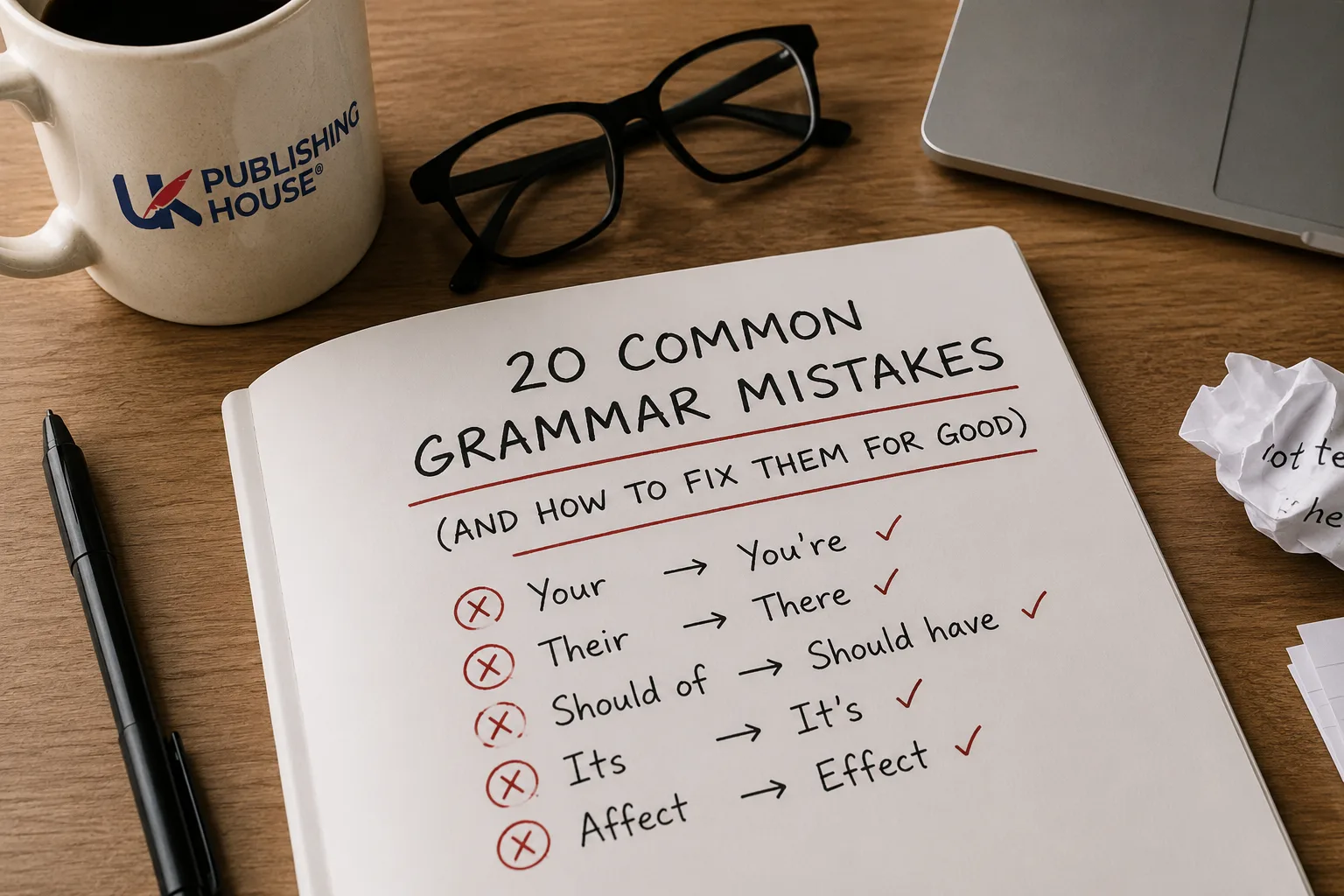
1. Your vs You're
Severity: Fatal in client emails and professional correspondence.
Before: Your going to love this proposal.
After: You're going to love this proposal.
"Your" means ownership: your book, your CV, your idea. "You're" is short for "you are." The simplest test in English: if you can swap in "you are" and the sentence still makes sense, the apostrophe belongs.
This one keeps tripping people up because autocorrect leans towards "your" by default. It's statistically the more common word, so the phone guesses it. You have to override the suggestion consciously.
Memory hook: "You're" has an apostrophe because there's an invisible "a" hiding inside.
2. There vs Their vs They're
Severity: Fatal.
Before: Their going to park over there in they're usual spot.
After: They're going to park over there in their usual spot.
Three small words doing three different jobs. "There" describes a location (it contains "here"). "Their" shows ownership (it contains "heir," as in inheritance). "They're" is the contraction of "they are."
Only one of them has an apostrophe, and that's the one that means "they are." The other two are owning their respective spaces, the place and the possession.
Memory hook: if you can replace it with "they are," the apostrophe belongs.
3. Its vs It's
Severity: Distracting.
Before: The company increased it's prices.
After: The company increased its prices.
This is the exception that breaks the rule. Normally an apostrophe-s means possession, but with "its" the possessive form has no apostrophe at all. "It's" only ever means "it is" or "it has."
The reason this trips even careful writers is that it contradicts the pattern your brain has learned everywhere else. Think of it like "his" and "hers." Those don't take apostrophes either. Possessive pronouns are a closed club, and "its" is a member.
Memory hook: if "it is" doesn't fit, drop the apostrophe.
4. Whose vs Who's
Severity: Distracting.
Before: Who's book is this?
After: Whose book is this?
Same pattern as "its/it's." "Who's" is always short for "who is" or "who has." "Whose" is the possessive form, the one that asks about ownership.
Quick check: if you can swap in "who is" and the sentence still works, use the apostrophe. If not, "whose" is the word you want. This one is forgivable in casual writing but stands out instantly in anything formal.
5. Comma Splices
Severity: Distracting.
Before: I finished the report, I sent it to the team.
After: I finished the report, and I sent it to the team. Or: I finished the report. I sent it to the team.
A comma splice happens when you stitch two complete sentences together using only a comma. A comma isn't a strong enough piece of equipment for that job. You need a full stop, a semicolon, or a coordinating conjunction (and, but, so, or, yet) to do the joining properly.
If both halves of the sentence can stand on their own, a comma alone won't hold them together.
6. Run-On Sentences
Severity: Distracting.
Before: We need to schedule the meeting it has to happen before Friday otherwise we miss the deadline.
After: We need to schedule the meeting. It has to happen before Friday; otherwise, we miss the deadline.
A run-on is what happens when independent clauses pile up without proper punctuation. The sentence keeps going past its natural stopping point, and the reader runs out of breath trying to follow it.
The simplest test is to read your draft aloud. Wherever your voice naturally pauses or stops, there should be a comma, a semicolon or a full stop. If you're gasping for air, your reader is too.
7. The Greengrocer's Apostrophe (Plural Apostrophes)
Severity: Distracting to Fatal, depending on context.
Before: Fresh apple's £2 per kilo.
After: Fresh apples £2 per kilo.
This one has a name for a reason. The "greengrocer's apostrophe," apostrophes shoved into ordinary plurals on chalkboards outside corner shops, has been British satirical fodder for decades. Lynne Truss built half her career on it.
The rule is simpler than most. Plurals never take apostrophes. Not on menus, not on hashtags, not on Christmas greetings, not when you're talking about the Smiths visiting at the weekend (it's "the Smiths," not "the Smith's"). The apostrophe is only for ownership and contraction.
8. Missing Possessive Apostrophes
Severity: Distracting.
Before: The managers office is down the hall.
After: The manager's office is down the hall. Or: The managers' office is down the hall.
The opposite problem to number seven. Singular nouns take an apostrophe-s. Plural nouns ending in "s" take just an apostrophe after the "s." Plural nouns not ending in "s" (children, women, people) take an apostrophe-s.
Where it sits matters as much as whether it's there at all. "The manager's office" means one manager has an office. "The managers' office" means several managers share one. Different meanings, one tiny mark.
9. Subject-Verb Agreement (And the UK Collective-Noun Question)
Severity: Fatal in formal writing.
Before: The list of requirements are on the desk.
After: The list of requirements is on the desk.
The verb has to agree with the actual subject, not whatever noun is closest. "List" is the subject; "of requirements" is a prepositional phrase that exists to confuse your ear. Mentally cross it out. "The list is on the desk" sounds correct immediately.
This is also where UK English diverges from American. British writing often treats collective nouns as plural when the group is acting as individuals: the team are arguing about tactics, the committee have decided. American writing prefers singular throughout. Both are correct in British English; just pick one per piece and hold it.
10. Affect vs Effect
Severity: Distracting.
Before: The weather will effect our plans.
After: The weather will affect our plans.
"Affect" is almost always a verb meaning to influence. "Effect" is almost always a noun meaning a result. Yes, both have rarer uses ("to effect change," "a flat affect"), but the standard rule covers ninety-nine percent of cases.
Memory hook: "A" comes before "E" in the alphabet, just as Action (affect) comes before the End result (effect).
11. Practise vs Practice
Severity: Distracting in British prose. Fatal in legal, medical and academic contexts.
Before: I need to practice my presentation. The doctors practise has moved.
After: I need to practise my presentation. The doctor's practice has moved.
This one is uniquely British. In UK English, "practise" is the verb and "practice" is the noun. American English collapsed both into "practice" decades ago. The same noun-verb split applies to "licence" (noun) and "license" (verb), and "advice" (noun) and "advise" (verb).
UK readers who consume a lot of American content slip into the American pattern without realising. So does Grammarly, unless you set its language preference to British English first. If you're heading towards professional manuscript formatting for submission, this is the kind of detail a British editor will flag immediately.
Memory hook: S is for Something you do (verb). C is for the Concrete noun.
12. Fewer vs Less
Severity: Distracting.
Before: Less people attended this year.
After: Fewer people attended this year.
"Fewer" is for things you can count. "Less" is for things you can measure but not count.
Countable: people, pounds, mistakes, books, hours. Use "fewer."
Measurable but not countable: time, water, stress, sugar, money in the abstract. Use "less."
The UK supermarket checkout sign that says "10 items or less" should technically read "10 items or fewer." Tesco famously updated theirs after years of customer complaints. Whether your reader will notice depends on the audience, but in any formal context, the distinction matters.
13. Passive Voice Overuse
Severity: Fatal when it obscures accountability. Distracting when it just weakens tone.
Before: The report was written by the team, and the error was discovered.
After: The team wrote the report, and they discovered the error.
Passive voice flips the natural order of a sentence. The thing being acted on becomes the subject; the actor disappears or trails along at the end. It isn't always wrong, sometimes the actor genuinely doesn't matter ("The roof was replaced in 2019"), but in business writing and academic prose it tends to creep in everywhere and dilute everything.
The zombie test is famous: if you can add "by zombies" after the verb and the sentence still makes sense, you're looking at the passive. "The decision was made... by zombies." Yep, passive.
14. Inconsistent Verb Tenses
Severity: Distracting to Fatal in narrative and academic work.
Before: She walks into the room and sat down.
After: She walked into the room and sat down.
Pick a tense and stay there. Most paragraphs don't need to time-travel. If you're describing past events, stay in the past. If you're using the literary present ("the protagonist refuses to engage"), stay in the present.
The trickier case is when you're analysing past events using a present-tense lens, a common move in academic writing. Then you have to be deliberate about which sentences sit in which tense, rather than drifting between them.
Memory hook: check your verbs in pairs. If one walks, the other sits. If one walked, the other sat.
15. That vs Which
Severity: Distracting.
Before: The car, that was red, sped away.
After: The car that was red sped away. Or: The car, which was red, sped away.
"That" introduces information essential to the meaning of the sentence (which car? the red one). "Which" introduces extra information you could remove without changing what the sentence is about. The "which" version always sits between commas; the "that" version never does.
A note for UK writers: British style guides like the Guardian and the BBC are noticeably more relaxed about using "which" in restrictive clauses than American ones. The car which was red sped away will pass muster in most British prose. The strict that/which rule is more rigid across the Atlantic.
16. Dangling Modifiers
Severity: Distracting. Fatal when they create real ambiguity.
Before: Walking down the street, the trees were beautiful.
After: Walking down the street, I thought the trees were beautiful.
A modifier has to describe the subject of the main clause. In the "before" sentence, the trees are doing the walking, which is absurd but technically what the grammar says. The fix is to make sure the subject of the main clause is whoever or whatever the modifier is actually about.
The test: ask "who is doing the action in the modifier?" If the answer isn't the subject of your sentence, you've got a dangler. Newspaper sub-editors have built whole careers around catching these before they reach print.
17. Semicolon Misuse
Severity: Distracting.
Before: I like pizza; and burgers.
After: I like pizza and burgers.
The semicolon has one main job: joining two closely related independent clauses without using a conjunction. The wind was howling; the dog refused to come in. Both halves can stand alone as sentences, and the semicolon links them.
It doesn't introduce a list, that's the colon's job. It doesn't replace a comma before "and" or "but." If you wouldn't use a full stop in that exact spot, you probably shouldn't use a semicolon either.
Memory hook: a semicolon is a full stop wearing a comma as a disguise. Both sides must be able to stand alone.
18. Colon Misuse
Severity: Distracting.
Before: I need: milk, eggs and bread.
After: I need milk, eggs and bread. Or: I need a few things: milk, eggs and bread.
A colon must follow a complete sentence. It's a signal to the reader that what comes next was promised by what came before. Without that complete setup, the colon dangles in mid-air, and the sentence feels off without anyone being able to explain why.
If the words before the colon don't form a stand-alone sentence, the colon isn't ready to appear yet.
19. Single vs Double Quotation Marks (UK)
Severity: Distracting in published UK writing. Fatal in academic submissions specifying house style.
Before: She said "the deadline has moved."
After: She said 'the deadline has moved'.
British book publishing and most academic style guides put single quotation marks on the outside and reserve doubles for quotations within quotations, though many UK newspapers (the Guardian, the Times, the Telegraph) use doubles on the outside. American convention does the opposite. Worse, British punctuation usually sits outside the closing quote unless it belongs to the quoted material itself; American punctuation tucks inside regardless of meaning.
Word, Google Docs and most AI writing tools default to American conventions. You have to set the language to British English explicitly, and even then the smart-quote autocorrect sometimes overrides you. If you're working in journalism, fiction or academic writing for a British audience, getting this right matters more than you'd expect. We've written a fuller breakdown on how to punctuate quotes correctly, which is worth bookmarking.
20. Stationary vs Stationery
Severity: Distracting. Fatal on a CV applying to an office supplies firm.
Before: Please order more stationary for the office.
After: Please order more stationery for the office.
"Stationary" with an "a" means not moving. "Stationery" with an "e" means writing materials, paper, envelopes, pens. Both are valid words, which is why autocorrect almost never catches the swap.
Memory hook: stationery contains e for envelopes. Stationary contains a for "at a standstill."
Honourable Mentions (Grammar Mistakes Worth Knowing)
A few common mistakes didn't quite make the top twenty but are worth knowing about, because they mark the difference between competent writing and consistently polished writing.
Lay vs Lie. You lay something down (it takes an object). You lie down (no object). The past tense gets confusing because the past tense of "lie" is "lay." Forgivable in casual speech, distracting in formal prose.
Who vs Whom. "Who" is the subject, "whom" is the object. Test by answering with "he" or "him." If "him" fits, use "whom" (both end in m). Increasingly forgivable in everyday writing; only the most formal registers still police it.
Peak, Peek and Pique. A mountain top, a quick look, and a stimulation of interest. The classic homophone trio. You pique someone's curiosity; you don't peak it.
Principal vs Principle. A person (a school principal) or an adjective (principal cause) versus a moral rule (a matter of principle).
Licence vs License. Same noun-verb pattern as practise/practice. The licence is the document; you license something to be done.
Fix the Paragraph: Real-World Editing Scenarios
Spotting a single mistake in isolation is easy. The real test is whether you can catch several errors at once, inside a paragraph that's also trying to communicate something. Here are three scenarios where multiple common grammar mistakes typically pile up.
The Professional Email Disaster
Picture a Monday morning email to a line manager about a missed deadline. Six embedded errors. A "your" where it should be "you're." A passive voice construction hiding who actually made the mistake. A comma splice gluing two anxious sentences together. A run-on apologising at length. By the time the reader reaches the actual point, they've already formed an impression.
The fix isn't to obsess over every word as you draft. It's to write the email, walk away for ten minutes, then come back and read it as if someone else wrote it. The errors leap off the screen.
The LinkedIn Post That Undermined the Author
A new role announcement. The kind of post that gets shared, screenshot and forwarded. Then a tense shift mid-paragraph. A dangling modifier turning the sentence into accidental comedy. A confused-pair slip (it was meant to "pique" interest, not "peak" it). Small errors, big audience. This is where having a finished author website and a habit of running social posts through a quick proofread starts to matter, especially if you're trying to build credibility as a writer.
The Academic Abstract Ambiguity
University writing has its own particular hazards. A dissertation abstract dense with passive voice, mismatched verbs and that/which slips can make even strong research feel uncertain. The fix is structural before it's mechanical: rewrite the actor back in, pin down the tense, then go through and clean up the small stuff. If you're working towards submission, knowing how to format your manuscript properly is half the battle; the rest is the prose itself.
When Good Grammar Goes Bad: Nuance and Evolving Rules
Grammar is not a static monolith. Anyone who tells you otherwise is selling you something. Dictionaries describe how the language is actually used. Style guides prescribe particular conventions for particular contexts. The two often disagree.
Prescriptivism vs Descriptivism
The split infinitive ("to boldly go") was condemned for decades by writers who believed it broke an unbreakable Latin rule. Except English isn't Latin, and Fowler dismissed the prohibition as superstition over a century ago. Today, the split infinitive is fine, sometimes even necessary for clarity.
Ending a sentence with a preposition has the same history. Once forbidden, now standard. "This is the kind of nonsense up with which I will not put," Churchill is supposed to have said, mocking the rule's awkwardness.
Knowing which "errors" are real errors and which are contested preferences is itself a sign of grammatical maturity.
Register and Audience Calibration
The level of precision your writing needs depends entirely on where it's going. A legal contract, a research paper or a formal job application demands strict adherence to convention. A WhatsApp message to a friend, a casual Slack note or a punchy social caption can break almost every rule listed above and still be perfect for its purpose. The discipline of copywriting, in particular, often deliberately breaks formal rules to land a tone or a rhythm that strict grammar can't reach.
Match precision to register. Don't apply legal-brief standards to your WhatsApp messages, and don't write your dissertation in the register of a tweet.
Style Guide Variations That Trip People Up
UK writers run into a few specific quirks worth knowing.
The Oxford comma (the final comma before "and" in a list of three or more) is used by Oxford University Press but skipped by most British newspapers, including the Guardian and the Times. Both are defensible; pick one per piece and stay consistent. If you want a proper deep dive on this, we've covered the Oxford comma in full elsewhere on the blog.
The "-ise" versus "-ize" question is similar. Both are technically British. Most UK publishers and newspapers prefer "-ise"; Oxford University Press prefers "-ize." Again, pick a convention and hold the line.
Dates run day-month-year in the UK (16 June 2026), not the American month-day-year. Mixing them in international correspondence causes genuine confusion.
The Self-Editing Protocol: How to Catch Your Own Mistakes
Self-editing is a skill. It doesn't come naturally, because your brain is so good at filling in what you meant to write that it papers over what you actually wrote. The fix is a process that disrupts that autopilot.
Step 1: Cool the draft. Don't edit immediately after writing. Put the document away for a few hours, ideally overnight. The distance is what lets you see the page as a reader rather than as its author.
Step 2: Run a villain-specific sweep. Use the Grammar Villain section above to identify your top three recurring errors. Then use Ctrl+F to search for known troublemakers: "your," "their," "it's," "affect," "practice," "that."
Step 3: Audit by ear. Have your device read the draft aloud. Awkward phrasing, missing words and repetitions you've read past five times become obvious the moment you hear them.
Step 4: Read backwards. Read the document one sentence at a time, starting from the last sentence and working back to the first. The narrative flow stops carrying you, and each sentence has to stand on its own mechanical merits. This is the trick that catches more grammar errors than any other.
Step 5: Use the ruler trick. Print the draft and cover the lines below your current line with a ruler or piece of paper. It forces line-by-line focus and improves error-catch rates dramatically.
Step 6: Run a banned-words check. Keep a personal list of weak intensifiers you over-rely on: "very," "really," "quite," "actually," "just." Scan for them and replace each one with a stronger verb or noun, or cut it entirely. This is closer to what professional proofreaders do; if you want to understand the discipline more fully, our piece on what proofreading actually involves walks through the difference between editing and proofreading in detail.
Step 7: The dialect check. Run a final pass looking for stray Americanisms. Color, organize, practice used as a verb, double quotation marks where there should be singles, punctuation pulled inside quotes, US-format dates. Your spellchecker has probably been quietly converting your British English into American without your noticing. Set it to British English and run the check again.
Step 8: The register check. Read the draft once more, but only for tone. Is the level of formality right for the audience? Are there spots where you've drifted into corporate-ese, or into chatty informality where it doesn't belong?
Grammar Fails in the Wild
There's nothing quite like a public grammar mistake to remind you why this stuff matters. A few well-known categories of carnage:
Menu Mayhem. The café board offering "Taco's £3" implies, technically, that the taco owns three pounds, which would be impressive economics on its part.
Signage Sabotage. "Your welcome!" painted on a delivery van. "The manager's are on holiday" on a corner-shop sign. Permanent, expensive errors that get photographed and shared widely.
Headline Horror. Tabloid headlines with dangling modifiers that create unintentional comedy. (Yes, "Walking down the street, the trees were beautiful," really does appear, with no irony.)
Social Media Slip-Ups. Brand tweets with homophone errors that get screenshotted faster than the brand can delete them. Even a slick book video trailer campaign can be undermined by a typo on the closing card, which is why captions and credits need the same scrutiny as the script.
The Greengrocer Hall of Fame. A British tradition. Apple's £2, banana's three for a pound, fresh strawberrie's. Possessive forms applied to fruit that owns nothing. Lynne Truss made an entire bestseller out of these.
The Toolkit: What Helps, What Doesn't, and What Requires Human Judgement
No tool will replace a careful eye. Some will get you most of the way, and that matters; for a busy writer with a deadline, "most of the way" is often enough. But knowing what each tool does well and where it fails saves time and avoids false confidence.
Real-Time Digital Checkers
Grammarly flags homophones, basic punctuation issues and obvious typos during drafting. Set the language preference to British English in settings before you use it, or it will start "correcting" your correct UK spellings into American ones.
ProWritingAid does the same job at greater depth, with style and consistency analysis across long manuscripts. It's particularly useful for novel-length work where consistency drifts naturally over the course of writing.
Both have well-known blind spots: dangling modifiers, misapplied semicolons, single-versus-double quotation marks in UK contexts, and subtle register mismatches. Don't rely on them for those.
Clarity and Concision Tools
Hemingway Editor highlights passive voice and over-long sentences. It flags passive voice indiscriminately, so use human judgement to keep the passives that are doing real work, particularly in legal or scientific writing where the actor genuinely is irrelevant.
Authoritative References
The Oxford English Dictionary is the standard for British usage and etymology. Collins and Cambridge are accessible everyday references with British English as default.
For style guidance, New Hart's Rules is the gold standard for UK book and academic publishing. The Oxford Style Manual covers everything else. The Guardian and Observer Style Guide is freely available online and excellent for journalistic prose. The BBC News Style Guide is clean, modern and UK-public-service in tone.
When You Need a Real Pair of Eyes
There's a point in any writing project where the tools have done what they can do and you need a human reader. A friend who reads carefully helps. A trained professional helps more. If you're preparing a manuscript for submission or publication, working with a professional editor is the single biggest improvement most writers can make to their work. If you're wondering exactly what they do differently from a ghostwriter, our breakdown on the difference between a ghostwriter and an editor is a useful starting point, as is our guide to finding a UK book editor and publisher when you're ready to take that step. For those approaching the work from the other side of the table, you can also look at getting hired as a freelance proofreader, which offers a useful insider's view of the trade.
The Bottom Line
Most grammar mistakes don't reveal anything deep about your intelligence or your skill as a writer. They reveal that you're a human being writing in a digital environment that actively works against precision. The fact that you've read this far is proof you're already doing the work most people skip.
Pick three of the mistakes above that you know are your particular weak spots. Work on those for a fortnight. Then come back and pick three more.
If you're approaching something high-stakes, a manuscript heading for submission, a CV that needs to land, a piece of fiction you've been polishing for months, professional help saves time and catches what your own eyes never will. Whether that means partnering with a full publishing service, working with a ghostwriter, or commissioning a specialist fiction ghostwriter depends entirely on where you are in the process. A polished manuscript benefits enormously from strong book design, targeted book marketing, and quality book printing, but none of that compensates for prose riddled with the mistakes we've just covered. Get the words right first.