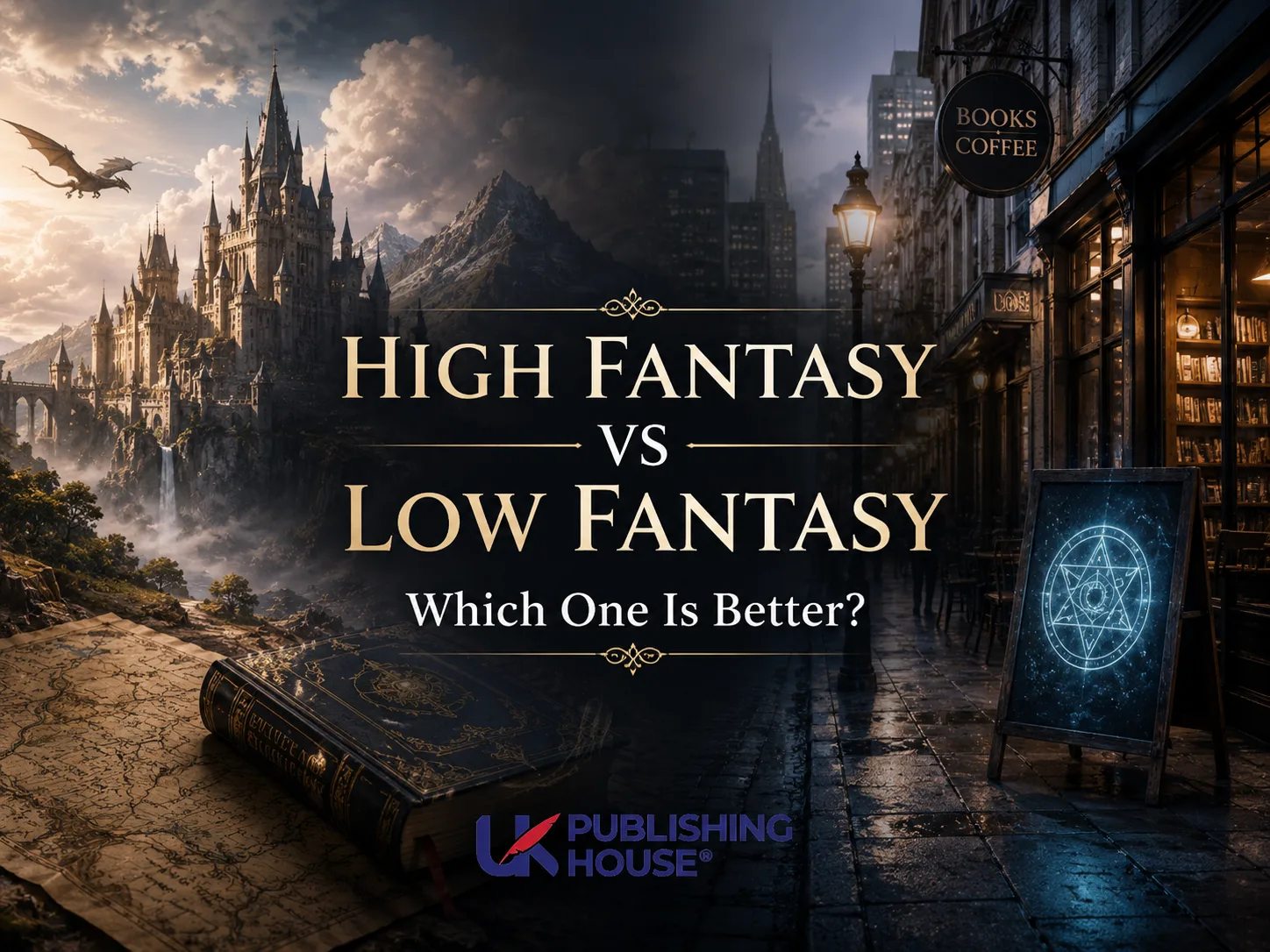
You've got a story burning in your chest. Maybe it's a sprawling saga of warring kingdoms, or maybe it's something quieter, a tale about a barista who slowly works out that her regulars aren't quite human. Either way, the story is alive in your head. And then you sit down to describe it to someone, or to type it into a submission form, and a small, annoying question stops you cold.
Is this high fantasy? Or low fantasy?
If that question has ever made you hesitate, you're in very good company. Almost every writer who has ever loved the genre has stumbled over those two terms at some point. They get thrown around in reviews, in writing forums, in agent wish-lists, and somehow nobody ever sits you down and explains them properly. So the confusion lingers. And here's the thing that actually matters: that confusion isn't just a vocabulary problem. It can quietly stall a whole project. You hold back from committing to your world bectale about a barista who slowly works out that her regulars aren't quite human ause you're not sure what kind of world it's meant to be.
Let's fix that, properly and for good.
This guide isn't going to hand you a dictionary definition and leave you to it. By the time you reach the end, you'll understand the real difference between high and low fantasy, you'll know which one fits the story you actually want to tell, and you'll have a handful of practical tools to start building it with genuine confidence. We'll look at definitions, yes, but also at modern examples, a clear decision framework, worldbuilding blueprints for each path, the mistakes that trip up beginners, and a few hands-on exercises that turn all this theory into actual pages.
Here at UK Publishing House, we work with debut and seasoned authors every day, and the writers who understand their subgenre from the outset almost always end up with cleaner, more confident manuscripts. So let's cut through the noise and get your fantasy novel pointed in the right direction.
Understanding the Fantasy Landscape
Before we pull high and low fantasy apart, it's worth pausing on the bigger picture, because the terms only make sense once you understand what they sit inside.
Fantasy, stripped right down to its bones, is fiction that contains something the real world simply doesn't have. Magic. Dragons. Gods who answer when you call them. A door in an ordinary terraced house that opens onto somewhere impossible. That "something extra" is the beating heart of the genre, and it's enormously flexible. It can be the entire foundation of an invented universe, or it can be a single strange object sitting on a kitchen table in an otherwise perfectly normal life.
That flexibility is exactly why fantasy resists tidy boxes. It isn't a binary with two neat compartments. It's a spectrum. At one far end you've got vast, fully invented worlds with their own maps and languages and thousand-year histories. At the other end you've got our world, our streets, our weather, with just a whisper of the uncanny bleeding through. High fantasy and low fantasy are simply two regions on that spectrum, and most stories land somewhere along the line rather than slamming into one extreme.
Why High vs Low Fantasy Matters for Writers
So why bother learning the difference at all? Why not just write the story and let someone else slap a label on it later?
Because the subgenre you choose shapes everything. It quietly sets your reader's expectations before they've even finished the first chapter. It influences your pacing, your tone, the scale of your stakes, even the kind of language that will feel right on the page. High fantasy makes a promise of escape and grandeur, of being swept somewhere far from the everyday. Low fantasy makes a different promise, that wonder is hiding in the familiar, that magic could be lurking just behind the bus shelter on your own street.
Get that promise muddled, and your reader feels it. They might not be able to name what's wrong, but they'll sense a manuscript that doesn't quite know what it wants to be. The opening reads like a quiet, grounded character study, then halfway through the world's fate suddenly hangs in the balance and the tonal gears grind. Mislabelling, in other words, doesn't just confuse the marketing. It can muddle the writing itself.
There's a deeper truth underneath all this, and it's worth saying plainly. Start with a core concept, not a world. Define your story's emotional heart, the thing it's really about, before you build a single kingdom or name a single spell. The subgenre should serve that heart, never the other way round. If you're still working out where your idea belongs, getting familiar with the different types of fiction genres and how each one works is a useful place to find your bearings before you commit.
Defining High Fantasy: Worlds Beyond Our Own
Let's start at the grander end of the spectrum, because it's the one most people picture the instant they hear the word "fantasy" at all.
High fantasy unfolds in a secondary world. That's the key phrase, and it's worth sitting with. A secondary world is a place entirely separate from our own, with its own geography, its own history, its own rules, its own everything. There's no portal from modern Earth, no "and then she woke up in a strange land." The story simply lives there, fully and completely, from the first page to the last.
Core Characteristics of High Fantasy
A few features tend to travel together in high fantasy, and once you start noticing them you'll spot them everywhere.
The setting is that fully realised secondary world, often arriving with maps in the front pages and invented languages dotted through the dialogue. Magic tends to be pervasive and structured, woven right into how the world functions, frequently operating through systems with clear costs and limitations. And the themes lean epic. We're talking good versus evil, the fate of nations, the hero's long and difficult journey towards something far bigger than themselves.
That word "epic" is doing a lot of work, so let's be precise about it.
The Epic Scope and Stakes
High fantasy rarely busies itself with small, domestic problems. The conflict is usually world-altering in some way. A dark lord rising. A land slowly dying. An ancient prophecy grinding into motion whether anyone wants it to or not. The stakes are enormous, often external, and frequently tangled up with the survival of an entire people or realm.
But here's the bit that separates competent high fantasy from the genuinely unforgettable kind. The very best high fantasy anchors those colossal stakes in something deeply, achingly personal. Yes, the kingdom might fall, but what makes us turn the pages at two in the morning is whether this one frightened, stubborn character can save the brother they love. The epic gives the story its scale. The personal gives it its pulse. If you're still shaping who that character is, our guide to what makes a believable fictional character on the page is worth a read. You need both, and the personal is the one beginners most often forget.
Magic Systems in High Fantasy
In high fantasy, magic is rarely just set dressing. It's a tool, a force, sometimes practically a character in its own right. And crucially, it tends to follow rules the reader can actually grasp.
Think of Brandon Sanderson's Allomancy, where ingesting and "burning" particular metals grants particular powers, all of it governed by clear, learnable mechanics. Or Patrick Rothfuss's sympathy, a kind of magic built on energy transfer that obeys something close to the laws of physics. In both cases the magic has logic, and that logic is precisely what makes it satisfying. The reader can anticipate, calculate, and feel the tension when a character runs low on whatever fuels their power.
This is the golden rule for any high fantasy writer building a magic system: give it clear costs and limitations. Every spell should have a price, whether that's exhaustion, lost memory, a physical toll, or something stranger. Magic without cost is just a convenient button the author presses whenever the plot gets stuck, and readers can smell that a mile off. If you want to track all of this properly as your system grows, worldbuilding platforms like World Anvil and Campfire are built for exactly that kind of detail.
Classic and Modern Examples of High Fantasy
Nothing makes a definition click quite like real books, so let's ground this.
On the classic shelf, The Lord of the Rings by J.R.R. Tolkien is the archetype itself, the secondary world, the epic quest, the mythic scale that practically every later high fantasy is measured against. Ursula K. Le Guin's A Wizard of Earthsea gives us another secondary world, but a quieter, more philosophical one, built around balance and the deep power of true names.
Step into the modern era and the genre is thriving. Samantha Shannon's The Priory of the Orange Tree delivers sweeping epic scope alongside diverse, character-driven politics. Evan Winter's The Burning series brings an African-inspired world, a tightly structured magic system, and pacing that refuses to let you go.
And then there's the contemporary twist worth knowing about. Romantasy, the booming blend of romance and fantasy, very often borrows high fantasy settings to crank up the emotional stakes, with Rebecca Yarros's Fourth Wing leading the charge and countless successors following. Meanwhile cosy fantasy, such as Travis Baldree's Legends & Lattes, proves something genuinely useful: a story can be high fantasy in setting while keeping its stakes small and personal. A coffee shop in an invented city is still a secondary world. The spectrum, in other words, is alive and well.
Defining Low Fantasy: Magic in the Real World
Now let's cross to the other end, which is, in many ways, the more slippery of the two to pin down, and all the more interesting for it.
Low fantasy is set in our world, or in a version of it we'd instantly recognise. The pavements are real pavements. The rain is proper, miserable, recognisable rain. And into that ordinary reality, magic intrudes, rare, hidden, sometimes unsettling. It doesn't define the world the way it does in high fantasy. Instead it disrupts a world we thought we understood.
Core Characteristics of Low Fantasy
The setting, then, is the familiar one: our world, or a near-mirror of it, where magical elements stay hidden, rare, or intrusive. The magic itself is often subtle, unexplained, or quietly dangerous. It unsettles the normal order rather than running it.
And the stakes shrink, in the best possible way. They become personal and intimate. A family curse passed down through generations. A secret society operating one street over from your own. A single supernatural event that quietly upends one ordinary life. The world isn't ending. But somebody's world is, and that proximity is the whole appeal.
There's a brilliant little principle that makes low fantasy land: use the familiar to ground the strange. Drop your magical intrusion into the most mundane, relatable setting you can find. A werewolf prowling a moonlit forest is expected, almost cosy. A werewolf in the harsh strip-lighting of a 2am launderette, watching the machines spin, is genuinely unnerving. The ordinariness is what makes the strangeness bite.
The Personal, Grounded Stakes
Low fantasy thrives on collision, the moment the ordinary and the extraordinary smack into each other. Because the world isn't at risk, the protagonist's emotional journey gets to sit right at the front and centre, fully lit. What's threatened isn't a kingdom. It's a relationship, a community, a hard-won sense of who you are.
And paradoxically, that smaller scale often makes the magic feel more immediate and more threatening, not less. When a dark lord menaces a far-off realm, it's thrilling but abstract. When something inexplicable starts happening in a house that looks exactly like yours, to a person who sounds exactly like you, it crawls a lot closer to the skin.
Magic as Intrusion or Secret
In low fantasy, magic usually lives in the margins. A hidden door tucked behind the library shelves. A family heirloom with a past nobody talks about. One person, quietly carrying a gift they were never supposed to have.
Neil Gaiman's The Ocean at the End of the Lane is a masterclass in this, ancient, unknowable magic surfacing through the half-remembered fog of a childhood in rural England, where the line between memory and myth refuses to stay still. The power of it comes precisely from how grounded the rest of the world feels before the strangeness seeps in. If you want to draft scenes like that, where the real-world setting has to feel utterly authentic before you let the magic breathe, a clean, distraction-free tool such as Reedsy Studio's free writing app keeps you focused on exactly that.
Classic and Modern Examples of Low Fantasy
On the classic side, C.S. Lewis's The Chronicles of Narnia offers an interesting hybrid, a portal fantasy that begins firmly in our world before the wardrobe opens, with that real-world frame keeping everything anchored. Susan Cooper's The Dark Is Rising sends ancient magic stirring awake in contemporary Britain, all frost and folklore and ordinary children pulled into something vast.
Among modern titles, N.K. Jemisin's The City We Became brings a gritty, recognisable New York to literal life, while Leigh Bardugo's Ninth House buries secret societies and genuinely dark magic beneath the ivy of Yale. Both feel like our world, with the lid lifted just enough to show what's squirming underneath.
The current market here leans hard into urban fantasy and magical realism, with a real and growing appetite for diverse cultural mythologies woven into everyday settings rather than the same recycled European folklore. Cosy fantasy overlaps in this space too, small-town magic, low stakes, a warm cup of something and a gentle enchantment. Proof, once again, that these labels describe a sliding scale, not a pair of locked rooms.
High Fantasy vs Low Fantasy: A Side-by-Side Comparison
Sometimes you just want it all laid out where you can see it at a glance. So here's the core of everything we've covered, side by side, as a quick reference you can come back to whenever the terms start to blur again.
Feature | High Fantasy | Low Fantasy |
Setting | Entirely secondary world, often with its own maps, languages and history. | Our world (or a recognisable version), with magical elements hidden or intruding. |
Magic | Pervasive, structured, often with clear rules and systems. | Rare, subtle or unexplained; may be a secret or a dangerous intrusion. |
Stakes | Epic, world-altering: the fate of kingdoms, the balance of good and evil. | Personal, intimate: a character's survival, a family secret, a local mystery. |
Tone | Grand, mythic, often with a sense of destiny and elevated language. | Grounded, gritty or whimsical; the extraordinary feels close and tactile. |
Protagonist | Often a chosen one, a hero of prophecy, or a figure of great destiny. | An ordinary person thrust into extraordinary circumstances; relatable and flawed. |
Conflict | External, large-scale: wars, dark lords, ancient evils. | Internal and external, but rooted in personal relationships and immediate threats. |
Worldbuilding | Extensive, from creation myths to political systems; the world is a character. | Selective, focused on the magical element's impact on the real world; less is more. |
Reader Promise | Escape, wonder and the triumph of hope over overwhelming darkness. | Wonder in the familiar, the uncanny, and the idea that magic could be just around the corner. |
Examples | The Lord of the Rings, The Priory of the Orange Tree, The Burning series. | The Ocean at the End of the Lane, Ninth House, The City We Became. |
Keep this table somewhere handy while you're drafting. When you catch yourself drifting, a personal, intimate scene suddenly sprouting a world-ending prophecy, glance back at it and ask which column your story actually wants to live in.
How to Choose Your Fantasy Type: A Decision Framework
Right, theory's lovely, but you've got a story to write. So how do you actually decide which path is yours?
The good news is that you almost certainly already know, somewhere underneath the doubt. The framework below just helps you drag that instinct into the daylight where you can see it clearly.
The Fantasy Subgenre Decision Flowchart
Work through these questions honestly, in order, and let your answers carry you towards your subgenre. Think of it as a conversation with your own story.
First question: does your story take place in a world entirely separate from our own? If yes, you're leaning high fantasy, so move to the next question. If no, if it's set in our world, skip ahead to the question about hidden magic.
Second question, for the secondary-world writers: are your stakes world-altering, the fate of nations, the balance of cosmic forces? If yes, you're in classic high fantasy territory, and you might explore its epic or heroic subtypes. If no, if your invented world hosts small, personal, slice-of-life stakes, you've found high fantasy with low stakes, the cosy-fantasy corner of the secondary-world map.
Third question, for the real-world writers: is magic a known, openly accepted part of everyday life in your setting? If yes, you're drifting towards alternate history or magical realism, where the lines with low fantasy blur beautifully. If no, keep going.
Fourth question: is the magic hidden, rare, or a secret intrusion into the real world? If yes, welcome to low fantasy, with all its flavours, urban fantasy, contemporary fantasy, dark fantasy. If no, it might be worth re-evaluating whether your story is fantasy at all, or whether it's actually straight literary fiction wearing a slightly magical coat.
That little sequence will catch the vast majority of stories and point them home.
Key Questions to Ask About Your Story
If you want to go deeper than the flowchart, sit with these three questions, because they tend to expose the truth of a project faster than anything else.
What is the emotional core of your story, and does it demand a vast canvas or an intimate stage? Some emotions need a continent to breathe; others suffocate anywhere bigger than a single kitchen. How much worldbuilding are you genuinely willing to do before you start writing? High fantasy asks for serious upfront design, and if that prospect thrills you, that's a signal; if it exhausts you, that's a signal too. And what kind of magic feels right for this particular plot, a system you can cleverly exploit, or a mystery that quietly defies all explanation?
A practical tip that serves both paths: draft a one-page "world bible" before you write, but keep it loose enough to evolve as the story grows. High fantasy might need several pages; low fantasy might need a single tidy paragraph. Adjust the scope, keep the habit.
Case Studies: Stories That Blend High and Low Fantasy
And just when you think you've got it all sorted, the most interesting books cheerfully refuse to pick a side.
Alix E. Harrow's The Ten Thousand Doors of January is a portal fantasy that slips between our world and a whole sheaf of others, braiding the intimate and the epic into a single ribbon. V.E. Schwab's The Invisible Life of Addie LaRue takes an unmistakably low fantasy premise, a desperate bargain struck with a dark force in 18th-century France, and then lets it stretch across centuries until it feels positively mythic.
These blends aren't mistakes or muddles. They're choices, made by writers who understood both ends of the spectrum well enough to stand confidently in the middle. Which is rather the point of learning all this in the first place. You learn the rules so you can break them on purpose. If you'd like a broader walkthrough on how to write a fantasy novel from first idea to finished draft, it picks up neatly where this leaves off.
Worldbuilding Essentials for High Fantasy
So you've chosen high fantasy. Excellent. Now comes the part that's equal parts thrilling and terrifying: building a whole world from absolutely nothing.
Crafting a Secondary World From Scratch
Resist the urge to start with a map full of place names. Start instead with one big, magnetic concept, the kind of idea you can't stop thinking about. A world where magic is slowly dying. A continent shattered into floating pieces by an ancient war between gods. A city built, quite literally, on the back of a sleeping dragon that everyone prays never wakes.
From that single spark, build outward and downward. Geography shapes culture, a people on a barren coast will worship, eat, fight, and grieve differently from a people in a lush river valley. And culture, in turn, shapes conflict. Let one decision cascade naturally into the next, and your world starts to feel discovered rather than invented. A tool like Inkarnate is genuinely brilliant here, sketching out maps can spark history and politics you'd never have dreamed up sitting at a blank page.
Designing a Magic System With Rules and Costs
We touched on this earlier, but for high fantasy it's worth lingering, because your magic system can carry an entire book or quietly sink it.
Define three things with real clarity: what your magic can do, what it absolutely cannot do, and what it costs the person using it. Brandon Sanderson's well-known "laws" of magic are a sturdy starting scaffold here, the core idea being that a reader's satisfaction with magic solving a problem is directly proportional to how well they understand that magic in the first place.
Every spell should have a price, exhaustion, memory loss, a physical toll, something. The simplest practical step is almost dull, but it works: build a table or spreadsheet listing each ability alongside its cost and its limitations, and Campfire's dedicated magic-system module is purpose-built for exactly this. The romance of magic comes from the writing; the reliability of it comes from this slightly tedious bookkeeping. You need both.
Building Cultures, Histories and Maps
Here's a beginner trap worth flagging loudly: the monoculture. The entire elf race is wise and aloof. Every single dwarf loves gold and grumbling. Real worlds are never that tidy. Even within your invented one, let belief, language, custom, and temperament vary from region to region, generation to generation. That internal friction is where stories quietly grow.
And remember that history isn't dusty background, it's live ammunition. A treaty signed five hundred years ago can still detonate a war in your opening chapter. The past should constantly leak into the present and cause trouble. World Anvil offers ready-made templates for timelines, family trees and cultural articles that keep all of this organised before it sprawls out of control. High fantasy also tends to run long, so it's worth checking the typical word counts readers expect by genre before your epic balloons past what publishers will look at.
Tools and Resources for High Fantasy Worldbuilding
To pull it together, a quick high fantasy toolkit. World Anvil is your comprehensive worldbuilding platform, all interactive maps and branching timelines. Campfire is the writing software with dedicated world and magic-system modules. Inkarnate handles intuitive, attractive fantasy map-making. Fantasy Name Generators rescue you when every character is temporarily called "Bob." And Scrivener, the long-form writer's old faithful, keeps your towering pile of worldbuilding notes sitting neatly alongside the manuscript itself.
Worldbuilding Tips for Low Fantasy
Chosen low fantasy instead? Your challenge is the precise opposite, and don't let anyone tell you it's the easier one. You're not building a world from scratch; you're taking the real one and threading something impossible through it so carefully that readers half-believe it could be true.
Integrating Magic Into the Familiar
The magic in low fantasy should feel like a secret the real world has been keeping all along, right under everyone's noses. Sensory detail is how you sell it. The sharp smell of ozone a half-second before a spell catches. The sudden, wrong chill of a ghost's hand passing through yours. These small physical specifics are what make the unbelievable land with a thud.
And that grounding principle bears repeating because it's the whole game: set your magical intrusions in mundane, relatable places. The supernatural always hits harder against an ordinary backdrop. A haunting in a crumbling gothic mansion is fine, expected, almost comfortable. A haunting in a brand-new build on a quiet suburban cul-de-sac is the one that keeps people up at night.
Subtle Worldbuilding: Show, Don't Tell
Low fantasy lives and dies by restraint. Rather than stopping the story to explain how the magic works, show a character discovering it, usually the hard way, often painfully. Let dialogue, environmental clues, and raw human reaction reveal the magical layer of your world without a single paragraph of lecture.
Here's a small exercise you can try tonight: write a scene in which a character encounters magic for the very first time, and describe only what they see, hear, and feel in the moment. No explanation. No backstory. No helpful narrator stepping in to clarify the rules. Just the lived, disorienting experience of it. That discipline is the absolute soul of good low fantasy.
Maintaining Believability in a Real-World Setting
Because your setting is real, your research has to be real too. If your story unfolds in Manchester, then the streets, the weather, the accent, the texture of local life all need to ring true before you dare add a single drop of the supernatural. Get the ordinary wrong and readers won't trust you with the extraordinary.
Think hard, too, about consequences rippling outward. Magic shouldn't happen in a sealed bubble. A spell might short out every streetlight on the road. A magical creature might leave traces, claw marks, strange residue, missing pets, that draw the attention of curious neighbours and online conspiracy theorists alike. Those ripples are what make a hidden magical world feel like it genuinely coexists with ours, rather than floating politely above it. For drafting and formatting this kind of grounded manuscript with a minimum of fuss, Reedsy Studio's clean interface keeps your attention where it belongs, on the story.
Tools and Resources for Low Fantasy Writing
Your low fantasy toolkit looks a little different. Scrivener earns its place for organising research, character sketches, and location notes right beside your draft. Campfire's character and plot modules help you track those personal stakes and tangled relationships that drive the whole thing. Fantasy Name Generators still come in handy, even in the real world you'll need names for secret societies, hidden places, and suspiciously old artefacts. And The Fantasy Fiction Formula by Deborah Chester is a craft book whose lessons on plot structure and character development apply just as cleanly to low fantasy as to its grander cousin.
Common Mistakes to Avoid (and How to Fix Them)
Every fantasy writer makes a few of these on the way up. The trick isn't avoiding them entirely, it's spotting them early enough to fix them before they harden into habit.
Info-Dumping and Front-Loading Worldbuilding
The mistake: opening your book with three dense pages of history, geography, and lineage before your protagonist has so much as cleared their throat. You spent months building that world and you desperately want readers to admire it. Understandable. Also fatal.
The fix: weave your worldbuilding into action and dialogue, and dole it out in small, digestible pieces. Reveal the world through your character's eyes, as they move through it, rather than pausing the story to deliver a lecture. Trust your reader to keep up. Trust your world to emerge. Front-loading kills pacing faster than almost anything else, so resist it hard.
Derivative Settings and Tolkien Clones
The mistake: elves, dwarves, a brooding dark lord, and a vaguely medieval European map, again. Tolkien cast such a long shadow that for decades fantasy struggled to step out of it, and beginners still drift into the silhouette by default.
The fix: reach for the under-represented. Draw on mythologies that haven't been strip-mined a thousand times. Mix genres. Subvert the tropes readers think they've got pegged. What happens if your chosen one flatly refuses the call to adventure and opens a bakery instead? Today's market is genuinely hungry for fresh tropes and diverse voices, so that instinct towards something new isn't just artistically braver, it's commercially smarter. If you want to understand the conventions you're playing with first, our explainer on what a trope is and how writers use one well is a handy companion.
Inconsistent Magic Rules
The mistake: magic conveniently solves a crisis in chapter four, then mysteriously can't be bothered to solve a nearly identical crisis in chapter nine, purely because the plot needed the tension. Readers notice. Readers always notice.
The fix: write a magic-system document, yes, even for low fantasy, that clearly states what magic can and cannot do, and then hold yourself to it without flinching. If you ever break your own rule, there must be a visible, meaningful cost. Consistency is what separates magic that feels real from magic that feels like the author cheating.
Neglecting Character Development for Worldbuilding
The mistake: the world is breathtaking, the maps are gorgeous, the histories run deep, and the characters are flat cardboard cut-outs wandering through it all. It's the most seductive trap in the genre precisely because the worldbuilding is so much fun.
The fix: start with character and keep returning to character. What does your protagonist actually want? What are they quietly terrified of? How does the world, magical or mundane, keep getting in their way? Sharpening the push and pull between your hero and whoever opposes them helps here, and our complete guide to the difference between a protagonist and an antagonist in a story breaks that down clearly. The world is the stage, but the character is the show. We come for the dragons; we stay for the people.
Writing Exercises and Prompts to Solidify Your Skills
Reading about craft is comfortable. Doing it is where the actual growth lives. So here are three exercises designed to turn everything above into pages you can keep. Block out an hour, silence your phone, and just write, nobody's marking this.
Exercise 1: Draft a Magic System for High Fantasy
Design a magic system with three distinct abilities, and give each one a clear cost and a clear limitation. Then write a 300-word scene in which a character uses one of those abilities and visibly suffers the consequence for it. The goal here is to train yourself to build rules that generate conflict rather than dissolve it, magic that complicates your protagonist's life instead of conveniently tidying it up.
Exercise 2: Write a Low Fantasy Scene With a Magical Intrusion
Pick the most mundane real-world setting you can think of, a bus stop in the rain, the cereal aisle of a supermarket, a silent corner of your local library. Now introduce one single magical element that quietly shatters the ordinary. Write a 500-word scene from the point of view of a character who witnesses it. The goal is to practise grounding the strange in sensory, relatable, specific detail, making the impossible feel like it really just happened, right there, in the cereal aisle.
Exercise 3: Worldbuilding on a Spectrum, Blending High and Low Elements
This one stretches you. Take a high fantasy concept, a secondary world with an epic quest, and deliberately inject a low fantasy element, something small, personal, and intimate at its centre. Or flip it: take a low fantasy concept, say a secret magical society humming away beneath modern London, and add a high fantasy element, a prophecy with the power to reshape the world. Write a one-page outline for the resulting hybrid story. The goal is to break the binary in your own head and, in the process, start discovering the voice that's uniquely yours.
Expert Insights and Further Resources
No writer builds a career in isolation, and the fantasy community is one of the warmest and most generous out there. Here's where to keep learning once you've closed this guide.
Recommended Reading and Craft Books
A few craft books genuinely earn their shelf space. The Fantasy Fiction Formula by Deborah Chester is a no-nonsense guide to plot, character, and worldbuilding, written by someone who's mentored bestsellers. Steering the Craft by Ursula K. Le Guin is full of sharp exercises and hard-won wisdom about language and narrative from one of the genre's true greats. And Wonderbook by Jeff VanderMeer is a gloriously illustrated, idea-packed resource that treats fantasy writing as the imaginative adventure it ought to be.
Online Communities and Writing Groups
Find your people. The r/fantasywriters community on Reddit is an active, welcoming spot for feedback, prompts, and endless subgenre debate. Writing-challenge communities that have stepped in since NaNoWriMo wound down such as the smaller regional write-ins and successor challenges that sprang up in its place carry a strong fantasy contingent and a real sense of momentum. And the SFWA, the Science Fiction and Fantasy Writers Association, offers professional-grade resources for authors who are serious about going the distance. Wherever you land, joining a writing group or online community gives you the two things every writer needs and few can manufacture alone: accountability and honest feedback.
Trusted External Resources
For ongoing craft guidance, Writer's Digest publishes reliable articles on writing, publishing, and genre trends. Mythcreants runs deep, thoughtful dives into fantasy tropes, worldbuilding, and storytelling mechanics, and it's staffed by professional story consultants, so the advice has real weight behind it. And Reedsy Learning offers free ten-day email courses on the craft, including several aimed squarely at fantasy writers. Bookmark all three; they'll repay the click many times over.
Your Next Steps as a Fantasy Writer
Let's bring it home. You arrived here tangled up in two confusing little labels, and you're leaving with a genuine working understanding of both, plus the tools to actually use them. That's real progress, so take a breath and feel it.
From Concept to First Draft: A Roadmap
Here's your simple three-step path out of theory and into a manuscript. Step one: use the decision flowchart in this guide to confirm your subgenre, or your deliberate, confident blend of both. Step two: complete the worldbuilding checklist for your chosen type, but set yourself a strict timer, because worldbuilding is the most delicious form of procrastination ever invented and it will happily eat your entire writing life if you let it. Step three: write the first chapter. Don't edit as you go. Don't tinker. Just get the words down. You can fix a messy page a hundred different ways. You can't fix a blank one at all.
So don't let the planning become the project. Set a deadline to start writing your first chapter, and make today the day you begin. Once you've got a draft, the question shifts to what comes next, and our look at choosing between self-publishing and traditional publishing in 2026 will help you think clearly about where your finished book should go.
Final Words of Encouragement
The fantasy genre is vast, and it's genuinely hungry for new voices, yours included. Your story matters, whether it spans galaxies and warring empires or unfolds entirely within the walls of a single rented flat where something impossible has just begun. There is honestly only one wrong choice in all of this, and that's not writing it at all.
When you're ready to take that draft from your laptop towards real readers, with professional editing, design and full book publishing support shaped around your goals, the team at UK Publishing House is here to help you make it the very best version of itself. The blank page gets a little less intimidating with every single word you put down. So go and put some down.