You've written your book. The manuscript is polished, the cover's sorted, and you're finally sitting in front of the upload screen ready to press publish. Then you hit a field marked "Publisher" and everything stops.
Is that your own name? A company you're supposed to have set up? Something called an "imprint" that everyone keeps mentioning but nobody quite explains?
That little blank box is where a lot of indie authors first bump into the business side of publishing, and it's not a gentle introduction. Search the question online and you'll get whiplash. One forum tells you to just type your name and move on. The next insists you must register a limited company and trade mark your imprint or you'll end up in a courtroom. Somewhere in between, you're left frozen, worried that one wrong move will quietly haunt your author career for years.
So let's clear it up properly. This guide explains exactly what a publishing imprint is, whether you actually need one, and, if you decide to go for it, how to set yours up from scratch, right through to seeing it live on Amazon. No scare tactics, no padding, just the straight, up-to-date picture for 2026. By the end you'll have a clear way to decide, a checklist you can actually follow, and the confidence to either set your imprint up over a weekend or skip it entirely without a shred of guilt.
Let's turn that blank "Publisher" field into something that works for you.
What Is a Publishing Imprint?
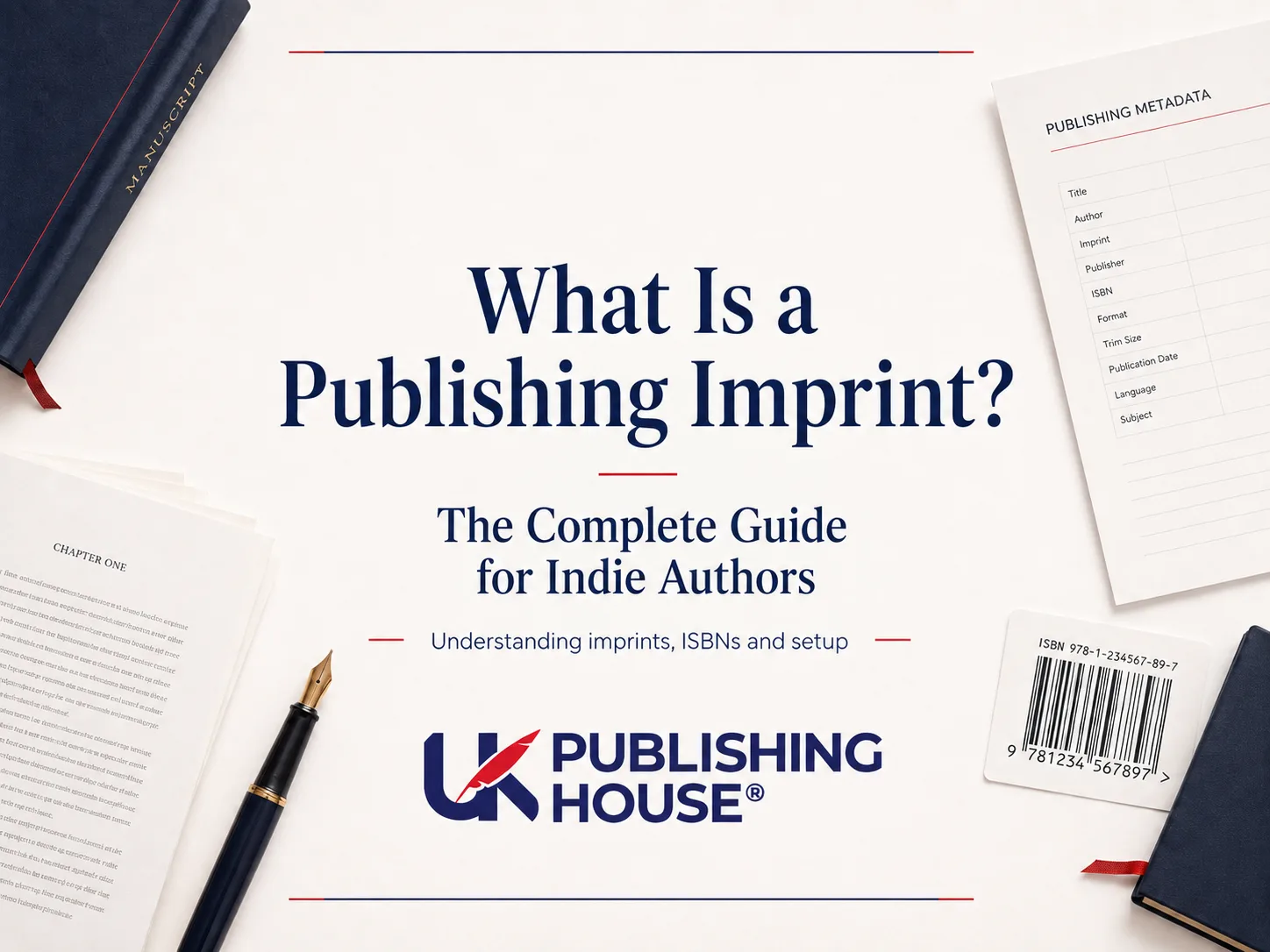
Here's the simplest way to put it. An imprint is the trade name a book is published under. It's the brand name that sits on your title page, appears on your copyright page, and shows up in the metadata that retailers display next to your book.
That's it. An imprint isn't a legal entity in its own right. It's not a company, a licence, or a registration. t's a name you choose to present your work to the world under, much the same way a pen name is a name you write under. "Blue Sky Books" doesn't exist as a person or a separate legal body. It's a banner you publish beneath.
The word itself trips people up, partly because "imprint" has a few meanings floating around. In everyday English, the imprint definition leans towards a mark left behind, a footprint pressed into sand, an impression stamped onto a page. Other words for imprint in that general sense include stamp, mark, impression, or print. But in publishing specifically, the meaning of imprints narrows right down. Here, an imprint is a publisher's brand name, the identity under which a particular line of books goes out. So when someone asks what does imprint mean in a book context, the answer isn't "a mark in the sand," it's "the publishing name on the spine."
Understanding that distinction is the whole foundation of this guide, because once you grasp that an imprint is simply a name with a purpose, the rest of it stops feeling so intimidating. If you're still finding your feet with the wider business of getting a book out into the world, our walkthrough on the complete process of how to publish a book in the UK gives you the bigger map this fits into.
Imprint vs Publisher vs Self-Publishing Platform: Clearing the Confusion
The single biggest tangle for new authors is mixing up three things that sound similar but do completely different jobs: the publisher, the imprint, and the platform. Get these straight and most of the confusion evaporates.
A publisher is the business that produces and sells books. An imprint is a brand name that publisher (or you) puts on a specific line of those books. A platform is the tool you use to upload and distribute. One produces, one brands, one delivers. Here's how they compare side by side.
Entity Type | What It Is | Who Owns It | Examples | ISBN Ownership | Control Over Rights |
Traditional Publisher | A company that acquires, edits, produces, distributes and markets books, usually paying an advance and royalties. | The publishing company itself (shareholders or private owners). | Penguin Random House, HarperCollins, Hachette | The publisher owns the ISBN and is listed as the publisher of record. | The publisher typically controls most rights, print, digital, audio, translation, as set out in the contract. |
Publishing Imprint | A trade name or brand used by a publisher (or a self-publisher) to identify a specific line of books. It's the name that appears on the book and in the metadata. | The individual or company that created it. If you self-publish, that's you. | "Viper" (an imprint of Profile Books), "Tor" (an imprint of Pan Macmillan), or your own "Blue Sky Books." | If you buy your own ISBNs, you own them and your imprint is listed as the publisher. Use a free ISBN and the platform owns it. | You keep all rights when you self-publish under your own imprint. |
Self-Publishing Platform | An online service that lets you upload and distribute your book to retailers like Amazon and Waterstones. It's a tool, not a publisher. | The platform company (Amazon owns KDP, Ingram owns IngramSpark). | Amazon Kindle Direct Publishing (KDP), IngramSpark, Draft2Digital, Kobo Writing Life | The platform may offer a free ISBN, but then the platform, or its own house imprint, is listed as the publisher of record. | You keep all rights to your book. The platform is a distributor, not a rights holder. |
Notice the pattern running down that ISBN column, because it's where the imprint question really bites.
Why the distinction matters for indie authors
When you accept a platform's free ISBN, Amazon or IngramSpark ends up listed as the publisher on your product page. To some readers and retailers, that quietly signals "hobbyist" rather than "serious author." It's a small detail, but small details stack up.
Create your own imprint and buy your own ISBNs, and you're suddenly in full control of your publisher identity. Your name, or rather your imprint's name, sits where it should. It tells anyone looking that there's a proper publishing operation behind the book, not just a file someone uploaded one evening. That's the heart of why imprints matter, and it's worth understanding before you decide whether to bother with one. It's also one of the quiet dividing lines in the wider debate around choosing between self-publishing and traditional publishing in 2026, where who gets named as publisher is part of what you're really deciding.
Why Create Your Own Imprint?
So an imprint is just a name. Why go to any trouble at all? Because a well-chosen name, used consistently, does a surprising amount of heavy lifting. Here's what you actually get out of it.
Professional credibility and reader trust
There's a real difference between a book that reads "Published by John Smith" and one that reads "Published by Blue Sky Books." Both might be the exact same author doing the exact same work, but the second one looks like a publishing house. Readers, reviewers and bookshops respond to that. A consistent imprint name across all your titles quietly tells everyone you're running a professional operation rather than dabbling.
When you pick that name, give yourself room to grow.
Choose something broad enough to cover future genres or pen names. "Mystery Thrillers Press" boxes you in the moment you fancy writing a romance, whereas something more neutral travels with you wherever your writing goes.
Brand building across multiple books and series
An imprint acts as a thread tying your catalogue together. As your backlist grows, that shared name becomes a brand readers start to recognise. They see "Blue Sky Books" on a title they loved, spot it again on a new release, and there's an instant flicker of trust. That recognition is exactly the kind of thing that professional book design and cover branding services are built to reinforce, and an imprint name is the simplest version of it.
Separation of genres and pen names
If you write sweet romance under one name and pitch-black thrillers under another, lumping them under a single imprint can confuse the very readers you're trying to delight. Separate imprints let you keep those worlds apart, so each audience gets a clean, consistent experience without stumbling into the wrong shelf. (More on whether you need one imprint or several in a moment, there's a simple way to decide further down.)
Long-term business value
Here's the part most authors never think about at the start. An imprint is an asset. If you ever decide to sell your backlist, bring other authors on board, or pass the business on, an established imprint with a track record makes the whole thing far more attractive and far easier to transfer. You're not just naming a book line, you're building something with its own standing.
How an imprint can help discoverability on Amazon
Let's be honest about this one, because there's a lot of myth around it. Amazon's algorithm doesn't have a secret "imprint boost" button. Using an imprint won't magically rocket you up the rankings. What it does do is more practical. When a reader clicks your publisher name on a product page, they're shown every book listed under that imprint. For an author with a growing catalogue, that's a genuinely useful cross-selling tool, one tap and they're looking at your whole shelf.
The trick is consistency. When you set up your imprint on KDP, use the exact same imprint name in the "Publisher" field every single time. That's the name that shows on your Amazon product page, and it's what groups your books together. One slip in spelling and the link breaks. It's also worth pairing this with a properly set-up Amazon Author Central UK profile, which is the other half of how readers find their way from one of your books to the rest.
When You Might NOT Need an Imprint
Now for the part a lot of guides skip, because not everyone needs an imprint, and pretending otherwise would be dishonest. Here are the situations where setting one up is more faff than it's worth.
You're publishing a single book as a hobby
If this is a one-off, a memoir for the family, a passion project with no sequel in sight, the effort of setting up an imprint probably isn't justified. Using your own name as the publisher is perfectly respectable.
You're testing the waters on a tight budget
Imprints come with costs, ISBNs, possibly registration, maybe a logo. If you're on a shoestring and simply want to see whether your book finds readers at all, you can always add an imprint later once you know it's worth it.
You're happy with a platform's free ISBN
If you genuinely don't mind "Independently published" or a platform name showing as the publisher, you can skip the imprint entirely. Plenty of successful authors do exactly this, and it doesn't dent their sales in any meaningful way. If you're leaning this way, it's worth weighing up the full benefits and drawbacks of Amazon KDP before you commit, since that free ISBN is part of a bigger trade-off.
You write in one genre under one name
If your brand simply is your author name, and you've no plans to branch out, an imprint adds very little. You are the brand. That's enough.
If you're sitting on the fence, here's the safest move: start without one. You can create an imprint later and update your book's metadata when you do. The one thing you can't undo is the publisher of record on an ISBN once it's assigned. So if you used a free ISBN and later want your own imprint on it, you'd have to unpublish and republish with a brand-new ISBN to make the switch. Knowing that now saves you a headache later.
How to Create a Publishing Imprint: A Step-by-Step Guide
Decided an imprint is right for you? Good. The actual process is far less daunting than the internet makes it sound. Here's the whole thing, broken into seven manageable steps.
Step 1: Brainstorm and research your name
Start loose. Jot down words that capture your genre, your tone, the feeling you want your publishing house to give off. Think about the impression a reader gets before they've read a single page. Once you've got a shortlist, do a quick reality check: search the name across social media and see whether the matching domain is free. Consistency across all of these builds recognition, and it's far easier to grab everything now than to discover later that your perfect name is taken everywhere but the one place you registered it. Domain registrars like Namecheap or GoDaddy will tell you in seconds whether the matching .co.uk and .com are available, and snapping the domain up early stops anyone else wandering off with it.
Step 2: Check trade mark and domain availability
Before you fall properly in love with a name, make sure nobody else has already trade marked it in the publishing space. Your first stop is the UK Intellectual Property Office (IPO) trade mark search, which is free to use. Search your exact name and a few close variations, you're looking for anything in publishing or related categories that could cause a clash. If you'll be selling into the EU, it's worth a glance at the EUIPO database too. Five minutes here can save you a forced rebrand and an awkward cease-and-desist letter much further down the line.
Step 3: Register your business (sole trader or limited company)
This is the legal step that ties your imprint name to you, and there are two main routes.
As a sole trader, you register with HMRC for Self Assessment and simply trade under your imprint as a business name. There's no separate filing fee, which makes it the simplest and cheapest option for a solo author. One thing to know: the UK has no central register for sole-trader trading names, so a trade mark (from step 2) is really how you protect the name itself.
A limited company is registered with Companies House, with a standard online incorporation fee of £100 (raised from £50 on 1 February 2026) plus an annual confirmation statement fee of £50. This gives you limited liability and a cleaner separation between your publishing business and your personal finances, which becomes genuinely useful if you ever plan to publish other authors. If the paperwork makes you nervous, a formation agent such as 1st Formations or ANNA can handle it and provide a registered office for a modest fee.
The rule of thumb: sole trader for simplicity and low cost if it's just you, limited company if you're building something bigger or want that liability protection.
Step 4: Purchase ISBNs under your imprint
An ISBN is the unique identifier your book needs to be properly listed and distributed. To have your imprint shown as the publisher of record, you need to buy your own ISBNs and register them under your imprint name, rather than leaning on a platform's free one. In the UK and Ireland, these come from Nielsen, the official ISBN agency, through their ISBN store. Buying a block works out far cheaper per ISBN than buying singles, so if you've got more than one book or format in mind it's the obvious choice, check the current Nielsen store for up-to-date block pricing. And you will need separate ISBNs for each format: ebook, paperback, hardback and audiobook each get their own. If hardbacks are on your radar, our guide to what's involved in hardback book printing in the UK explains how the format choice feeds back into all of this.
Step 5: Set up the imprint on publishing platforms
Now you enter your imprint name in the "Publisher" field on each platform you use. The golden rule is consistency, the exact same name, spelled and punctuated identically, everywhere. We'll go through the platform-by-platform detail just below, because each one tucks the field in a slightly different place.
Step 6: Design a logo and create a publisher page
A simple logo adds a professional finish. You don't need anything elaborate, a clean, text-based logo that reads well in black and white on a copyright page does the job nicely. Canva or Adobe Express both offer free or low-cost templates that'll get you there. While you're at it, add a basic "Publisher" page to your author website. It reinforces that the imprint is a real, standing entity and makes life easier for any reviewer or journalist who wants to reference it. If you haven't got a site yet, having a dedicated author website built for you is one of the more worthwhile foundations to put in place early.
Step 7: Use the imprint consistently everywhere
Finally, put your imprint name on the title page and copyright page of every book, and use it in your metadata, on your website, in press releases, anywhere your book appears. (If you're unsure how the copyright page should be laid out, it's worth looking at a few real UK book copyright page examples to get the format right.) Consistency is the whole game. The imprint only builds recognition if it shows up the same way, every time, across every channel.
Legal and Business Structure Options
Step three deserves a closer look, because choosing your business structure is the bit that makes most first-time authors hesitate. Here's the fuller picture without the jargon.
Sole trader: the simple route
You're operating as an individual, trading under your imprint as a business name, with no legal separation between you and the business for liability purposes. It's effectively free to set up, you just register for Self Assessment with HMRC and report your income each year. Best suited to solo authors publishing only their own work, where the risk of disputes is low.
Limited company: when you want liability protection
This is a legal entity separate from you, so if the business is ever sued, your personal assets are generally shielded. It costs £100 to incorporate online with Companies House (up from £50 since 1 February 2026), plus a £50 annual confirmation statement fee and likely some accountancy costs. It's the right call for authors who plan to publish other writers, or who simply want a firm wall between their writing income and their personal finances.
PLC or larger structures: overkill for nearly everyone
Unless you're building a sizeable publishing house with employees and outside investment, you can comfortably ignore these. They solve problems most indie authors will never have.
Whichever route you choose, keep your registration and any annual filings current. For limited companies in particular, file your confirmation statement and accounts with Companies House on time, missing deadlines invites penalties. The official gov.uk pages for registering as a sole trader and setting up a limited company are the place to confirm current fees and requirements, since these do shift.
ISBNs and Your Imprint: What You Must Know
ISBNs come up again and again in this conversation, so let's give them their own moment, because getting this right is what makes the imprint stick.
Why you should own your ISBNs
The ISBN is the key to your book's identity. Own it, and you control the publisher name that appears in the databases used by retailers, libraries and bookshops worldwide. That's the whole point. Don't use a free ISBN from Amazon or IngramSpark if you want your imprint to be the publisher of record, those free ones will list the platform instead, and you can't change it afterwards.
How to buy ISBNs from Nielsen
Head to the Nielsen ISBN store, create an account, and register as a publisher. Enter your imprint name exactly as you want it to appear, then buy your block. Check the store for current single and block pricing for 2026. You'll assign each ISBN to a specific format later, so there's no rush to allocate them all at once.
International ISBN agencies
Selling beyond the UK? The agencies differ by country. In the US it's Bowker (MyIdentifiers.com), in Australia it's Thorpe-Bowker, and in Canada ISBNs are actually free through Library and Archives Canada, though you still register as a publisher. There's a fuller rundown of these towards the end of the guide.
Assigning ISBNs to each format
Every format needs its own ISBN, one for the Kindle ebook, one for the paperback, one for the hardback, one for the audiobook. Bring out a second edition and that earns a fresh ISBN too. When you assign an ISBN in Nielsen's system, the publisher and imprint details you registered get tied to it, so double-check the name reads correctly before you finalise anything.
Setting Up Your Imprint on Publishing Platforms
Here's where the rubber meets the road. Each platform handles the publisher field slightly differently, so let's walk through the main ones.
Amazon KDP
During book setup, in the "Book Details" section, you'll find a "Publisher" field. Enter your exact imprint name there. That name then shows in the "Product details" section of your Amazon listing, and it powers the "More books by this publisher" link when you've got multiple titles under the same imprint. Use identical spelling, punctuation and capitalisation every time, even something as minor as "Blue Sky Books" versus "Blue Sky Books Ltd" can split your catalogue into two unconnected piles.
IngramSpark
IngramSpark's title setup has a dedicated "Publisher" field. Pop your imprint name in, and it flows out to every retailer Ingram distributes to, including Waterstones, independent bookshops and libraries. This is the route that gets you genuine bricks-and-mortar reach.
Draft2Digital
Draft2Digital keeps things simple. In the "Book Information" tab there's a "Publisher" field, enter your imprint name and it's carried across all their distribution channels, including Apple Books and Kobo.
Kobo Writing Life keeps a combined field. In the title details you'll find a 'Publisher / Imprint' box enter your imprint name and it appears on your Kobo store listing. Enter your imprint name and it appears on your Kobo store listing. (You might notice Barnes & Noble Press missing from this list, that platform is US-only, so for UK authors Kobo Writing Life is the more relevant equivalent.)
Whichever platforms you use, the instruction is the same: enter the name once, correctly, and never let it drift. And if the wider job of getting your manuscript professionally produced and out to readers feels like a lot to shoulder alone, our full self-publishing and book production service handles the parts you'd rather not.
Common Mistakes to Avoid
A few errors crop up again and again. Sidestep these and you'll save yourself real grief.
Using a platform's free ISBN
This is the big one. It locks the platform in as your publisher of record and makes the ISBN impossible to transfer later. If your imprint matters to you, buy your own.
Inconsistent naming
"Blue Sky Books" on KDP and "Blue Sky Publishing" on IngramSpark fragments your brand and quietly confuses readers. Pick one exact form and stick to it.
Skipping the trade mark search
Choose a name that's already trade marked and you could be looking at a cease-and-desist letter and a forced rebrand. The IPO search is free, so there's no excuse.
Choosing a name that's too narrow
"Vampire Romance Press" is a lovely name right up until you write a cosy mystery. Think years ahead, not just about the book in front of you.
Leaving the imprint off the book itself
Both the title page and the copyright page should display your imprint name. It's a small touch that signals professionalism to anyone who opens the cover.
Forgetting your annual filings
If you've gone the limited company route and miss your confirmation statement or accounts deadline, you risk penalties or even being struck off. Set a calendar reminder the day you incorporate.
Should You Create an Imprint? A Quick Decision Guide
Still not sure which side of the fence you're on? Work through these four questions in order and you'll land on a clear answer.
Question 1: Will you publish more than one book in the next three years?
If no, you probably don't need an imprint yet, use your own name or "Independently published" and revisit this when your plans grow. If yes, move on.
Question 2: Do you write in multiple genres or under different pen names?
If no, jump to question four. If yes, keep going.
Question 3: Do you want those genres or pen names kept completely separate in readers' eyes?
If yes, create separate imprints for each brand, it keeps your audiences distinct and avoids cross-genre confusion. If no, move to question four.
Question 4: Is building a long-term publishing brand important to you, beyond just selling books?
If yes, create an imprint, it's a foundational asset that grows with you. If no, an imprint is optional. You can still publish to a professional standard without one; you'll just miss out on some of the branding upside.
There's no wrong answer here. The point is to match the decision to your actual ambitions rather than following someone else's blanket rule.
A Real-World Look: Building a Brand with an Imprint
Theory only goes so far, so picture an author we'll call Sarah. She started out publishing a single romance novel under her own name, no imprint, no grand plan. After three books, she set up an imprint, "Heartfelt Press," and within six months noticed a meaningful lift in the "also-bought" clicks on her Amazon pages, readers were following the thread from one title to the next. Later, when she branched into thrillers under a different pen name, she launched a second imprint, "Dark Ink," to keep that darker work cleanly separated from her romance readership.
Sarah's story makes the point better than any list can: an imprint isn't just a name on a copyright page. Used deliberately, it's a tool for growth, a way of turning a scattering of individual books into something that feels like a catalogue with a brand behind it.
International ISBN and Imprint Considerations
If your ambitions reach beyond the UK, the process is broadly the same everywhere, but the agency you deal with changes from country to country. Here's a quick reference.
Region | ISBN Agency | Notes |
United Kingdom & Ireland | Nielsen ISBN Agency | Register as an individual or a publisher. |
United States | Bowker (MyIdentifiers.com) | The main US agency for ISBNs. |
Australia | Thorpe-Bowker | Works much like the UK system. |
Canada | Library and Archives Canada | ISBNs are free, but you must register as a publisher. |
European Union | National agency (varies by country) | Each country runs its own; check your national ISBN agency. |
If you plan to publish in several languages or distribute widely, look into each country's requirements early. Some require a local publisher entity, and that's far better to know at the planning stage than after you've committed to a name and a structure.
Maintaining Your Imprint: A Yearly Check
An imprint isn't quite "set and forget." A light annual review keeps everything in order. Once a year, make a point to file your confirmation statement and accounts on time if you run a limited company (or keep your Self Assessment current as a sole trader), check that your imprint name still reads identically across every platform, review any new platform features that might change how your imprint is displayed, and refresh any internal records or checklists you keep. It's fifteen minutes of housekeeping that prevents the slow drift that catches authors out.
Your Imprint, Your Brand
Setting up a publishing imprint is one of those quietly empowering steps that shifts how you see yourself. You stop being someone uploading files and start being a publisher building a brand. Whether you set one up this weekend or park the idea for now, you've got what you need to make that call with your eyes open.
Remember, the goal was never perfection. It's professionalism. Start from where you are, work through the steps at your own pace, and let the imprint grow alongside your catalogue. And if you'd rather hand the technical side, ISBNs, formatting, distribution, to people who do it every day, that's exactly the kind of thing the team at UK Publishing House can take off your plate, so you can get back to the writing.
Your future readers won't see the paperwork. But they'll feel the difference.