Ever stood in the fiction aisle of your local bookshop, phone in hand, completely stuck? You picked up something labelled a "thriller" that moved slower than a Sunday afternoon. Or a "romance" that never delivered its happy ending. You are not alone, and it is not your fault.
Genre labels get thrown around loosely, and when they do not do their job, they cost you time and the joy of actually finishing a book.
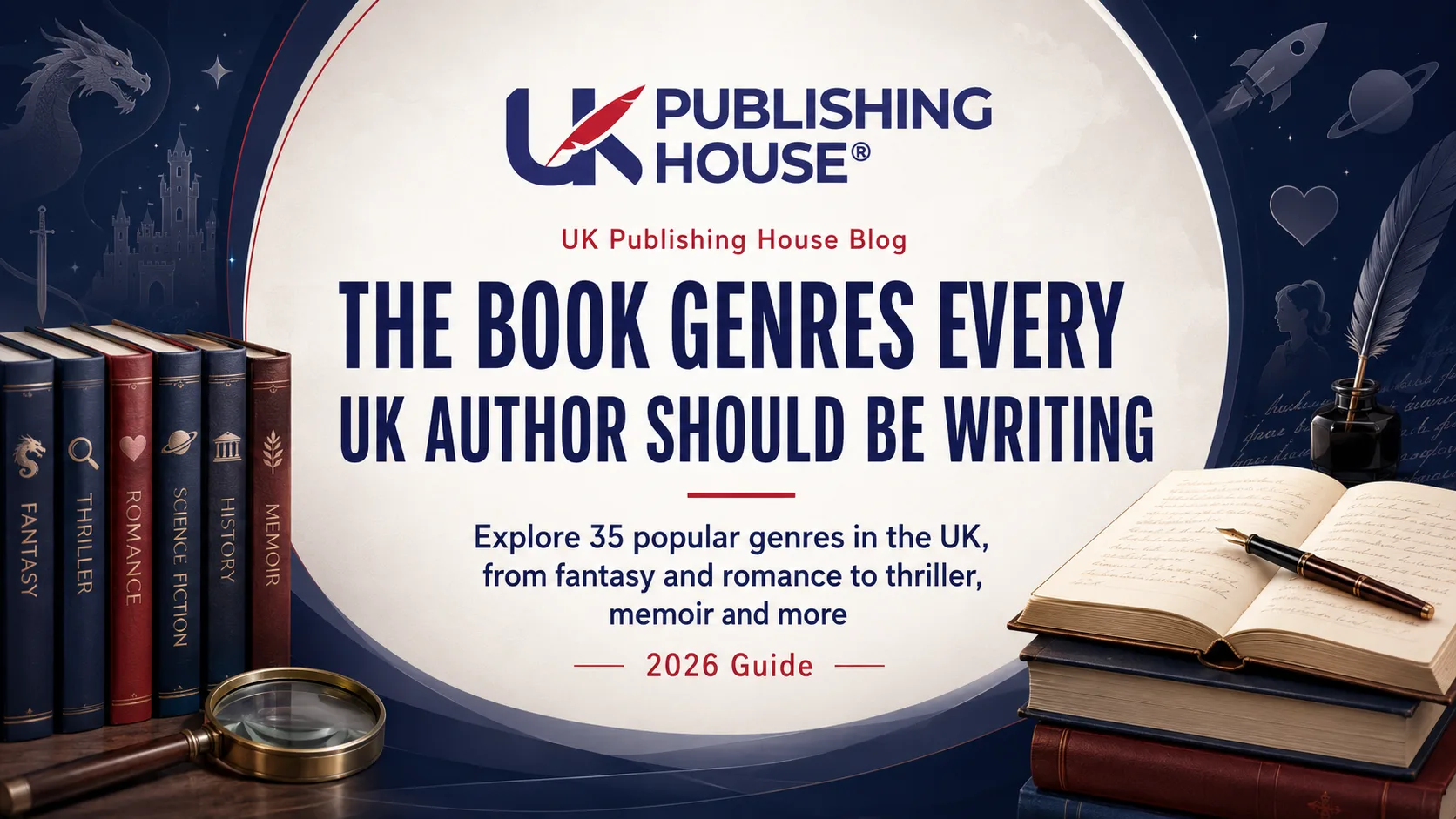
Here is the thing: genres are not just marketing labels stuck on a spine. They are roadmaps. They tell you what kind of emotional journey you are signing up for, long before you read the blurb. By the end of this guide, you will understand all 35 popular book genres in the UK, know exactly which ones match your mood, and, if you are a writer, how to position your manuscript for today's market.
Unlike static genre lists untouched since 2019, this 2026 edition reflects what is actually happening in UK publishing right now, including the rise of hybrid genres like romantasy, the horror resurgence, and where agents are currently looking. Let's turn genre confusion into your reading superpower.
What Is a Book Genre and Why Does It Matter?
A book genre is simply a category of literature grouped by similarities in style, form, tone, or subject matter. That is the textbook definition. In practice, genre does two very different jobs depending on which side of the book you are on.
For readers, genre sets expectations: pace, emotional payoff, and the tropes you are likely to encounter, so you can find books you will actually love rather than gambling on a cover.
For writers, genre helps you find your audience. It tells you which agents to query and which shelves your book will sit on. Get the genre wrong on submission, and even a brilliant manuscript can struggle to find a home.
Genres also shift. What counted as simply "popular fiction" fifty years ago has splintered into dozens of tightly defined subgenres, hence the rise of blended categories like romantasy and horromance, which we will get to later.
The 35 genres in this guide are grounded in internationally recognised categories, alongside industry sales data and reader surveys. If you are curious how a book's structure ties into all this, our guide on the different parts of a book is worth a look before you dive in.
Fiction Genres Explained
Let's start where most readers spend their time: fiction. Twenty genres, each with its own promise to the reader.
Fantasy
Fantasy drops you into imaginary worlds built from scratch, complete with magic systems, mythical creatures, and stakes that usually decide the fate of a kingdom, or several. World-building is everything here; the best fantasy authors make invented worlds feel more real than the six o'clock news.
Look out for epic fantasy (sprawling, multi-book sagas like Brandon Sanderson's The Way of Kings), urban fantasy (magic hidden inside a modern city, as in Neil Gaiman's Neverwhere), and the increasingly popular cozy fantasy (low-stakes, comforting magic, think Travis Baldree's Legends & Lattes).
Start with Patrick Rothfuss's The Name of the Wind or Sarah J. Maas's A Court of Thorns and Roses. If dragons and other mythical beasts are your thing, our piece on mythical creatures in the UK is a fun rabbit hole.
Science Fiction
Science fiction explores the "what if": what if we colonised Mars, what if AI outgrew us, what if society collapsed and rebuilt itself differently. Expect speculative technology, alien encounters and futures that feel scientifically plausible even when they are not.
Subgenres include hard SF (rigorous, technically grounded stories such as Andy Weir's The Martian), space opera (character-driven adventures across the stars, like James S. A. Corey's Leviathan Wakes), and cyberpunk (high-tech, low-life futures, as in William Gibson's Neuromancer).
Do not let the science put you off. Many of the best sci-fi novels, Frank Herbert's Dune and Andy Weir's Project Hail Mary among them, are really about people first.
Romance
Romance centres on a love story with one non-negotiable rule: the ending has to be happy, or at least hopeful (publishers call this HEA or HFN). It is the biggest-selling fiction genre by a wide margin, and dismissing it as fluff says more about the critic than the books.
Try contemporary romance (Emily Henry's Beach Read), historical romance (Tessa Dare's The Duchess Deal), or romantic suspense, which folds in a thriller plot (Nora Roberts's The Witness).
Sceptical? Start with Sally Thorne's The Hating Game or Casey McQuiston's Red, White & Royal Blue. The emotional depth might surprise you.
Mystery
Mystery is built around a puzzle, usually a crime, that the reader solves alongside, or just behind, the detective. Clues are planted, red herrings scattered, and the resolution has to feel earned, not lucky.
Subgenres range from the cosy mystery (amateur sleuth, small town, minimal violence, as in Richard Osman's The Thursday Murder Club) to the police procedural (Michael Connelly's The Black Echo) and historical mystery (Caleb Carr's The Alienist).
If you like a classic whodunit, start with Agatha Christie. If you prefer character over puzzle, Tana French is your author.
Thriller
Thriller exists to make your pulse climb. Expect tension, danger, a ticking clock, and a villain who needs stopping before the last page.
Look for psychological thrillers with unreliable narrators (Alex Michaelides's The Silent Patient), legal thrillers set in the courtroom (John Grisham's The Firm), and action thrillers with global stakes (Robert Ludlum's The Bourne Identity).
Dan Brown's The Da Vinci Code and Paula Hawkins's The Girl on the Train are solid entry points. Just do not start one right before bed.
Horror
Horror is designed to unsettle you, whether through supernatural dread or the darker corners of human nature. Atmosphere does most of the heavy lifting.
Subgenres include supernatural horror (Stephen King's The Shining), body horror (Nick Cutter's The Troop), and folk horror, steeped in rural, pagan or ancient evils, an area where a strong Gothic sensibility often shows up. If you fancy writing in that vein, our guide to outlining a Gothic novel is a good starting point.
Horror is in the middle of a genuine resurgence right now. New to the genre? Start with a short story collection like Joe Hill's 20th Century Ghosts to sample different flavours.
Historical Fiction
Historical fiction blends invented characters and events with real periods and settings, and it lives or dies on research. The best examples do not just describe the past; they make you feel embedded in it.
Subgenres overlap heavily with others: historical romance, historical mystery, and alternate history, which imagines a different outcome for real events (Philip K. Dick's The Man in the High Castle).
Markus Zusak's The Book Thief and Anthony Doerr's All the Light We Cannot See are two of the genre's most-loved modern examples. Look for a historical note at the back of the book; it usually signals an author who has done their homework.
Literary Fiction
Literary fiction prioritises voice, theme and psychological depth over plot mechanics. It is often labelled "serious" literature, though that label puts off more readers than it should.
Try contemporary literary fiction (Sally Rooney's Normal People), fiction that applies a literary sensibility to the past (Kazuo Ishiguro's The Remains of the Day), or experimental fiction with an unconventional structure (Mark Z. Danielewski's House of Leaves).
If you love plot and think literary fiction sounds slow, try Donna Tartt's The Secret History; it has the pull of a thriller with the prose of something far more considered. Sharpening how you describe characters helps here too; our piece on adjectives to describe a person is a handy reference for writers working in this space.
Contemporary Fiction
Contemporary fiction is set in the present day and focuses on realistic characters navigating everyday life, relationships, identity and current social questions.
Subgenres include upmarket fiction (accessible literary style with commercial appeal, like Maria Semple's Where'd You Go, Bernadette), women's fiction and new adult, both covered in more depth below.
Try Kiley Reid's Such a Fun Age or Matt Haig's The Midnight Library. It is a great palate cleanser between heavier reads.
Women's Fiction
Women's fiction centres women's experiences, relationships and personal growth, usually with real emotional depth and a hopeful tone by the end.
Subgenres include domestic drama, built around family secrets (Celeste Ng's Little Fires Everywhere), romantic women's fiction with a strong subplot rather than a sole focus (Taylor Jenkins Reid's The Seven Husbands of Evelyn Hugo), and issue-driven women's fiction (Kathryn Stockett's The Help).
Liane Moriarty's Big Little Lies and Gail Honeyman's Eleanor Oliphant Is Completely Fine show exactly why book clubs love this category. There is sharper social commentary here than the label suggests.
Young Adult (YA)
YA is written for and about teenagers, roughly ages twelve to eighteen, and centres coming-of-age themes, identity and first experiences. It is an age category, not a single genre, since it stretches across fantasy, contemporary and romance.
Try YA fantasy (Leigh Bardugo's Six of Crows), YA contemporary (Angie Thomas's The Hate U Give), or YA romance (Jenny Han's To All the Boys I've Loved Before).
Suzanne Collins's The Hunger Games and John Green's The Fault in Our Stars are crossover hits that plenty of adults read and love.
New Adult (NA)
New adult sits between YA and adult fiction, following protagonists in their late teens to mid-twenties through college, early careers, and first serious relationships, usually with more mature content than YA.
Look for NA romance (Elle Kennedy's The Deal), NA fantasy, which sometimes overlaps with adult fantasy shelving, and NA contemporary, a category Colleen Hoover has largely defined.
Hoover's It Ends With Us is the genre's most commercially dominant example right now. If you have aged out of YA but are not ready for heavier literary fiction, this is your sweet spot.
Children's
Children's books cover picture books, early readers, chapter books, and middle grade (roughly ages eight to twelve), each with age-appropriate themes around adventure, friendship, and learning.
Subgenres include middle grade fantasy (the Harry Potter series), middle grade contemporary, tackling real-life issues with warmth (R. J. Palacio's Wonder), and illustrated picture books (Drew Daywalt's The Day the Crayons Quit).
Rick Riordan's Percy Jackson series and E. B. White's Charlotte's Web remain benchmarks. Revisiting a childhood favourite as an adult is a genuinely underrated joy.
Graphic Novels & Manga
Graphic novels tell stories through sequential art, combining illustration and text. Manga specifically refers to Japanese comics, usually serialised and read right to left.
Subgenres span superhero stories (Alan Moore's Watchmen), memoir in graphic form (Marjane Satrapi's Persepolis), and manga itself (Tsugumi Ohba's Death Note). If you want a proper primer, we have a dedicated guide to what a graphic novel actually is.
Art Spiegelman's Maus and Brian K. Vaughan's Saga are excellent starting points, especially if you think you "don't like comics." Printing choices matter here too; if producing your own illustrated work, it is worth understanding greyscale, monochrome and black and white printing before going to press.
Short Story Collections
A short story collection gathers standalone stories, often linked by theme, setting or character, into a single book.
Look for linked collections where the stories connect (Elizabeth Strout's Olive Kitteridge), themed anthologies featuring multiple authors (The Best American Short Stories series), and flash fiction, typically under 1,000 words per piece.
Jhumpa Lahiri's Interpreter of Maladies and George Saunders's Tenth of December are ideal for readers short on time; you can finish a whole story in one sitting.
Poetry
Poetry uses the rhythmic and aesthetic qualities of language, meter, imagery, and condensed phrasing to evoke meaning and feeling, often in verse.
Subgenres include lyric poetry, focused on personal emotion (Rupi Kaur's Milk and Honey), narrative poetry, which tells a story (Homer's The Odyssey), and spoken word, written for performance (Sarah Kay). A well-placed simile does a lot of the work in this genre; if that craft term is new to you, our explainer on similes is worth five minutes.
Kaur's The Sun and Her Flowers and Mary Oliver's Devotions are accessible starting points if poetry has ever felt intimidating.
Drama / Plays
Drama is written to be performed, built from dialogue and stage directions rather than prose description.
Subgenres include tragedy, tracking a protagonist's downfall (Hamlet), comedy, usually ending happily (The Importance of Being Earnest), and modern drama, tackling realistic contemporary issues (A Raisin in the Sun).
Arthur Miller's Death of a Salesman and August Wilson's Fences reward reading aloud, or listening to a recorded performance, so you can catch the rhythm that text alone can hide.
Magical Realism
Magical realism sets magic inside an otherwise realistic world and treats it as completely normal, with no explanation offered or needed.
Try Latin American magical realism (Gabriel García Márquez's One Hundred Years of Solitude), contemporary takes on the form (Erin Morgenstern's The Night Circus), and fabulism, which leans mythic and fable-like (Neil Gaiman's The Ocean at the End of the Lane).
If you love fantasy but want something more grounded, this is your bridge. Laura Esquivel's Like Water for Chocolate and Haruki Murakami's Kafka on the Shore are both excellent starting points.
Dystopian
Dystopian fiction imagines an oppressive or frightening society and usually follows a protagonist who starts to question the system from the inside.
Subgenres include YA dystopian (The Hunger Games), foundational classic dystopian works (George Orwell's 1984), and eco-dystopian fiction focused on environmental collapse (Paolo Bacigalupi's The Water Knife).
Margaret Atwood's The Handmaid's Tale and Aldous Huxley's Brave New World remain the genre's cornerstones. These books often mirror current anxieties, which makes them either cathartic or a little too close to home- choose your moment.
Adventure
Adventure follows a hero through dangerous, fast-paced journeys or quests, usually with exotic settings and a clear physical challenge to overcome.
Subgenres include action-adventure (David Grann's The Lost City of Z, technically non-fiction but reads like adventure fiction), survival adventure, pitting a person against nature (Michael Punke's The Revenant), and sea adventure (Patrick O'Brian's Master and Commander).
Yann Martel's Life of Pi and Jack London's The Call of the Wild are pure escapism, ideal if you need a break from heavier literary fiction.
Nonfiction Genres Explained
Nonfiction covers just as much ground as fiction, and it is where a lot of readers discover they actually enjoy "boring" subjects once the right author gets hold of them.
Memoir & Autobiography
A memoir covers a specific period or theme in the author's life; an autobiography covers the whole thing, cradle to near enough present day. Both rely on first-person honesty and reflection.
Subgenres include celebrity memoir (Michelle Obama's Becoming), trauma memoir, focused on overcoming adversity (Tara Westover's Educated), and humorous memoir (Tina Fey's Bossypants).
Jeannette Walls's The Glass Castle and Paul Kalanithi's When Breath Becomes Air read like novels. Many memoirs are also ghostwritten or shaped by a collaborator behind the scenes; our piece on what a ghostwriter does explains the process.
Biography
A biography is a detailed account of someone's life, written by someone else, built on research, interviews and primary sources rather than personal memory.
Look for historical biography (Ron Chernow's Alexander Hamilton), celebrity biography (Walter Isaacson's Steve Jobs), and group biography, weaving several lives together (Rebecca Skloot's The Immortal Life of Henrietta Lacks).
Biographies can be intimidating doorstops. If that puts you off, try a shorter, tightly focused one, or a biographical novel like The Paris Wife instead.
Self-Help & Personal Development
Self-help books offer practical strategies for improving some part of your life, from productivity to mental health to relationships, usually grounded in psychology or personal experience.
Subgenres include productivity and habits (James Clear's Atomic Habits), mindfulness and happiness (Eckhart Tolle's The Power of Now), and relationships and communication (Gary Chapman's The 5 Love Languages).
The best examples in this genre read like a conversation with a smart friend rather than a lecture. Look for concrete exercises, not just platitudes; Brené Brown's Daring Greatly is a good benchmark.
Business & Economics
This genre covers business strategy, economic theory, entrepreneurship, and leadership, usually backed by data and real case studies.
Try entrepreneurship (Eric Ries's The Lean Startup), leadership and management (Jim Collins's Good to Great), or behavioural economics (Daniel Kahneman's Thinking, Fast and Slow).
You do not need an MBA to enjoy these. Malcolm Gladwell's Outliers and Phil Knight's Shoe Dog are both narrative-driven and genuinely gripping.
History
History books examine past events, societies, and figures through research and analysis, and the best ones read nothing like a textbook.
Subgenres include military history (Barbara Tuchman's The Guns of August), social history, focused on everyday life (Isabel Wilkerson's The Warmth of Other Suns), and microhistory, which zooms in on one small event or object (Mark Kurlansky's Salt: A World History).
Yuval Noah Harari's Sapiens and Erik Larson's The Devil in the White City are excellent proof that narrative history can be every bit as gripping as fiction.
Science & Nature
Science and nature writing explains scientific concepts, discoveries, and the natural world for a general audience, no lab coat required.
Try popular science (Stephen Hawking's A Brief History of Time), nature writing (Robin Wall Kimmerer's Braiding Sweetgrass), and environmental science (Elizabeth Kolbert's The Sixth Extinction).
Carl Sagan's Cosmos is a classic starting point. The best books in this genre are really about the people and stories behind the discoveries, not the equations.
Travel
Travel writing describes journeys, places, and cultures, usually blending personal narrative with sharp observation.
Subgenres include travel memoir (Bill Bryson's A Walk in the Woods), adventure travel, covering extreme expeditions (Jon Krakauer's Into Thin Air), and culinary travel (Michael W. Twitty's The Cooking Gene).
Bruce Chatwin's In Patagonia and Elizabeth Gilbert's Eat, Pray, Love are both proof that armchair travel is a genuine pleasure in its own right.
True Crime
True crime examines real crimes, criminals, and the justice system, usually written with the pacing and suspense of a thriller.
Try investigative journalism (Michelle McNamara's I'll Be Gone in the Dark), historical true crime (The Devil in the White City again), and memoir true crime, where the author has a personal connection to the case (Alexandria Marzano-Lesnevich's The Fact of a Body).
Truman Capote's In Cold Blood and Ann Rule's The Stranger Beside Me remain genre-defining. The best true crime is not about the gore; it is about why crimes happen and what they cost the people left behind.
Cookbooks & Food Writing
This category covers straightforward recipe books as well as writing that explores food culture, history, and personal memory.
Subgenres include recipe-focused cookbooks (The Joy of Cooking), food memoir, pairing personal stories with recipes (Anthony Bourdain's Kitchen Confidential), and food science, explaining the "why" behind cooking techniques (Samin Nosrat's Salt, Fat, Acid, Heat).
Julia Child's Mastering the Art of French Cooking and Michelle Zauner's Crying in H Mart show just how much story a cookbook can carry.
Essays & Criticism
Essay collections gather short nonfiction pieces, personal reflection, cultural analysis or both, unified mainly by a strong authorial voice.
Try personal essays (Leslie Jamison's The Empathy Exams), cultural criticism (Jia Tolentino's Trick Mirror), and nature essays (Annie Dillard's Pilgrim at Tinker Creek).
Joan Didion's Slouching Towards Bethlehem and Roxane Gay's Bad Feminist are perfect for dipping in and out of. Find a voice you love, and you will follow it anywhere.
Religion & Spirituality
This genre explores religious belief, practice, history or personal spiritual experience, and can be either scholarly or deeply personal.
Look for comparative religion (Huston Smith's The World's Religions), spiritual memoir (Thomas Merton's The Seven Storey Mountain), and mindfulness and meditation (Jon Kabat-Zinn's Wherever You Go, There You Are).
Reza Aslan's Zealot is a good entry point even for sceptical or secular readers; the best books here offer insight into how other people find meaning, whatever your own beliefs.
Health & Wellness
Health and wellness books cover physical and mental health, fitness, nutrition and general wellbeing, ideally backed by real evidence.
Subgenres include nutrition and diet (Michael Pollan's In Defense of Food), mental health (Bessel van der Kolk's The Body Keeps the Score), and fitness and exercise (Christopher McDougall's Born to Run).
Matthew Walker's Why We Sleep is essential reading. Stick to authors with real qualifications, MDs and PhDs, and check the publication date; health advice moves fast.
Parenting & Family
Parenting books offer guidance on raising children, family dynamics and pregnancy, usually grounded in developmental psychology.
Try pregnancy and baby guides (What to Expect When You're Expecting), toddler and child development (Daniel J. Siegel's The Whole-Brain Child), and books aimed specifically at raising teenagers (Lisa Damour's Untangled).
Adele Faber's How to Talk So Kids Will Listen & Listen So Kids Will Talk is a longstanding favourite. The best parenting books offer frameworks, not rigid rules; take what works and leave the rest.
Humour
Humour writing exists to entertain, usually through essays, memoir, or satire, built on wit and sharp observation.
Subgenres include humorous essays (David Sedaris's Me Talk Pretty One Day), satire, and comedic memoir (Amy Poehler's Yes Please).
Trevor Noah's Born a Crime and Mindy Kaling's Is Everyone Hanging Out Without Me? are great choices if you are in a reading slump; a funny book can genuinely reignite your interest in reading.
Art & Photography
Art and photography books showcase visual work or discuss art history and criticism, often in a large, image-heavy format.
Try art history (E. H. Gombrich's The Story of Art), photography monographs (Annie Leibovitz: A Photographer's Life), and instructional how-to art books (Betty Edwards's Drawing on the Right Side of the Brain).
John Berger's Ways of Seeing and Brandon Stanton's Humans of New York are visual feasts even if you never read them cover to cover. If putting together your own illustrated book, good design makes or breaks this genre; our book design team can help.
2026 Genre Trends and Market Insights
Genre popularity is not static, and 2026 has its own shape. UK print sales data has consistently shown romance sitting at or near the top of the fiction charts for several years running. Colleen Hoover's continued dominance, alongside a wave of newer voices, is a big part of that, and romantasy has become one of the fastest-growing hybrid categories in UK bookshops.
Fantasy remains a powerhouse, particularly in YA and adult, with literary agents reporting high interest across the board. Cozy fantasy, low-stakes and comforting, has emerged as a genuine breakout subgenre rather than a niche curiosity.
Horror is having a proper moment too, with more agent interest and more breakout hits than the genre has seen in years; it is currently one of the strongest genres for debut writers to break into.
Manga and graphic novels are surging as readers, particularly younger ones, look for screen-free entertainment and cross-media tie-ins with film and TV. On the nonfiction side, practical categories, cookbooks, self-help, DIY- are climbing as readers look for tangible skills.
Some categories are increasingly crowded, though: children's picture books and certain YA subgenres are highly competitive, and agents are being noticeably selective. If you are querying, the right tools show which agents are actively requesting your genre.
Genre Blending: The Rise of Hybrid Genres
Genre blending happens when a book deliberately combines elements from two or more distinct genres to create something that does not fit neatly on one shelf. Readers, driven partly by online reading communities, increasingly want fresh takes rather than a straightforward, single-genre read.
The most talked-about hybrids right now:
● Romantasy (romance + fantasy): a fully realised fantasy world with a central love story carrying real weight. Rebecca Yarros's Fourth Wing and the A Court of Thorns and Roses series are the genre's current flag-bearers.
● Horromance (horror + romance): dark, unsettling, but with a romantic core running through it. Isabel Cañas's The Hacienda is a strong example.
● Cozy fantasy: low-stakes, warm and comforting magic, as in Legends & Lattes.
● Literary thriller: thriller pacing wrapped in literary prose, Donna Tartt's The Secret History and, often cited if debated, Gillian Flynn's Gone Girl.
● Science fantasy: science fiction with magic or mythical elements woven in, as in Tamsyn Muir's The Locked Tomb series.
● Historical fantasy: magic layered onto a real historical setting, Susanna Clarke's Jonathan Strange & Mr Norrell being the definitive example.
The easiest way to spot a hybrid is to check how it is shelved. If a book sits under three or four different genre tags, it is almost certainly a blend.
For writers, blending genres is not something to shy away from, but you do need to understand the core expectations of each genre you are borrowing from. When querying, pitching your book as "X meets Y" (think "The Night Circus meets Jane Eyre") gives agents an instant, accurate sense of what they are looking at.
How to Choose Your Next Genre: A Reader's Guide
If you tend to stick to one genre or freeze in front of the shelf entirely, here is a practical way through it.
Step 1: Identify your reading mood. Do you want to escape, learn something, feel every emotion, or be genuinely thrilled? "I want to be scared" points to horror or thriller. "I want to believe in magic" points to fantasy.
Step 2: Map your favourite tropes. Love enemies-to-lovers? You will probably enjoy romance. Love found family? Try fantasy or science fiction. Keep a simple reading journal, and patterns will show up fast.
Step 3: Use a "gateway book" strategy. Pick something that blends your comfort genre with something new. If you love historical fiction, try The Night Circus (historical fantasy). If you love romance, start with The Hating Game, then branch into romantic suspense.
Step 4: Lean on recommendation tools. The "Readers Also Enjoyed" feature is genuinely useful for finding genre blends near a book you already loved. Mood and pace tags help you match a book to your exact reading vibe. A "Genre Kryptonite" newsletter is worth subscribing to for curated deep dives into specific genres.
Step 5: Set a genre challenge. Commit to reading one book from an unfamiliar genre each month, and lean on communities for recommendations along the way.
A quick shortcut: do you prefer real-world settings or imaginary ones? If real-world, fast pace or character depth? Fast pace usually means thriller or mystery; character depth usually means literary or contemporary fiction.
And do not be afraid to DNF (did not finish) a book that is not working. Use the sample feature on your e-reader to test-drive a genre before committing properly.
Genre-Specific Writing Tips for Authors
If you are writing rather than just reading, genre awareness matters even more: it shapes how agents evaluate your submission and how readers judge whether you delivered on your promise.
General advice that applies everywhere:
● Read widely in your genre. Know the top ten bestsellers from the last two years.
● Research agents who represent your genre, and check UK-based agent directories for current listings.
● Join a genre-specific writing community for craft support and market intelligence.
A few genre-specific pointers:
Fantasy: World-building matters enormously, but resist the urge to info-dump. Weave detail in through character experience, and avoid opening with a prologue that reads like a history lecture.
Romance: The central relationship has to be the focus of every scene. Study the genre's structural beats, meet-cute, conflict, grand gesture, and give your leads believable chemistry from page one.
Mystery/Thriller: Plant clues fairly. The solution should feel inevitable once revealed, never a twist from nowhere. Outline carefully to manage red herrings, and keep chapters short and cliffhanger-driven.
Horror: Build atmosphere slowly. What you do not show is often scarier than what you do. Understand the difference between terror (anticipation) and horror (revulsion).
Literary Fiction: Voice and interiority carry more weight than plot mechanics, but you still need a compelling character arc. Reading current literary journals keeps you close to what the market wants.
Young Adult: An authentic teen voice is non-negotiable, avoid anything that reads like an adult performing "teen." Identity, belonging and firsts remain evergreen themes.
Point of view choice matters just as much as genre convention. If you are working in close third person, our guide to writing in third person limited walks through exactly how to keep that perspective consistent.
When you are ready to query or move toward publication:
Track agent response times and genre preferences, and look into professional editors who specialise in your genre for a manuscript critique before you submit. Genre-specific writing courses can also help if you want structured feedback.
A tight synopsis matters just as much as your opening pages; if that is the part you keep putting off, our guide to writing a synopsis breaks it down step by step. When mentioning comparable titles in a query letter, choose ones published in the last two to three years that did well but are not mega-blockbusters, it signals you understand the current market.
Agents in 2026 are broadly looking for fantasy with genuinely original magic systems, horror with real social commentary underneath the scares, and romantasy with strong, coherent world-building.
Once your manuscript is in shape, our professional editing team can give it a proper pass, and if you would rather hand the writing over entirely, our ghostwriting and dedicated fiction ghostwriting services cover both non-fiction and novel-length projects.
From Genre to Published Book: What Comes Next
Once you know your genre and have a finished manuscript, the process from there looks fairly similar regardless of what you have written. A publisher, or a hybrid publishing partner, will typically take you through formatting, so your book is properly laid out for print and ebook, before moving into cover design, printing, and distribution.
If you are self-publishing, it is worth understanding each stage separately: proper formatting so your manuscript looks like a finished book rather than a Word document, quality printing if you want physical copies that do justice to your genre (illustrated genres are particularly printing-sensitive), and a coherent marketing plan so readers can actually find your book.
A simple author website gives readers and agents somewhere to find you beyond a single book listing, and a short book video trailer has become genuinely effective at bringing visual, high-concept genres like fantasy, horror, and romantasy to life on social media.
If any part of that process feels like a lot to figure out alone, from publishing itself through to formatting, book printing, marketing, building an author website, or producing a book video trailer, UK Publishing House handles each stage individually or as a complete package.
Genre Comparison Table
Genre | Typical Pacing | Emotional Tone | Common Tropes | Target Audience | Example Book |
Fantasy | Varies, often epic and sprawling | Wonder, adventure, high stakes | Chosen one, magical quests, mythical creatures | Teens to adults who love world-building | The Name of the Wind by Patrick Rothfuss |
Science Fiction | Fast (space opera) or slow (hard SF) | Intellectual curiosity, awe, sometimes dystopian | Space travel, AI, alien encounters | Readers who enjoy "what if" scenarios | Dune by Frank Herbert |
Romance | Steady, focused on relationship development | Emotional, hopeful, swoony | Enemies-to-lovers, fake dating, second chance | Broad, historically women-led | The Hating Game by Sally Thorne |
Mystery | Moderate, with clues and reveals | Curious, suspenseful, satisfying | Red herrings, detective with a past | Puzzle-lovers, all ages | The Thursday Murder Club by Richard Osman |
Thriller | Fast, page-turning | Tense, anxious, exciting | Race against time, unreliable narrator | Adrenaline seekers | Gone Girl by Gillian Flynn |
Horror | Slow build, then intense | Fear, dread, unease | Haunted house, monster, final girl | Fans of the macabre | The Shining by Stephen King |
Historical Fiction | Often leisurely, immersive | Reflective, educational, poignant | Real historical events, period detail | History buffs, book clubs | All the Light We Cannot See by Anthony Doerr |
Literary Fiction | Variable, often slower, character-driven | Thought-provoking, melancholic | Unreliable narrator, coming-of-age | Readers seeking depth and prose | Normal People by Sally Rooney |
Young Adult | Fast, engaging | Intense, emotional, hopeful | First love, rebellion, identity quest | Teens and adults who enjoy coming-of-age | The Hunger Games by Suzanne Collins |
Pacing and tone here are generalisations; plenty of books in each genre break the pattern deliberately, so treat this as a starting compass rather than a strict rulebook.
Final Thoughts
Genres are tools, not rules. They help you find books you will love, and they help writers reach the readers already looking for exactly what they have written. The 2026 landscape is more diverse and blended than ever, so treat that fluidity as an invitation rather than a complication.
If you have been stuck in the same genre for a while, challenge yourself to try one new one this month. Use the mood-mapping and gateway-book strategies above to make the jump easy, and if you are a writer working out where your manuscript fits, come back to the comparison table and FAQ whenever you need a reset.
What is your favourite genre, and which one are you planning to try next?