You've heard the term "graphic novel." Maybe you've seen the covers of Maus or Persepolis on a friend's shelf, or spotted a display table of them at Waterstones. But you're not quite sure what makes a graphic novel different from the comic books you grew up with, or where you'd even start. The terminology feels slippery, the number of titles is overwhelming, and you half-wonder if these illustrated books count as "serious" reading at all.
That confusion keeps a lot of curious readers on the sidelines. Without a clear starting point, it's easy to grab a random volume from a decades-long superhero series, feel completely lost, and conclude the whole medium is just capes and fight scenes. Which is a shame, because you'd be missing some of the most powerful storytelling being published today.
This guide is your no-jargon introduction. By the end, you'll know exactly what a graphic novel is, how it differs from a comic book, how to read its visual language properly, and, most usefully, which book to pick up first based on your own taste. We'll walk through the history, the genres, the reading techniques, and the best places to find your next read, so you can walk into any library or bookshop with confidence.
What Is a Graphic Novel? A Clear Definition
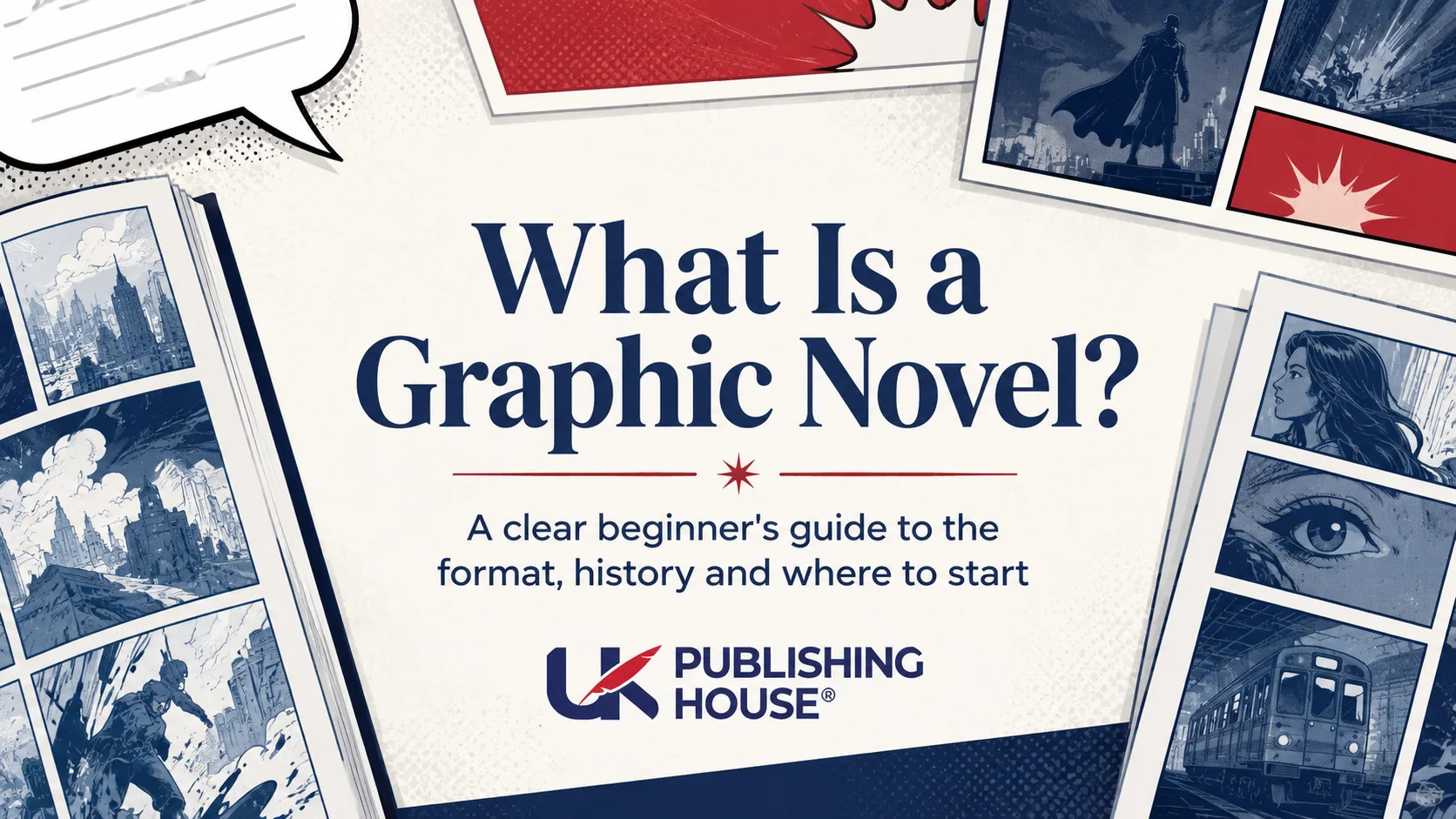
A graphic novel is a book-length work of fiction or nonfiction that tells a story through sequential art: a combination of images and text, usually bound as a single complete volume with its own beginning, middle and end. Unlike a stack of previously published comic issues, a graphic novel is often conceived and published as one standalone work, sometimes called an "original graphic novel."
The term was popularised in the late 1970s to distinguish longer, more literary works from periodical comic books. Today it's used more loosely to describe almost any book-format comic, including collected editions of stories that were originally serialised. According to Britannica, the phrase is closely associated with Will Eisner's A Contract with God (1978), a collection of four interlinked stories that put "graphic novel" on its cover to signal literary ambition.
A few things define the format beyond the label:
Length and completeness. Most graphic novels run 60 pages or more, and you get a full story arc in one volume, not a cliffhanger chapter.
Visual-verbal synergy. The pictures aren't just illustrating the words. They carry real narrative weight, and you're interpreting both at once.
Bound book format. Graphic novels are published as paperbacks or hardcovers with proper ISBNs, and they're shelved in bookshops and libraries like any other book.
Subject matter that goes everywhere. Memoir, history, journalism, fantasy, science, biography. A graphic novel is a format, not a genre.
Expert tip: "Graphic novel" is as much a marketing term as a literary one. Some creators prefer "graphic narrative" or simply "comics." For a newcomer, though, "graphic novel" is still the most recognisable entry point, so it's the one worth learning first.
Graphic Novel vs Comic Book: What's the Real Difference?
This is the single biggest point of confusion for new readers, so let's settle it properly.
Comic books are typically periodical, staple-bound pamphlets of 20 to 30 pages, usually part of an ongoing series. A single issue is a chapter, not a complete story. Graphic novels, by contrast, are book-length, bound volumes containing a complete narrative, either an original work or a collected edition of a comic book storyline (often called a "trade paperback"). Trade paperbacks sit somewhere in between: they gather several issues of a series into one book, usually covering a single arc, and they're how most readers first stumble into graphic novels without realising it.
Comic Book | Graphic Novel | |
Format | Stapled pamphlet | Bound paperback or hardcover |
Length | 20–30 pages | 60+ pages |
Story | One chapter of an ongoing series | Complete, self-contained arc |
Shelf placement | Comic shop, single issues | Bookshop or library, book section |
Culturally, "comic book" still carries a whiff of disposable entertainment, while "graphic novel" has earned a kind of literary respectability, even though both are part of the same artistic medium. Plenty of acclaimed graphic novels, including Watchmen and Sandman, started life as monthly comics before being collected into the books people now recognise. When someone asks what the difference actually is, the simplest honest answer is: a graphic novel is a book, a comic book is a magazine. The real craft, though, is in how you read them, and that's identical for both.
It's worth clearing up a few myths while we're here. Graphic novels aren't just for kids; they cover war, trauma, sexuality and dense philosophy alongside lighter fare. They aren't all about superheroes either; capes are one genre among many, alongside memoir, historical fiction and nonfiction, all equally prominent on the shelves. And they're not lesser reading than prose. Literacy organisations, including the American Library Association, have pointed to graphic novels as effective tools for building vocabulary and critical thinking, sometimes more effectively than text alone, because readers have to actively decode two channels of information at once.
A Brief History of the Graphic Novel
The graphic novel didn't appear from nowhere. Early precursors include the woodcut novels of the early twentieth century, such as Lynd Ward's Gods' Man, which told wordless stories purely through sequential images. Newspaper strips like Winsor McCay's Little Nemo in Slumberland showed just how sophisticated a comics page layout could be, and European bande dessinée, Hergé's Tintin chief among them, established the hardcover "album" format that later shaped the graphic novel's physical look.
The modern graphic novel really arrives in the late 1970s and 1980s. Will Eisner's A Contract with God (1978) is often cited as the first modern graphic novel, using the term on its own cover to signal something more ambitious than a typical comic. Art Spiegelman's Maus, serialised through the 1980s and collected in 1991, went on to win a Pulitzer Prize and proved comics could carry the full weight of historical trauma. Around the same time, Frank Miller's The Dark Knight Returns and Alan Moore's Watchmen deconstructed the superhero genre entirely and pulled in mainstream adult readers who'd never picked up a comic before.
The 2000s brought a surge in young adult graphic novels, Raina Telgemeier's Smile among the most influential, alongside a growing wave of manga in Western markets. That growth hasn't slowed. According to Business Research Insights, the global graphic novel market was worth around $18.1 billion in 2026, with projections putting it near $45 billion by 2035. Manga is doing much of the heavy lifting: Circana reported a 45% jump in manga unit sales in the first quarter of 2026 alone, making it the single strongest category in the entire print book market. Original graphic novels now regularly land on bestseller lists, something that would have seemed unthinkable when Eisner first put the term on a cover.
Major Genres and Categories: Finding Your Niche
Here's the thing worth repeating: graphic novel is a format, not a genre. It spans everything prose fiction does, and then some.
Memoir and autobiography are often the most accessible entry point, because they're grounded in real life rather than an unfamiliar fictional universe. Marjane Satrapi's Persepolis, Alison Bechdel's Fun Home, and George Takei's They Called Us Enemy are landmark examples, each raw, personal and immediately gripping.
Superhero and fantasy is the most recognisable genre, but far from the only one, and modern entries often deconstruct the genre or tell fully standalone stories. Watchmen and Batman: Year One require zero prior continuity knowledge, while Ms. Marvel: No Normal offers a fresh, diverse take on the teen superhero trope. Fantasy series like Saga or Monstress build entire worlds without demanding decades of backstory, and if you're curious how graphic novel fantasy compares to its prose cousins, the same high fantasy vs low fantasy distinctions apply just as well to illustrated stories.
Historical and nonfiction graphic novels make history feel visceral in a way prose sometimes can't. Maus tackles the Holocaust, March walks through the Civil Rights Movement in Congressman John Lewis's own words, and The Best We Could Do follows a family's journey from wartime Vietnam to America.
Manga and other global traditions deserve real attention here, because most "what is a graphic novel" guides stop at Western titles. Manga, Japanese comics typically read right to left, spans every genre imaginable, from the action of One Piece to the romance of Fruits Basket to the horror of Uzumaki. Bande dessinée, the Franco-Belgian tradition behind Tintin and Asterix, remains foundational to European comics. And newer to English-language readers, Korean manhwa, Italian fumetti and Latin American historietas are all gaining international audiences worth exploring.
Young adult, middle grade and children's graphic novels are the fastest-growing segment in libraries and schools right now. Series like Dog Man, The Baby-Sitters Club adaptations, and New Kid dominate school reading lists, often tackling friendship, identity and grief in genuinely age-appropriate ways. They're also brilliant for hooking reluctant readers and building visual literacy early.
Expert tip: if you're an educator, try pairing a middle-grade graphic novel like El Deafo with a prose novel exploring a similar theme. Different formats engage different kinds of readers, and seeing the same idea handled two ways deepens the discussion.
How to Read a Graphic Novel: Visual Literacy Basics
This is the part most beginner guides skip entirely, and it's genuinely the heart of getting more out of the medium.
The building blocks: panels, gutters and layout. A panel is a single framed image, one moment frozen in time. The gutter is the space between panels, and it's where the real magic happens: your brain fills in whatever action happened between the two images, a process called "closure." Page layout controls pacing too. A full-page splash image creates a dramatic pause, while a tight grid of small panels speeds everything up.
Reading the images, not just the words. Character expression and body language often carry subtext the dialogue never states outright, so look at eyes and posture, not just speech bubbles. Colour palette sets mood: muted tones might signal a somber memory, while bright, saturated colour can indicate heightened reality. Background details matter too. A comic artist rarely draws something without a reason, so don't just scan the page, linger on it.
Expert tip: when you're reading closely, pay attention to panel transitions, a framework Scott McCloud lays out in Understanding Comics: moment-to-moment, action-to-action, subject-to-subject, scene-to-scene, aspect-to-aspect, and non-sequitur. Once you notice which transition an artist is using, you start seeing how they're controlling your sense of time.
Speech bubbles, captions and sound effects. The shape of a speech bubble carries tone: jagged edges often mean shouting or a radio transmission, while a cloud-like outline signals a thought rather than spoken dialogue. Captions, usually rectangular boxes, handle narration or scene-setting. Sound effects, words like "BANG" drawn directly into the art, blend text and image into a single visual moment.
You're an active participant. Unlike film, where a director controls pacing for you, a graphic novel hands you the clock. You can linger on a panel, flip back a page, or race ahead. The gutter is what makes you an active reader rather than a passive one: you're the one connecting the moments and building meaning, which is exactly what makes the medium feel so immersive once it clicks.
If you want to see all of this explained brilliantly and in the medium itself, Scott McCloud's Understanding Comics: The Invisible Art is a graphic novel about how comics work, and it remains the single best introduction to visual literacy going.
Notable Graphic Novels to Start With
A curated starting point beats a random pick every time. Here's a roadmap by taste.
For the memoir lover: Persepolis by Marjane Satrapi is a coming-of-age story set against the Iranian Revolution, told in stark black-and-white art. Fun Home by Alison Bechdel is denser and more rewarding, a tragicomic family memoir exploring sexuality and literature. They Called Us Enemy by George Takei is an accessible, powerful account of Japanese American internment, and a strong pick for classroom use.
For the fantasy and sci-fi fan: Start Saga by Brian K. Vaughan and Fiona Staples with Volume 1, a sprawling space opera about family and war with genuinely stunning art. Monstress by Marjorie Liu and Sana Takeda offers lush, dark world-building with a compelling lead. Paper Girls by Vaughan and Cliff Chiang mixes '80s nostalgia with a time-travel mystery, and it's complete across its collected editions.
For the history buff: Maus by Art Spiegelman is essential, if emotionally heavy, reading. March, the trilogy by John Lewis, Andrew Aydin and Nate Powell, is a firsthand account of the Civil Rights Movement. The Best We Could Do by Thi Bui follows one family's journey from war-torn Vietnam, exploring displacement and parenthood.
For the superhero-curious, no continuity required: Watchmen by Alan Moore and Dave Gibbons deconstructs the superhero myth entirely, dense and best suited to adult readers. Batman: Year One by Frank Miller and David Mazzucchelli is a gritty, grounded origin story needing zero prior Batman knowledge. Ms. Marvel: No Normal by G. Willow Wilson and Adrian Alphona offers a fresh, diverse take that works for YA and adult readers alike.
For kids and young adults: New Kid by Jerry Craft, a Newbery Medal winner, tackles race, class and fitting in at a new school. El Deafo by Cece Bell is a funny, heartfelt memoir about growing up deaf, told through anthropomorphic bunnies. This One Summer by Mariko and Jillian Tamaki is a poignant coming-of-age story about friendship and family secrets.
Expert tip: start with a standalone graphic novel rather than a long-running series, to avoid continuity confusion. Every title above is self-contained, so you can dive straight in without homework.
Glossary of Key Terms
Panel: a single framed image in a sequence.
Gutter: the space between panels, where your mind fills in the action.
Splash page: a full-page illustration, often used to open a scene or land a dramatic beat.
Spread: two facing pages designed to work as one visual unit.
Speech bubble: the graphic convention holding dialogue, its shape signalling tone.
Caption: a box, usually rectangular, providing narration or context.
Sound effect (onomatopoeia): words drawn into the art to represent sound, such as "BOOM."
Trade paperback (TPB): a softcover collection of several comic issues, usually one story arc.
Original graphic novel (OGN): a graphic novel published as a complete work, never serialised first.
Manga: Japanese comics, typically read right to left, spanning every genre.
Bande dessinée: Franco-Belgian comics, often published as large-format hardcover albums.
Sequential art: the term Will Eisner coined for storytelling told through a series of images.
The Graphic Novel Market and Cultural Impact
The graphic novel isn't a niche curiosity anymore, it's a genuine publishing force. According to Business Research Insights, the global market was worth roughly $18.1 billion in 2026 and is projected to grow at a compound annual rate of 7.2% through 2035. Manga is driving a huge share of that growth: Circana's 2026 book market data shows manga posting a 45% gain in unit sales in the first quarter alone, making it the strongest category across the entire print book market, ahead of every other genre tracked. Young adult and children's graphic novels continue to power library circulation and school adoption too, with titles like Dog Man and Heartstopper regularly topping charts. (Report figures on market size vary noticeably between research firms, so treat any specific dollar figure as directional rather than gospel, and check the original source for the latest number before quoting it elsewhere.)
The medium's reputation has shifted just as dramatically as its sales. Once quietly discouraged in classrooms, graphic novels are now actively embraced as tools for teaching visual literacy, critical thinking and empathy. The American Library Association publishes annual best-of lists specifically to help librarians build strong graphic novel collections, and research increasingly points to graphic novels supporting struggling readers, English language learners and students with dyslexia through contextual visual cues.
Literary awards back this up. Maus won a Pulitzer Prize, New Kid took the Newbery Medal, and This One Summer earned a Caldecott Honor, all firsts for the format. Universities now run dedicated comics studies courses, and academic journals such as Inks: The Journal of the Comics Studies Society publish peer-reviewed research on the medium. As comics scholar Scott McCloud puts it, comics is a medium, not a genre, and that distinction is finally sinking in across the literary world.
Resources to Deepen Your Graphic Novel Journey
If you want to go further, start with Understanding Comics: The Invisible Art by Scott McCloud, the definitive guide to how comics actually work, itself told as a graphic novel. For something more academic but still readable, The Graphic Novel: An Introduction by Jan Baetens and Hugo Frey covers the history, form and cultural significance in depth.
For finding and reading graphic novels, your local library is still the most accessible entry point, and most now carry extensive graphic novel sections for every age. Apps like Libby or Hoopla let you borrow digital copies for free using your library card. ComiXology offers a vast digital marketplace with guided-view technology built for reading comfortably on a tablet, which makes it a good way to sample before buying. Goodreads' Graphic Novels shelf is a solid community-driven discovery tool, searchable by genre or year, and No Flying No Tights specialises in reviews aimed at librarians and teens. For criticism and industry news, The Comics Journal is where readers go once they want to dig deeper into the art form itself.
Expert tip: join an online community like Reddit's r/graphicnovels for personalised recommendations. It's a genuinely welcoming space for newcomers who just want to ask "where do I start with X genre?"
So You Want to Create Your Own Graphic Novel?
Reading enough graphic novels has a funny way of making you want to write one. If that's where you've ended up, it helps to know that turning a script and some sketches into a finished, publishable book involves a fair few specialist skills, and you don't have to learn all of them yourself.
A strong story still needs sharp, objective feedback, which is what professional editing is for, tightening pacing, dialogue and structure before a single page goes near a printer. If the art and lettering aren't your strength, or you want a collaborator to help translate your vision onto the page, ghostwriting and dedicated fiction ghostwriting support can carry a story from concept to finished script. Once the content's locked, book design and formatting shape how panels, gutters and page layout actually read on the printed or digital page, the same visual literacy principles covered earlier in this guide, just applied from the creator's side rather than the reader's. It's also worth thinking through how to design a book cover early, since a graphic novel's cover art sets reader expectations before a single panel is opened.
From there, publishing support gets your finished graphic novel into print and onto the platforms readers actually use, while marketing and even a book video trailer help it find an audience once it's out in the world. UK Publishing House works across all of these stages, so whether you need one piece of the process or the whole pipeline, there's a place to start.