Ask ten people what a ghostwriter does and you'll get ten half-right answers. Most think it's just "writing someone else's book." Some think it's a bit sneaky. Almost nobody knows how the job actually works, or how to get into it.
Industry estimates put the global ghostwriting market well into the billions, and it's still growing. Yet the profession remains one of the least understood corners of publishing. If you've ever wondered whether your writing skills could turn into a proper, paying career, one where you never see your name on the cover but your bank account definitely notices the difference, this guide is for you.
We're going to walk through what ghostwriting actually involves, the different types of ghost writers working today, the skills you need, what you can realistically charge, and the ethical lines you don't cross. We'll also deal with the question everyone's asking: what happens to ghostwriting now that AI can write a passable paragraph in seconds.
By the end, you'll understand the meaning of ghostwriter well enough to explain it properly at a dinner party, and you'll have a workable roadmap if you want to do it yourself.
What Is a Ghostwriter? Core Role and Common Misconceptions
Defining Ghostwriting: More Than Just Writing Books
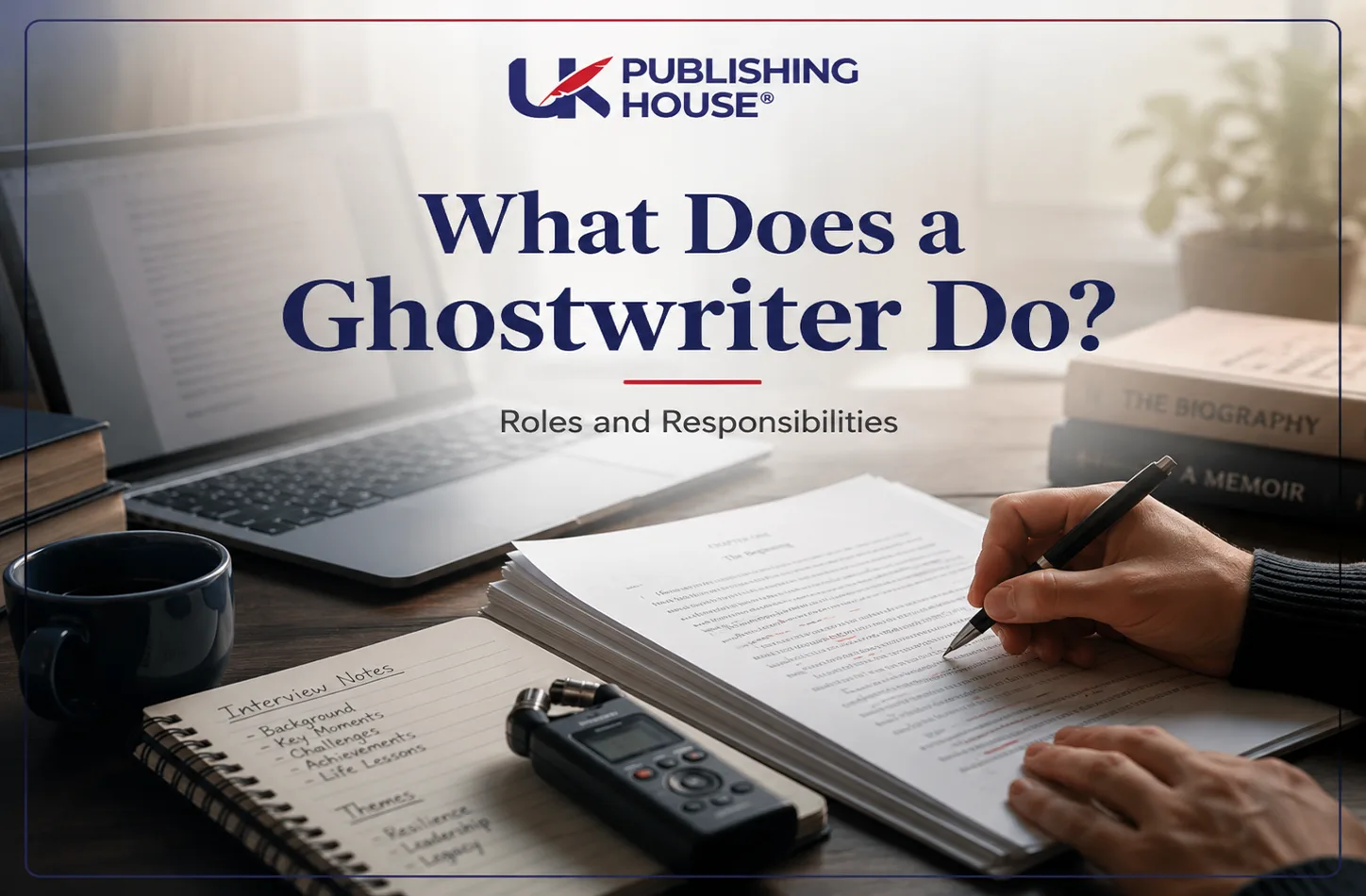
Here's the ghostwriter definition in plain terms: a ghostwriter is a professional writer who creates content that gets published under someone else's name. Books are the most visible example, but ghost writers also produce speeches, articles, social posts, business reports and more. The job isn't just typing what someone says. It's capturing a person's voice, their ideas and their expertise, then shaping all of it into something publishable, while staying invisible the whole time.
The best ghostwriters are part interviewer, part therapist, part detective. You're not simply writing. You're extracting the essence of a person and putting it on the page in a way that sounds unmistakably like them.
What Ghostwriting Is Not: Dispelling the Myths
A few myths need clearing up, because they put people off a genuinely good career.
Myth: Ghost writers just tidy up grammar. Reality: most of the work is structural. A ghostwriter often builds an entire book from a stack of interview transcripts and scattered notes. If you want to understand where the craft ends and basic correction begins, it's worth reading the difference between a ghostwriter and an editor, because the two roles get confused constantly.
Myth: It's dishonest. Reality: it's a transparent business arrangement. The client owns the finished work and pays for the labour that produced it, in much the same way a politician pays a speechwriter. Nobody's being deceived; everyone in the room knows the deal.
Myth: AI has already replaced ghostwriters. Reality: AI can help with research and first-draft scaffolding, but it can't replicate the trust, emotional read and voice capture that make ghostwriting work. More on that later.
Recent industry reporting suggests that a substantial share of published non-fiction involves some form of ghostwriting collaboration, which tells you how mainstream, and how legitimate, this work already is.
Types of Ghostwriting Services: A Comprehensive Overview
Ghostwriting covers far more ground than books. Knowing the landscape helps you pick a niche that suits your skills and your income goals.
Book Ghostwriting: Memoirs, Business Books and Fiction
Book ghostwriting is the niche most people picture. Projects range from celebrity memoirs and founder thought-leadership books through to genre fiction, and they typically run six to eighteen months, with multiple interviews and heavy research along the way.
If memoir work interests you, learn to ask questions that pull out sensory memory. "What did the room smell like that day?" gets you further than "what happened next?" ever will. For clients who want to turn their own life story into a book, our piece on how to write a book about your life is a useful companion read, and if fiction is more your territory, our fiction ghostwriting service works the same way: interview, structure, draft, refine.
Article and Blog Ghostwriting
Executives, founders and professionals hire ghost writers to keep a consistent presence online without doing the writing themselves. This niche demands quick voice-switching, one day you're a tech founder, the next a wellness coach, and it moves fast. Turnaround is short and the work is often ongoing rather than a single project. Google Docs earns its keep here, since it lets clients comment and approve in real time without an email chain.
Speechwriting and Executive Communications
Speechwriting rewards a good ear for spoken rhythm. You're writing for the mouth, not the eye, which is a different skill entirely from prose. Ghost writers in this space often work with politicians, chief executives and charity leaders, confidentiality is non-negotiable, and deadlines can be brutal.
Social Media and Short-Form Content Ghostwriting
A fast-growing niche where ghostwriters produce LinkedIn posts, threads and captions for busy professionals who know they need a presence but don't have the hours to build one. It rewards punchy, scroll-stopping writing and a decent grasp of how each platform actually behaves. Many writers in this space charge monthly retainers rather than per piece, which gives steadier income than one-off projects.
Business and Technical Ghostwriting
White papers, case studies, annual reports and industry analysis all sit here. This niche suits writers who can turn dense, technical material into something a busy reader can actually get through. Subject knowledge or strong research instincts matter more than flair.
Comparison Table: Ghostwriting Niches at a Glance
Niche | Typical Clients | Key Skills Required | Common Pricing Model | Typical Project Length |
Book Ghostwriting | Executives, thought leaders, aspiring authors, celebrities | Long-form structure, voice mimicry, interviewing, patience | Per project | 6–18 months |
Article & Blog Ghostwriting | Business owners, consultants, agencies | Voice adaptability, SEO basics, fast turnaround | Per word or per piece | 1 day–2 weeks per piece |
Speechwriting | Politicians, CEOs, charity leaders | Rhetorical technique, audience analysis, confidentiality | Per project | 1–4 weeks |
Social Media Ghostwriting | Executives, personal brands, influencers | Platform fluency, concise writing, trend awareness | Monthly retainer | Ongoing |
Business & Technical Ghostwriting | Corporations, consultants, subject experts | Research, data interpretation, formal clarity | Per project | 2–8 weeks |
Treat project length and pricing structure as a starting benchmark rather than gospel. Actual rates shift with experience, region and how in-demand a niche happens to be, so check what other ghostwriters in your niche are currently charging before you quote a client.
Essential Skills Every Ghostwriter Needs
Voice Mimicry: The Art of Sounding Like Someone Else
This is the ghostwriter's actual superpower. It goes well beyond vocabulary choice, you're absorbing someone's speech patterns, their humour, their worldview. Practise by transcribing interviews and rewriting passages in different "voices" until it stops feeling like an exercise.
Keep a "voice bible" for every client: a running document of their favourite phrases, pet peeves and storytelling quirks. Refer back to it constantly while you're drafting, especially on a project that stretches over months, because voices drift if you're not careful.
Interviewing and Active Listening
Your raw material comes from conversation. You need open-ended questions, an ear for the story underneath the story, and the instinct to know when to push for one more detail. The goal is to make the client feel properly heard while you quietly extract the gold. If you're stuck for a starting point on drawing out material, our guide on finding and capturing book ideas has useful prompts, even for non-fiction work.
Experienced agencies consistently say the same thing: the ability to listen properly and follow up with the right question is what separates a professional ghost writer from someone who just types fast.
Research and Fact-Checking
Even a knowledgeable client will misremember a date or round up a statistic. You need to verify claims, chase down sources, and protect both yourself and the client from an embarrassing correction down the line.
Adaptability and Genre Fluency
One month you're on a self-help book, the next you're deep in a technical white paper. You need to pick up new subjects fast and shift your tone to match the genre's own conventions, a memoir doesn't read like a business book, and it shouldn't.
Business and Client Management
Ghostwriting is a business, not a hobby with invoices. You'll negotiate contracts, hold boundaries, chase payments professionally and manage expectations that occasionally run ahead of the timeline. Diplomacy and patience matter here just as much as your prose. If a project also needs a proper polish once the draft is done, it's worth understanding what professional editing covers versus what you're already doing as the writer, so nobody pays twice for the same job.
How to Become a Ghostwriter: A Step-by-Step Career Roadmap
Here's a concrete path from "curious writer" to "working ghostwriter," even with zero prior experience.
Step 1: Assess Your Strengths and Choose a Niche
Look honestly at your writing background and interests. Are you drawn to long-form storytelling, punchy business content, or technical breakdowns? Use the comparison table above to match your instincts to a niche that fits your income goals as well as your taste.
Step 2: Build Core Ghostwriting Skills
Before you go anywhere near a paying client, put in deliberate practice:
Voice mimicry drills: rewrite a well-known speech in the style of a different public figure.
Interview practice: record mock interviews with friends and turn their stories into short narratives.
Study the craft: read on narrative structure and genre convention, and consider a course in ghostwriting or creative non-fiction.
Join writing communities, online or local, and offer to write sample pieces for feedback. It builds your portfolio and sharpens your instincts somewhere low-stakes.
Step 3: Create a Portfolio That Sells Your Ability
You can't always show ghostwritten work publicly, so get creative:
Before-and-after samples: with a client's permission, show a raw transcript next to the polished final piece. It demonstrates the transformation you actually deliver.
Spec work: write a sample chapter or article in your target niche to prove your voice-capture and general writing quality.
Testimonials: even a small project can produce a glowing quote that builds trust with the next client.
Most guides skip over this problem entirely, how do you prove your work when it's confidential by design? The before-and-after approach solves it without breaching anyone's trust.
Step 4: Set Your Rates and Build a Contract Template
Check current market rates (more on this below) and pick a pricing model: per word, per project, or retainer. Then draft a contract covering:
Scope of work and deliverables
Revision policy (two rounds is standard)
Payment schedule (fifty per cent upfront is common)
Confidentiality and copyright transfer terms
A kill fee, in case the project falls through
Step 5: Find Your First Ghostwriting Clients
Start with these channels:
Networking: industry events and writing associations put you in front of the right people.
Cold outreach: identify busy professionals, executives, consultants, founders, who need content but lack the time, and send a genuinely personalised pitch.
Content marketing: publish your own articles about ghostwriting on LinkedIn or Medium to draw in inbound enquiries.
Referrals: ask happy clients directly if they know anyone else who could use a ghostwriter, this is often the single best source of new work.
Your first client will probably come from a smaller, lower-key project. Treat it as training and a testimonial builder. Over-deliver, and that client refers you to the next, better one.
Step 6: Deliver Excellence and Manage the Relationship
Once you're hired, over-communicate, hit your deadlines, and stay genuinely open to feedback. A happy client is your best marketing channel, full stop. Once the manuscript's finished, it's worth knowing what comes next too; our overview of how to publish a book is a good one to point clients towards once your part of the job is done.
Ghostwriting Rates and Pricing Models in 2026
Knowing what to charge, and why, is the difference between a sustainable career and a burnt-out hobby.
Common Pricing Models
Per word: typical for articles and blog posts, and the model most clients in this niche expect to see quoted.
Per project: the standard for books, scaled to the length and complexity of the manuscript rather than a flat figure.
Hourly: less common, mostly used for consulting or heavy editing work.
Retainer: popular for ongoing social or blog work, which gives you income stability the per-project model doesn't.
Whichever model you use, treat it as a starting point and check current listings on Reedsy or similar platforms before you quote. For context on what published authors themselves typically earn, our piece on how much authors make is a useful comparison, ghostwriting income and author royalty income are two very different conversations.
Factors That Influence Your Rate
Experience and portfolio strength: a proven track record earns higher fees, no way around it.
Niche expertise: specialising in a high-demand area, medical or technical writing, for example, tends to push rates up.
Client type: corporate clients generally have bigger budgets than individual authors.
Project scope: a lighter, shorter manuscript costs far less than a longer one built on extensive interviews and fact-checking.
Set a personal floor rate and stick to it. Charging too little undervalues the profession and makes it painfully hard to raise rates later. If a client can't meet your floor, walk away, there's always another client.
How to Negotiate and Raise Your Rates
Start at a rate you're genuinely comfortable with, then push it up gradually with each new client. Add a surcharge when a project demands extra research or a tight deadline. And check industry benchmarks regularly, so you're never quietly leaving money on the table out of habit.
Ethical and Legal Considerations in Ghostwriting
Ghostwriting sits in a grey area for a lot of outsiders. Addressing the ethics directly, rather than dodging the question, is what makes you look like a professional rather than a chancer.
Confidentiality and Non-Disclosure Agreements
Most ghostwriting relationships open with an NDA. You'll be trusted with personal stories, business strategy and unpublished ideas, treat all of it as sacred. A breach can end your career overnight, and word travels fast in small industries.
Even once a project's finished, never confirm you ghostwrote a specific piece of work unless the client explicitly says you can. Discretion is your entire brand here.
Copyright and Ownership
In a standard ghostwriting agreement, the client owns copyright once they've paid in full. Spell this out clearly in your contract, because without a clean clause, ownership disputes get messy fast. Most professional bodies recommend a written agreement transferring all rights to the client on final payment, while allowing the ghostwriter to keep anonymised samples for their own portfolio.
Plagiarism and Originality
Every piece of content needs to be original or properly sourced. Plagiarism, whether it's lifted from someone else's work or from an AI tool, is a career-ending mistake. Run plagiarism checks and cite your sources properly, every time, no exceptions.
The Ethics of AI in Ghostwriting
AI tools can help with research, outlining, even a rough first pass, but they raise real questions. The industry standard is still settling, though many clients now expect disclosure if AI played a substantial role. The safest approach: treat AI as a brainstorming partner, never a replacement for your own writing.
Using AI to generate whole chapters without a client's knowledge is a breach of trust, plain and simple. Always agree on AI boundaries with the client upfront, before the project starts, not after something goes wrong. If you do use AI for research or idea generation, keep a log of prompts and outputs, it protects you if the question ever comes up.
The Future of Ghostwriting: AI, Trends and Opportunities
AI's Impact: Threat or Tool?
AI writing tools have got sharper, but they still can't replicate the human parts of ghostwriting: emotional nuance, client trust, and the skill of shaping a messy, real life into a coherent story. Rather than replacing ghost writers, AI is becoming a productivity tool, handling transcription, research summaries and rough first-draft outlines.
Surveys of working ghostwriters consistently find that most now use AI in some part of their workflow, yet an even larger majority say clients still rate human judgement and voice capture above everything else. As AI-generated content floods the market, a genuinely human-crafted narrative becomes more valuable, not less.
Emerging Niches and Opportunities
AI ethics consulting for authors: ghost writers who understand the tools can advise clients on using them responsibly.
Multilingual ghostwriting: as markets globalise, writers who can capture voice across languages are increasingly in demand.
Audio-first content: with podcasts and audiobooks booming, writers who can script for the ear have a real edge.
The Shift Toward Transparency
More authors now publicly credit their ghostwriters, a trend driven by readers who want authenticity, not a polished illusion. This shift is pushing towards more co-author credits and greater visibility for the people actually doing the writing, for those who want it. If you're weighing up how a book eventually reaches readers, our comparison of self-publishing versus traditional publishing is worth a read, since it shapes how visible a ghostwriter's contribution ends up being.
A Day in the Life of a Professional Ghostwriter
To make this tangible, here's a composite look at a typical day for a working book ghostwriter.
Morning: interview and research. The day starts with a ninety-minute call with a client, recorded and transcribed so nothing gets lost. Afterwards comes an hour of fact-checking, verifying claims and filling in the gaps with proper research.
Midday: outlining and drafting. With the interview still fresh, it's time to flesh out the chapter outline, slotting in quotes and stories from the morning's call, then a focused two-hour writing sprint aiming for around 1,500 words, written in the client's voice, voice bible open on the second screen.
Afternoon: check-in and admin. After lunch, the day's draft goes to the client with a short note explaining the key decisions made along the way. Then it's admin: updating the project timeline, sending an invoice for the next milestone, and following up on a couple of new enquiries.
Evening: professional development. Half an hour reading on narrative structure, half an hour practising voice mimicry by rewriting a magazine article in a different author's style. Small, consistent habits like this are what keep the skill sharp over years, not weeks.
Which Ghostwriting Niche Fits You? A Self-Assessment
Ask yourself these questions honestly:
Do you prefer long, immersive projects, or quick, varied assignments?
Are you comfortable with heavy client interaction, or do you work better independently?
What subjects do you already know well, or genuinely enjoy learning about?
How important is income stability versus the chance of a bigger, less frequent payday?
Match your answers to a niche:
Love deep storytelling and don't mind a year-long commitment? Book ghostwriting is your path.
Thrive on variety and fast turnarounds? Article and blog ghostwriting keeps things fresh.
Have a knack for persuasive, spoken-word rhythm? Speechwriting could be lucrative.
Social-media savvy with a gift for punchy, shareable lines? Social media ghostwriting offers recurring income.
Enjoy research and making complex topics clear? Business and technical ghostwriting is a strong fit.
You don't have to commit to one niche forever, either. Plenty of ghost writers start in articles or social media to build steady income, then move into books once they've got the experience and the client list to back it up.
Essential Tools for Professional Ghostwriters
The right toolkit makes you look, and work, like a professional from day one.
Writing and organisation: Scrivener is the standard for long-form projects, its binder system keeps chapters, research and notes organised in one place. Google Docs handles shorter pieces and real-time client collaboration well. A common workflow: draft the structure in Scrivener, export sections to Google Docs for client review.
Transcription and interview capture: Otter.ai records and transcribes client interviews accurately, letting you highlight key quotes and search transcripts later instead of scrubbing through audio. Always get consent before recording, a quick "I'd like to record so I can focus on listening rather than note-taking, is that alright?" covers it.
Editing and polishing: Grammarly or ProWritingAid catch grammar issues and flag consistency problems as a useful first pass. They're not a substitute for a human editor, and if a manuscript needs a proper professional read-through, that's a distinct skill from ghostwriting itself, worth understanding the difference before you promise a client both. It's also worth knowing what separates editing from proofreading, since clients often use the two terms interchangeably when they mean quite different things.
Project management and admin: Trello or Asana keep milestones and deadlines visible, and a read-only board shared with the client cuts down on micromanaging emails. HoneyBook or Bonsai handle contracts, invoicing and payment tracking with ready-made templates.
Finding clients: an optimised LinkedIn profile with ghostwriting-specific keywords brings in more enquiries than you'd expect. Reedsy is a curated marketplace worth a proper profile and consistent applications.
The real value isn't in owning each tool individually, it's in the workflow: record with Otter.ai, draft in Scrivener, share via Google Docs, invoice with Bonsai. That chain is what actually saves you hours every week.
What Comes Next: How UK Publishing House Can Help
Ghostwriting rarely ends when the manuscript's finished. If you're an author working with a ghost writer, or a ghostwriter guiding a client through the next stage, there's a whole publishing process still ahead. UK Publishing House supports every stage of that journey, from the first draft through to a finished, marketable book.
Once a manuscript is drafted, our publishing team can guide an author through the practical decisions that follow, and book design turns a finished manuscript into something that actually looks like a book on a shelf. Behind the scenes, proper formatting ensures the file works cleanly across print and digital editions, and book printing handles the physical side once the design is locked.
Getting the book in front of readers is its own project. Our marketing services and a properly built author website give a book a real online home, and a well-made book video trailer is one of the more effective, and underused, ways to generate pre-launch interest. And if you're looking specifically for ghost writing support for your own project, that's exactly where our team comes in.