Most writers think they have an idea problem. They don't. They have a retrieval problem, and a quiet, stubborn habit of killing their own sparks before those sparks ever reach the keyboard.
Here is the myth that does the damage. Somewhere along the way, you were sold the idea that novels arrive like weather. One day you are standing at the kitchen sink, and lightning strikes, and a fully formed story drops into your head, characters and all, ready to be typed up. So you wait. You wait for the bolt. You read other people's books and feel the gap between their finished worlds and your blank page, and you tell yourself the difference is that they were chosen and you weren't. That permission would come if you were good enough.
It won't. Not because you lack talent, but because that is not how book ideas actually work.
Let's be honest about what waiting really costs you. It costs you the brilliant line you thought of in the shower and lost by the time you'd towelled off. It costs you the hundred half-thoughts buried in three different notes apps, none of which you can find when you finally sit down to write. It costs you the "great" concept that felt electric on Tuesday and was dead by chapter four. And worst of all, it costs you the small, strange, genuinely yours observations that you talked yourself out of because they didn't feel like proper novel ideas yet.
This guide is built to fix that. Ideation is a system, not a gift. Over the next few thousand words we are going to build you one: a frictionless way to capture sparks the second they land, a repeatable way to stress-test a premise before you sink six months into it, and a clear bridge from a raw scrap of observation to a story that can actually carry a reader for eighty thousand words. The plan is simple to remember. Capture, organise, stress-test, structure. By the end, you will stop hunting for inspiration and start excavating it from the one source nobody else has access to, which is your own life.
The Anti-Inspiration Manifesto: Why Waiting for the Perfect Idea Kills Your Drafts
Before we touch a single tool, we need to clear out the belief that is doing the most harm. So let's start with the thing you are probably doing right now without realising it.
The Permission Paradox
You are waiting for permission. The lightning-bolt idea is really just permission in disguise, a signal you are hoping the universe will send to tell you that yes, this one is worthy, now you may begin. The trouble is that the signal never feels strong enough. There is always a version of the concept that seems a bit more original, a bit more marketable, a bit more you. So you hold off. You keep the page blank to keep the dream clean.
Here is the cruel twist. The very act of waiting trains you to reject ideas. Every time a small spark appears and you think "that's not big enough to be a novel," you are practising rejection. You get very, very good at it. Then you wonder why your idea bank is empty.
The fix is not to think harder. It is to lower the bar at the point of capture. There is no perfect idea sitting just out of reach. There is only workable material, combined and squeezed and pushed through a bit of deliberate pressure until it becomes something. Originality is far more often the product of two ordinary ideas colliding than one extraordinary idea descending. Plenty of beloved novels run on a familiar setup, a recognisable trope handled with care rather than a never-before-seen premise. If you understand what a trope actually is and how readers respond to one, you stop chasing the impossible "completely new" idea and start doing the achievable thing, which is making an old shape feel new in your hands.
The Neuroscience of Not Waiting
This is not just pep talk, and that matters, because you deserve better than motivational fluff. There is real cognitive science underneath it.
When you stop consciously chewing on a problem and let your mind wander, your brain does not switch off. It switches over to what researchers call the Default Mode Network, the system that hums along while you are doing nothing in particular. This is closely associated with the incubation effect. It is why the solution turns up in the shower, on the walk, on the drive home, and almost never while you are glaring at a blank document willing a story into existence. Your best connections are made when you are not looking directly at them.
Forced brainstorming has its place, but it tends to surface the obvious. Scheduled, screen-free boredom is what surfaces the strange. That is the single most useful thing cognitive psychology has to offer a novelist, and it is the opposite of how most of us treat our spare minutes.
It helps to know which of your beliefs about creativity are backed by research and which are simply folklore passed down through writing forums. The Default Mode Network and the incubation effect are real and studied. The temperamental muse who visits only the deserving is a story we tell ourselves. Writers like Lisa Cron, who roots story in how the brain is wired for narrative, John Truby and Robert McKee on structure, and here in the UK John Yorke, whose Into the Woods draws on his years at the BBC as Controller of Drama Production, where he executive produced EastEnders and founded the BBC Writers Academy, are all worth your time precisely because they treat storytelling as a craft with mechanics, not a mood you have to wait for. Read them as engineers, not gurus.
Normalising Ideation Anxiety
None of this makes the fear go away entirely, so let's name it. The fear is that every story has already been written, and that whatever you come up with will be a pale copy of something better.
Half of that is true. The big shapes have all been used. Boy meets girl, stranger comes to town, the quest, the fall. You are not going to invent a new human emotion. But that is the wrong unit to measure originality in. Nobody else has your specific combination of obsessions, grudges, regrets and noticing. The originality is not in the shape, it is in the texture you bring to it. Two writers given the identical one-line premise will almost always produce two completely different books, because the premise was never the interesting part. You were.
So the overwhelm is understandable, and I am not going to pretend it isn't there. But it is not evidence that you have nothing to say. It is just the standard friction of starting. Acknowledge it, then carry on anyway.
The Idea Archaeologist: Excavating Stories from Your Own Life
If you take one mental image away from this guide, make it this one. You are not a writer waiting to be visited. You are an archaeologist standing on a site that is already rich with material. The stories are in the ground beneath you. The work is digging, not summoning.
Why Reading More Novels Is Not Enough
The standard advice is to read widely, and you should. But if reading fiction were enough to fill you with original book ideas, every well-read person would be a novelist, and they are not. Reading other novels teaches you what novels sound like. It rarely gives you something fresh to say, because you are drinking from the same well as every other writer in your genre.
The faster route to originality runs through the back door, away from fiction entirely. Pull inspiration from places your competitors aren't looking. Music theory will teach you about tension and release, which is plot. Architecture is about how people move through space and feel watched or safe or small, which is setting and atmosphere. Photography trains you to notice the single revealing detail. Spend an hour in a museum exhibition and you walk out with three centuries of human strangeness. Listen to a concept album end to end and you have studied how a single mood can be sustained and varied across many parts. Read the obituaries, honestly, and you find whole lives compressed into a paragraph, full of the quiet contradictions that make characters live.
Non-fiction and the adjacent arts cross-pollinate. Fiction alone tends to inbreed. If you want ideas for books that don't feel like everyone else's, feed on something other than books.
Mining Personal History Without Writing a Memoir
Now turn the spade on yourself. This is the richest seam you own, and it does not mean writing a thinly veiled diary.
You are not mining events. You are mining obsessions, fears and forgotten memories, and then twisting them so far from the source that even you might not recognise them later. The recurring dream you've had since you were nine. The argument you still replay in the shower fifteen years on. The thing you are irrationally frightened of. The small private injustice that still makes your jaw tight. These are not just feelings. They are pressurised story material, and the pressure is exactly what a novel needs.
Try this. Write down five private fixations, the kind you would not say out loud at a dinner party. Then twist each one into a fictional "what if" that has nothing to do with your actual life. Frightened of being forgotten? What if a woman wakes to find that everyone she has ever helped has quietly erased her from their memory? The feeling is yours. The story is invented. That distance is what lets you write honestly without writing a memoir, and it is also how a raw emotion becomes a fictional character a reader can actually follow rather than a diary entry only you care about.
If your own life genuinely is the story you want to tell, that is a different and valid project with its own craft, and there is a real method to writing a book about your life that protects both the truth and the people in it. But for most novelists, your history is the quarry, not the building.
The Sensory Specifics Vault
Here is the habit that separates writers who capture usable material from writers who capture vague mush. Record the specific, not the abstract.
"A story about grief" is not an idea. It is a category. You cannot write it because there is nothing to grab. But the squeak of one particular floorboard in your nan's hallway, the third one from the top of the stairs, the one everybody learned to step over and now nobody needs to, that is an idea. That floorboard is grief made physical, and a reader will feel it in their chest in a way that the word "grief" never manages.
So train yourself to log smells, textures, gestures and sounds rather than themes and concepts. The way your father folds a newspaper. The specific blue of hospital corridors. The sound a kettle makes in a house where someone has just died. Concept summaries are forgettable. Sensory specifics are sticky, and stickiness is the whole game. Keep a vault of these details and you will never be short of the concrete raw matter that richer stories are built from.
Frictionless Capture Systems for Unpredictable Schedules
You now have more sources of inspiration than you can use. Which means we have a new problem, and it is the one that quietly defeats most writers. Ideas don't strike when you are sitting comfortably at your desk with an empty document open. They strike on the 7:42 to Paddington, mid-nappy-change, halfway through a night shift. If you cannot catch them in those moments, all the inspiration in the world is wasted.
The 30-Second Capture Rule
The rule is brutally simple. Capture immediately, judge later. From spark to saved should take under thirty seconds, and there is no editing allowed at the point of capture. None. The second you start asking "is this good enough to write down," you are back in the rejection habit, and you will lose the very sparks that mattered.
This is the reality the productivity gurus skip over. You are a commuter, a carer, a shift worker, a parent. Your ideas do not respect your schedule, so your capture method has to survive your actual life rather than an imaginary calm one. And here is the part people get wrong: the ritual matters more than the software. A scruffy notebook you always carry beats a beautiful app you have to dig out, unlock and navigate. Behaviour first, tools second.
Analog, Mobile and Desktop Workflows
In practice you want a small stack of options so that whatever your hands are doing, one of them is available.
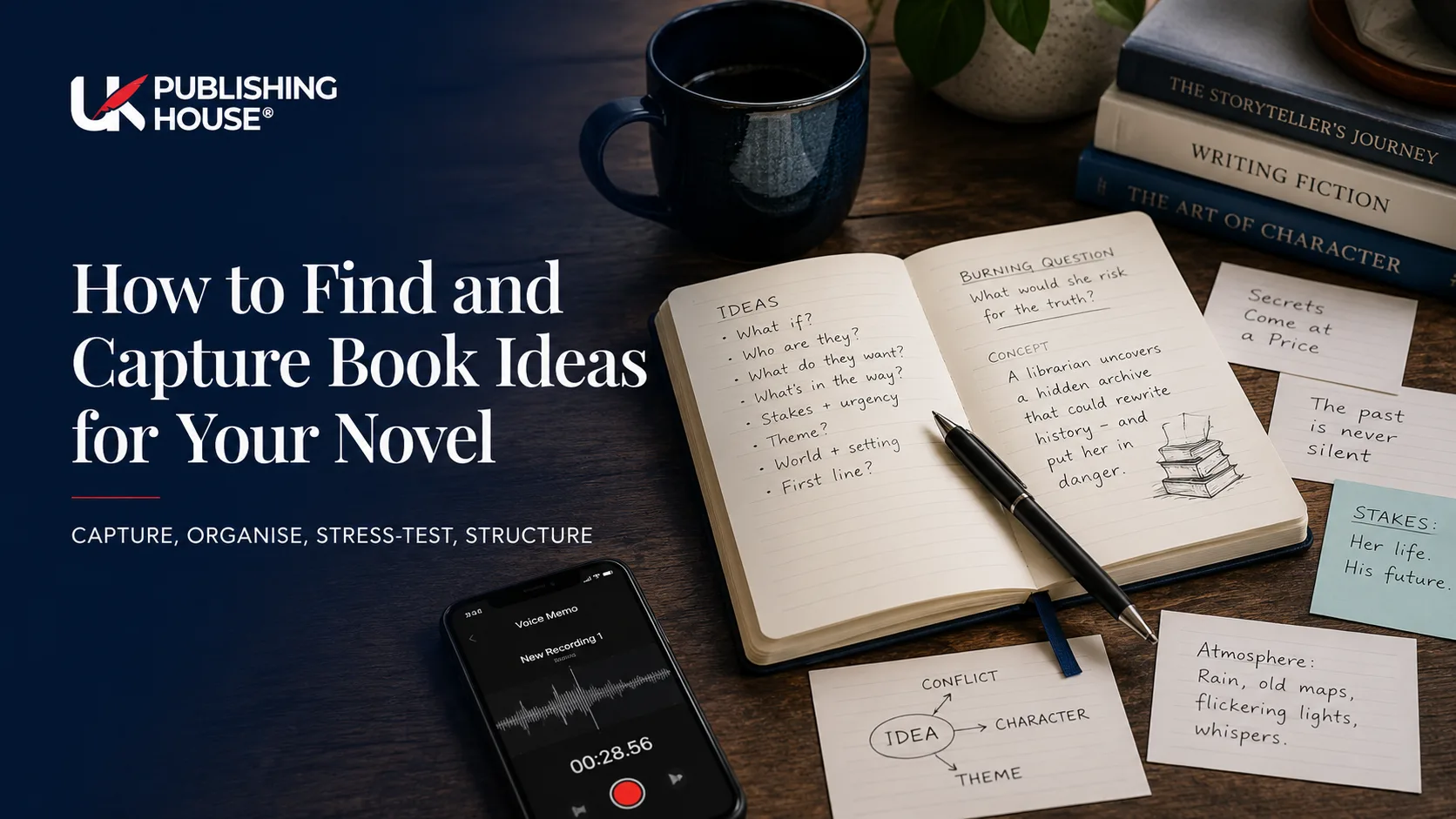
A waterproof pocket notebook and pen handles almost any environment, including the shower and the rain-soaked bus stop, with no battery and no boot-up time. For hands-busy moments, when you are walking, driving or doing the washing up, use Apple Voice Memos (with on-device transcription on iOS 18 and later) or Google Recorder, which transcribes on-device on Pixel phones, so your muttered idea becomes searchable text without you lifting a finger. Pair that with a voice-note-to-text app such as AudioPen if you want your rambling spoken thoughts tidied into something you will actually reread. For quick fragments, a line of overheard dialogue, a URL, a sudden image, your phone's native notes app is fine and fast. Then, crucially, build an evening habit of moving those raw captures into permanent storage so they don't rot in a dozen scattered places.
That last step is the one everyone drops, and it is the difference between a system and a graveyard.
Lifestyle-Specific Setups
Match the kit to your day rather than copying someone else's. The commuter wants audio capture, because their hands and eyes are busy and a notebook on a packed train is a faff. Parents and carers tend to do well with the waterproof notebook, because it survives chaos and needs no charging. Night-shift workers benefit from a low-light pen so a 3am idea doesn't require flooding the room with light. Whatever you choose, remember the priority order. Speed first. Elegance can come much later, once you actually have things worth organising.
Expert Tip: Capture every spark without filtering at the point of origin, then do your judging later. When you do, push each observation up the What-If escalation ladder through personal, communal and existential stakes, and generate ten variations before you commit. Date and mood-tag every capture so that months from now, on a hard drafting day, you can find your way back to the feeling that started it.
Choosing Your Capture Toolkit: A Side-by-Side Comparison
It helps to see the trade-offs in one place rather than as scattered advice, because no single tool wins on everything. Speed, how much context and emotion the method preserves, and how well it fits your real schedule all pull in different directions, and the honest answer is that most working writers run two or three of these together rather than picking one.
Method | Best for | Speed | Context retention | Top tool |
Analog notebook | Low-tech environments, quick sketches, battery-free zones | Instant | Very high (tactile and spatial memory) | Waterproof pocket notebook and pen |
Audio capture | Hands-busy moments: driving, chores, walking | Instant | High (emotional tone preserved) | Apple Voice Memos or Google Recorder (with AudioPen for cleaned-up summaries) |
Quick mobile note | Lines of dialogue, URLs, sudden images | Around 30 seconds | Medium | Native notes app |
Linked database | Evening processing, tagging, connecting ideas | 2–5 minutes | Very high (bi-directional links) | Obsidian or Notion |
Manuscript compiler | Assembling fragments into scene architecture | Variable | High (structural placement) | Scrivener |
The thing to take from this is that there is no perfect capture method, only the right method for the moment you are in. Audio is unbeatable for speed and for preserving the emotional tone of an idea, but it is poor for connecting fragments. A linked vault like Obsidian or Notion is slow at the point of capture but unbeatable for surfacing relationships later. Use the fast tools to catch, and the slow tools to connect.
From Raw Spark to Story Premise
So you have caught your sparks. Now comes the part where most idea banks go to die, because a scrap of observation is not a premise, and treating it like one is why so many promising book ideas fizzle out by chapter three.
Bridging the Translation Gap
There is a real distance between an abstract feeling or a striking image and the concrete machinery of plot and character. A mood is not a story. A beautiful sentence is not a story. "A red coat on an empty beach" is gorgeous and completely inert until you translate it into something with cause and consequence. Fragmented inspiration fails not because the fragments are bad, but because nobody built the bridge from fragment to structure. That bridge is what this section gives you.
The What-If Escalation Ladder
Take any small observation and push it upward through three rising levels of stakes. Personal, then communal, then existential.
Start with the scrap: a woman finds a letter. On its own, that is nothing. Push it to personal stakes and ask what it threatens for her directly. Is the letter proof her marriage was a lie? Now there is heat. Push it to communal stakes and widen the blast radius. What if the letter exposes a secret that her whole village has quietly agreed never to mention? Now there is pressure on a community, which means more characters with skin in the game. Push it to existential stakes and go for the deepest question underneath. What if telling the truth saves her soul but destroys the only people who kept her alive? Now you have a novel, because now the idea is asking a question with no clean answer.
You don't always climb to the top rung. But running every promising spark up the ladder tells you fast whether there is a story in there or just a nice image.
Character, Want, Obstacle, Stakes
A workable premise has four non-negotiable parts, and if any one is missing, the idea will stall. Character: someone specific we can follow. Want: something they are actively chasing, not just a state they are in. Obstacle: a force that genuinely stands in the way. Stakes: a real cost if they fail. "A sad man in a house" has a character and nothing else, so it goes nowhere. "A widowed signalman who refuses to leave the station cottage the railway is trying to repossess, because leaving means admitting his wife is gone" has all four, and you can feel it leaning forward into a plot.
This is also where you sharpen the opposing force. A want is only as strong as what pushes back against it, which is why the relationship between your protagonist and antagonist deserves as much attention as the hero. If you can retrofit a pretty image into those four parts, you have turned a fragment into an engine.
A Real-World Manuscript Evolution
Let me show you the whole pipeline working on one spark, anonymised but real in shape.
A writer is stuck on a delayed train outside Crewe. She notices an elderly man carefully refolding a paper railway timetable, the printed kind that was discontinued years ago. He smooths every crease like it matters. That is the capture: one image, dated, mood-tagged "tender, a bit sad," dropped into a voice memo before the train even moves.
Weeks later, in a review session, she finds it again and runs it up the ladder. Personal: who keeps a ritual alive for a system that no longer exists? Communal: what does his family think of it? Existential: what happens to a person when the world they were good at simply stops needing them? She applies character, want, obstacle, stakes. Character, a retired signalman. Want, to keep his late wife's daily routines running exactly as they were. Obstacle, a daughter who wants to move him into care and clear the house. Stakes, his entire sense of who he is against his own safety.
The messy middle was not tidy. Two false starts, a subplot that got cut, a six-week gap where she nearly abandoned it. But because she had dated and mood-tagged that first capture, she could keep returning to the original feeling, the tenderness of a man smoothing creases, whenever the draft went cold. The polished premise looks inevitable now. It absolutely was not. It was excavated.
The Viability Stress-Test: Will This Idea Survive 80,000 Words?
Here is the most expensive mistake in novel writing. Falling hard for an idea that is genuinely exciting at the concept stage and completely incapable of carrying a full book. You only discover the problem twenty thousand words in, after months of work, which is the worst possible time to find out. So before you commit, you stress-test.
Why Concept Excitement Dies at 20,000 Words
Concept excitement and structural strength are not the same thing, and confusing them is what drives the project-hopping so many writers know too well. A shiny new idea feels thrilling precisely because it has no problems yet. It is all promise and no drafting pain. Your current manuscript, by contrast, is full of the dull, hard problems of execution, so of course the new idea looks more attractive. It is the writing equivalent of a crush. The cure is not more willpower, it is testing ideas early so you only fall for the ones that can actually go the distance.
The Structural Audit
The fastest way to audit a premise for novel-length stamina is to interrogate its conflict, and a framework like the Story Grid methodology is built for exactly this. You don't need to apply the whole system to run the basic check. Ask three blunt questions. Is there a clear want driving the protagonist forward? Is there a genuine obstacle with the strength to resist that want across hundreds of pages? Is there a character arc, a way this person is forced to change? If any answer is a shrug, you have a premise that will run out of road. Different stories carry different distances, and word counts vary by genre, so a tight thriller and a sprawling fantasy have different stamina requirements, but the question underneath is always the same. Is there enough conflict here to sustain the length you are aiming for? Set yourself a minimum threshold and refuse to start drafting until the idea clears it.
The 10-Idea Rule
When you have a concept you like, do not write it yet. Generate ten variations first. This feels excessive and it is the point. The first three variations will be the obvious ones, the versions anyone would think of, the ones that are probably already on a shelf. The middle few get more interesting. The last three, the ones you have to genuinely strain for, are where the original angle usually hides. The rule exists to stop you marrying the first underbaked premise that walked past. Force the collisions, then choose.
Using AI as a Sparring Partner (Not a Ghostwriter)
We need to talk about this honestly, because it is the question hanging over every UK writing group right now, and pretending otherwise would be dishonest. AI tools can help with ideation. They can also quietly hollow out the one thing that makes your book yours. Both are true.
Used well, an assistant like ChatGPT or Claude is a sparring partner. You bring the obsession and the spark, and you use the tool to interrogate the premise. Generate twenty "what if" variations in seconds. Throw devil's-advocate questions at your plot. Brainstorm names. Pressure-test the holes you are too close to see. That is the healthy version, and there is a real method to using ChatGPT to help with a book without letting it write the book.
Used badly, it outsources the original spark itself, which is the only part you cannot afford to give away, and it drags in genuine concerns about ownership and copyright that the writing community has been debating loudly since the AI-and-publishing disputes of recent years. This is also where it helps to be clear on roles. An AI is not a collaborator with a voice, and it is not an editor either. If you want to understand where the human craft actually sits, the difference between a ghostwriter and an editor is a useful map, because both of those humans bring something a model cannot. The guardrail is one line. The writer brings the spark; AI only ever pressure-tests what the writer already cares about. Hold that line and the tool stays a tool.
The Dinner Party Test
Now for the cheapest, most reliable test of all, and it requires no software at all. Explain your idea out loud to a non-writer. A friend, a relative, the person next to you at the bus stop. Watch their face, and watch yours.
If you bore yourself halfway through the pitch, the idea lacks inherent narrative drive, and no amount of clever prose will fix that. If they lean in and ask "and then what happened," you have something. Listen for the exact moment their attention drifts, because that is usually the soft spot in your story. Learning to pitch a story aloud in a sentence or two is a skill in itself, and it is the same muscle you will need later when you write an elevator pitch for your book, so you may as well start practising it on your idea now.
The Interactive Idea Generator Formula
To make the bridge from spark to premise repeatable, build yourself a fill-in-the-blank equation drawn from your own notebook. Something like: a [specific character] wants [concrete want] but [obstacle] stands in the way, and if they fail, [stakes]. Populate every blank from captures you have already logged, and you have an instant prototype you can immediately run against the structural criteria above. It turns a vague pile of ideas into testable premises in minutes, which is exactly the speed you want at this stage.
Organising the Idea Bank (So You Can Actually Find Ideas Again)
Remember the very first thing I said. Most writers do not have an idea problem, they have a retrieval problem. You can capture brilliantly and stress-test ruthlessly and still lose everything if your ideas vanish into an unsearchable mess. So this is where we fix the leak.
From Hoarding to Retrieval
There is a world of difference between accumulating notes and owning an idea bank. Hoarding is what most people do: hundreds of fragments piling up across apps and notebooks, never revisited, slowly forgotten. Owning means you can find the right idea at the right moment. The difference comes down to three habits done consistently. Tagging, so things are findable. Linking, so related sparks connect. And periodic review, so the bank stays alive rather than becoming a landfill you are afraid to open.
The Compost Heap
Keep a dedicated file for dead ideas, and call it what it is, a compost heap. This is the home for every premise that failed the stress-test, every abandoned opening, every character who never found a story. Do not delete them. Failed concepts are not waste, they are fertiliser. A premise that could not stand on its own will often combine with another orphan to make something far stronger than either. Naming this file gives you permission to abandon ideas without guilt, which is healthy, because guilt is what makes writers cling to bad premises long past their use-by date.
Date and Mood-Tagging
When you capture, log two things alongside the idea: the date and the emotional weather. This is not admin for its own sake. Months later, on a grim drafting day when the story feels dead in your hands, the mood tag is a rope back to why you cared in the first place. Tag for retrieval, not for neatness. Emotion is the most useful tag of all, but a quick note of the genre seed or a possible point of view will save you serious time when you go looking.
Building a Linked Database
This is where a tool like Obsidian or Notion finally earns its place. Use bi-directional linking so that connecting two notes shows the link on both, which means unexpected relationships between fragments start surfacing on their own. The signalman timetable image links to a note about your own grandfather, which links to a half-idea about obsolescence, and suddenly three dead scraps are one living premise. Protect a short weekly ritual for this, fifteen minutes to connect new captures to what is already there. That quarter of an hour is where a pile of notes quietly turns into a body of work.
Product Recommendation: Build a capture stack that spans your environments rather than betting on one tool. A waterproof pocket notebook for analog moments, Voice Memos or Google Recorder with AudioPen for cleaned-up summaries when your hands are busy, and Obsidian or Notion for bi-directional digital organisation. When the fragments finally cohere and you are ready to assemble them into scene architecture, Scrivener is built for exactly that structural job, and getting the bones right early makes it far easier to format your manuscript cleanly when you reach that stage.
Advanced Tactics for Sustainable Creativity
The system above will keep you in ideas for years. But ideation is a renewable resource only if you maintain the conditions that produce it, and most writers accidentally starve themselves of those conditions. So here is how to keep the well full.
Scheduling Boredom
This is the one nobody wants to hear. Protect unstructured, screen-free time and guard it like a deadline. Your Default Mode Network, the connection-making system we met earlier, only switches on when you stop feeding your attention. Every queue, every red light, every spare two minutes that you fill with a screen is a moment of potential incubation that you have just killed. Call it the anti-dopamine principle. Not every gap in your day needs to be filled with content. Some of those gaps are where your next book is quietly assembling itself, if you would only let them stay empty.
Artificial Constraints for Infinite Possibilities
It sounds backwards, but a blank cheque is paralysing and a tight box is freeing. When infinite possibility leaves you frozen, impose an arbitrary limit and watch ideas start colliding. Restrict yourself to a single point of view. Pick a genre and commit, whether that is writing a fantasy novel with one fixed magical rule, writing a romance novel set entirely over twenty-four hours, or learning to structure a ghost story around a single haunted object. The constraint does the creative heavy lifting for you. Brian Eno and Peter Schmidt's Oblique Strategies deck, a physical pack or an app of single-line provocations, exists precisely for this, to knock you sideways when you are stuck. And here is the quiet truth underneath all of it: combining two mediocre concepts under a strict constraint will, more often than not, produce more original fiction than waiting around for one perfect idea ever will.
Cross-Pollination Habits
Finally, make input a discipline, not an accident. Schedule it. Regular visits to museums and galleries, album deep-listening sessions where you do nothing but listen, architectural walks where you actually look up. Then practise the conversion: how does this stained-glass window become a plot device, how does this key change become an emotional turn, how does this building's hidden staircase become a secret a character keeps. Turning non-literary artefacts into story material is a muscle, and it gets stronger with use. Writers who cross-pollinate on purpose never run dry.
The Idea Autopsy: Turning Dead Projects Into Renewable Inventory
One last source, and it is the one sitting in your drawer right now. The novel you abandoned. The fifty pages that went nowhere. You think of them as failures. They are inventory.
Why Abandoned Ideas Are Not Wasted
Creative guilt is a thief. It tells you that the project you gave up on was wasted time, and that shame makes you bury the thing rather than learn from it. But a draft that died is not a tombstone, it is raw material. Reframe it. You did not fail to write that book. You mined it, and most of the ore is still good.
The Autopsy Worksheet
Go through a dead project deliberately and dissect it into four kinds of reusable DNA: setting, character, theme and conflict. Pull each one out and look at it on its own terms. That side character who was more alive than your protagonist. The setting you built so vividly the plot couldn't keep up. The theme you kept circling. Catalogue these extracted parts somewhere findable, tagged like any other capture, so they are ready to be slotted into something new rather than lost a second time.
Hybridisation Techniques
Now recombine. Two weak sparks can fuse into one viable premise, which is the whole logic of the compost heap paying off. The brilliant character from a romance that never worked, dropped into the vivid setting from a thriller that stalled, can spark a third story stronger than either parent. Some of the most original book ideas are not invented from nothing at all. They are hybrids, stitched together from the best surviving organs of projects that didn't make it. Nothing is wasted if you are willing to perform the autopsy.
Start With One Spark
So let's bring the whole pipeline back into one line, because it is simpler than it looks. Capture without judgement, organise with links, stress-test with rigour, build the premise bridge, then draft with confidence. That is the system, and it quietly replaces the myth of genius with the habit of excavation. You are not waiting to be chosen anymore. You are digging, on purpose, with a method.
Here is your first action, and it is deliberately tiny. Tonight, set up one single capture tool. Not five. Not an elaborate tagging taxonomy. One. A notebook by the bed, or the voice memo app on your home screen. Then, before you sleep, record one observation from your day. The way the light fell. Something a stranger said. A floorboard that squeaked. That one captured spark is proof the system is already working, and tomorrow you do it again.
From there, the path forward is well trodden. When your ideas start cohering into a manuscript, that is when the rest of the craft comes in, and it helps to know what a finished route looks like. There is solid ground on how to publish a book from start to finish, on choosing your publishing path between self-publishing and traditional, and on what it really takes to find a book editor and a publisher who fit your work.
When the writing is done, professional editing is the stage that turns a strong draft into a strong book, and if you would rather have an experienced collaborator carry the drafting itself, that is exactly what fiction ghostwriting and broader ghostwriting services are built for, which is a different thing again from the model you were sparring with earlier, as anyone who understands what book ghostwriting actually involves will tell you.
Beyond that sit the finishing stages: book design and a cover that earns the click, which is why it pays to learn how to design a book cover that fits your genre, then formatting, book printing, and the parts that help readers actually find you, from book marketing to an author website to a book video trailer. And if you ever wonder whether all this effort is worth it, the honest numbers on how much authors actually make are a useful reality check, and a motivating one.
But all of that is downstream. None of it matters without the spark. So start there. Capture one tonight.